

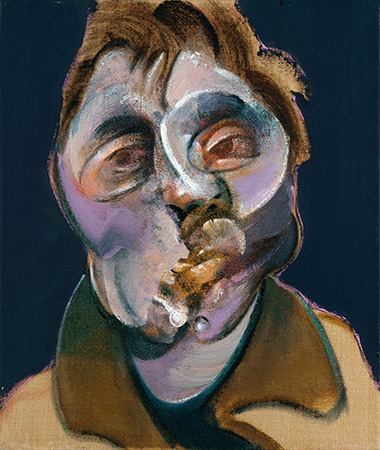
Francis Bacon did not paint people as they wished to be seen. He painted what it felt like to exist inside a body.
Born in 1909 in Dublin and later working primarily in London, Bacon became one of the most unsettling and powerful painters of the 20th century. His work refuses comfort. Faces dissolve, bodies twist, mouths scream without sound. To look at a Bacon painting is not to observe from a distance, but to be pulled into a confrontation with fear, desire, isolation, and mortality.
Bacon rejected both realism and pure abstraction. He wanted the figure, but fractured. Distorted. Pressured by invisible forces. His paintings often depict solitary figures trapped in transparent cages or geometric frames, as if existence itself were a confined space. These structures are not backgrounds. They are psychological states.
Violence runs through Bacon’s work, but not as spectacle. It is existential. Influenced by war, photography, medical imagery, and his own turbulent inner life, Bacon sought to capture what he called “the brutality of fact.” Flesh is smeared, faces melt, identities slip. Yet beneath the distortion is an intense vulnerability. His figures are not monsters. They are human beings stripped of protection.
One of Bacon’s recurring subjects was the screaming pope, inspired by Velázquez but transformed into something nightmarish. Authority collapses. Power cries out. In Bacon’s hands, icons of control become symbols of terror and fragility. He showed that no status, belief, or role shields us from the rawness of being alive.
Despite the emotional violence of his imagery, Bacon was meticulous and deliberate. Every distortion was calculated. He believed that painting should bypass intellect and go straight to the nervous system. The goal was not explanation, but impact. Not beauty, but truth as sensation.
Bacon’s personal life was marked by excess, loss, and contradiction. He lived intensely, destructively at times, yet worked with fierce discipline. Many of his most haunting paintings followed personal tragedy, transforming grief into visual language. Art, for Bacon, was not therapy. It was exposure.
His influence on contemporary art is immense. Bacon opened the door for artists to explore psychological realism, trauma, and emotional extremity without apology. He proved that figuration could still be radical, and that confronting darkness could be an act of clarity rather than despair.
Francis Bacon painted the human condition without anesthesia. His work does not soothe. It reveals. And in that revelation, it forces us to face the uneasy truth that to be human is to be fragile, embodied, and always on the edge of dissolution.


036q09