
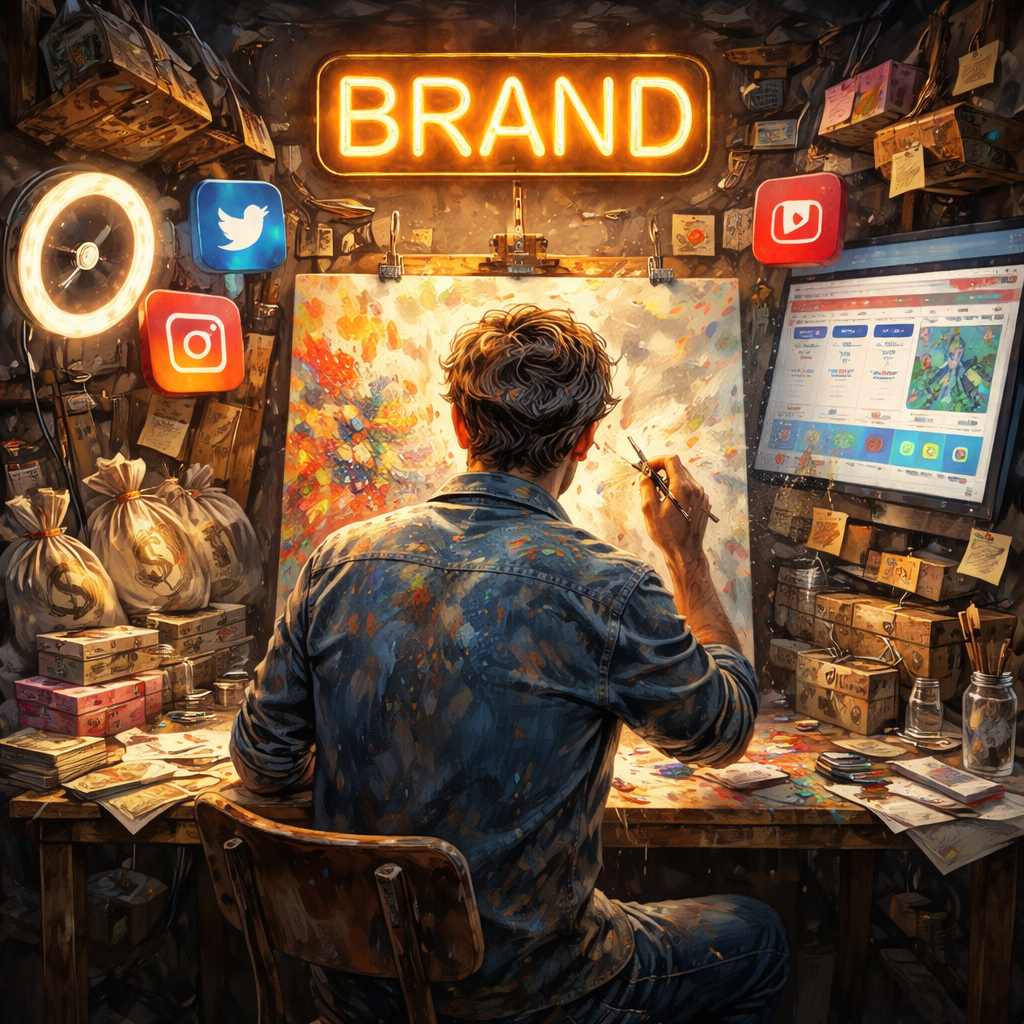
Art once stood apart from commerce, or at least pretended to. It positioned itself as expression before product, vision before visibility. Today, that separation feels increasingly fragile. In an era where artists are brands, platforms reward consistency, and visibility determines survival, the question arises quietly but insistently: can art still be honest when everything around it is optimized, monetized, and marketed?
This is not a nostalgic question. It is a structural one.
When the Artist Becomes the Product
Modern artists are no longer judged solely by their work. They are evaluated as identities. Personality, aesthetics, values, posting frequency, and public stance all feed into how the work is received. The artist becomes inseparable from their brand.
This changes creative incentives.
Honesty becomes risky when deviation threatens audience trust or algorithmic reach. Consistency becomes safer than exploration. What once felt like growth can now look like confusion in a marketplace that demands clarity.
Visibility Shapes Creation
In the past, art was often made first and seen later. Today, art is frequently made with visibility in mind. Artists anticipate platforms, audiences, trends, and reception before the work exists.
This doesn’t automatically corrupt art, but it does alter its starting point.
Creation begins with awareness of being watched.
The Pressure to Be Legible
Branding rewards legibility. A clear message. A recognizable style. A predictable emotional tone. But honesty is often messy, contradictory, and evolving.
When artists feel pressure to explain themselves in advance, ambiguity suffers. Work becomes easier to summarize but harder to live inside.
Art starts answering questions before it asks them.
Authenticity as Performance
Ironically, “authenticity” has become one of the most marketable traits. Artists are encouraged to appear raw, vulnerable, and personal in ways that still fit brand narratives.
This creates a strange paradox.
You are expected to be real, but not unpredictable. Emotional, but not inconvenient. Honest, but not destabilizing.
Authenticity becomes a performance rather than a process.
The Economics of Honesty
Honesty often costs time, money, and audience patience. It may not perform well immediately. It may confuse or alienate. In a system that rewards engagement and speed, slow or uncomfortable work struggles to survive.
Many artists compromise not because they lack integrity, but because they need sustainability.
Survival shapes expression.
Is Branding Always the Enemy?
Branding itself is not inherently dishonest. It can help artists reach audiences, maintain independence, and fund ambitious work. The problem arises when branding becomes the work rather than a container for it.
When image replaces inquiry.
When coherence replaces curiosity.
Where Honesty Still Lives
Despite these pressures, honest art persists. It often appears at the margins. In work that changes direction unexpectedly. In artists who accept smaller audiences in exchange for freedom. In pieces that resist summarization.
Honesty survives where control loosens.
It lives in risk.
The Role of the Audience
Audiences play a role too. Consumption habits reinforce systems. When people reward predictability and punish deviation, artists adapt accordingly.
Supporting honest art requires tolerance for discomfort, confusion, and change.
It requires patience.
A Shift, Not an End
Art has always existed within systems of power, money, and influence. Patronage, censorship, markets. The age of branding is not unique in shaping art, but it is uniquely visible.
What has changed is speed and exposure.
The question is not whether art can remain honest.
It is whether we allow it the space to be.
The Quiet Conclusion
Art is still capable of honesty, but honesty now requires intention. It must be chosen against convenience. Protected against optimization. Valued beyond metrics.
In the age of branding, honest art does not disappear.
It becomes harder to recognize.
And more important to defend.


7efb41
6z58a9
1rxqqd
5t3mjf
m2vhiu