

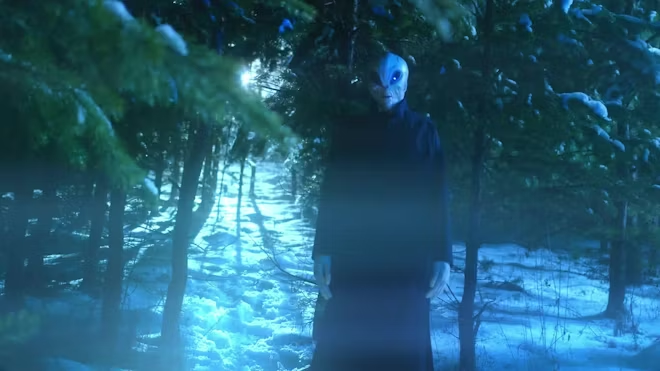
When the Unknown Refuses a Name
Most unexplained encounters fall neatly into familiar boxes. Ghosts belong to the dead. Aliens arrive from elsewhere. Animals follow biological rules. But there is a quieter, more disturbing set of encounters that fits none of these categories. Witnesses struggle to describe what they saw not because they are afraid, but because language itself seems insufficient.
These beings are not transparent or glowing. They do not arrive in spacecraft or vanish like apparitions. They occupy space. They cast shadows. They interact with the environment in subtle, undeniable ways. And yet, they do not behave like anything we recognize.
People who encounter them often hesitate before speaking. Not out of fear of disbelief, but because the experience resists comparison. The being was not hostile. Not friendly. Not curious in a human way. It simply was. Present, aware, and briefly intersecting with the observer’s reality.
Descriptions vary in detail but align in feeling. A form that is almost humanoid but wrong in proportion. Movement that feels deliberate yet unfamiliar. Limbs that bend too smoothly or not enough. Faces that seem unfinished, blurred, or impossible to focus on. Witnesses frequently say the same thing. The more they tried to look directly, the harder it became to see.
These encounters occur in ordinary places. Backyards. Roadsides. Forest edges. Hospital corridors. Empty stairwells. There is no dramatic buildup. No warning signs. The moment happens quickly, often lasting seconds, yet it imprints itself permanently.
What makes these experiences particularly unsettling is the emotional aftermath. Not terror, but displacement. A feeling that reality briefly shifted its rules. Many report an immediate certainty that what they saw was real, followed by confusion about how such a thing could exist unnoticed.
Scientific explanations vary. Some suggest rare neurological events where perception misfires under specific environmental conditions. Others propose extreme stress responses or momentary dissociation. These theories account for distortion, but not consistency. People from different cultures, ages, and belief systems report strikingly similar sensations. The same inability to classify. The same certainty without explanation.
Folklore offers fragments of understanding. Ancient stories speak of watchers, travelers, and boundary beings that exist between categories. Not alive in the human sense. Not dead. Not divine. Not natural. These beings were often described as indifferent to humans, appearing only when paths crossed accidentally.
Modern witnesses often say the same thing. The encounter did not feel intentional. As if neither party expected the other. As if two systems briefly overlapped before separating again.
What stays with observers is not what the being did, but what it implied. That the world contains layers we do not normally access. That our categories are conveniences, not truths. That something can exist without fitting into our frameworks of science, belief, or myth.
Most encounters end without resolution. No follow-up sightings. No escalation. Just a quiet return to normal life, now altered by one impossible memory.
People who experience this rarely seek answers anymore. They stop trying to label what they saw. Instead, they carry a different awareness. That reality may be broader than the stories we tell about it. And that sometimes, the most honest description is the simplest one.
Something was there. And it did not belong to anything we know.