

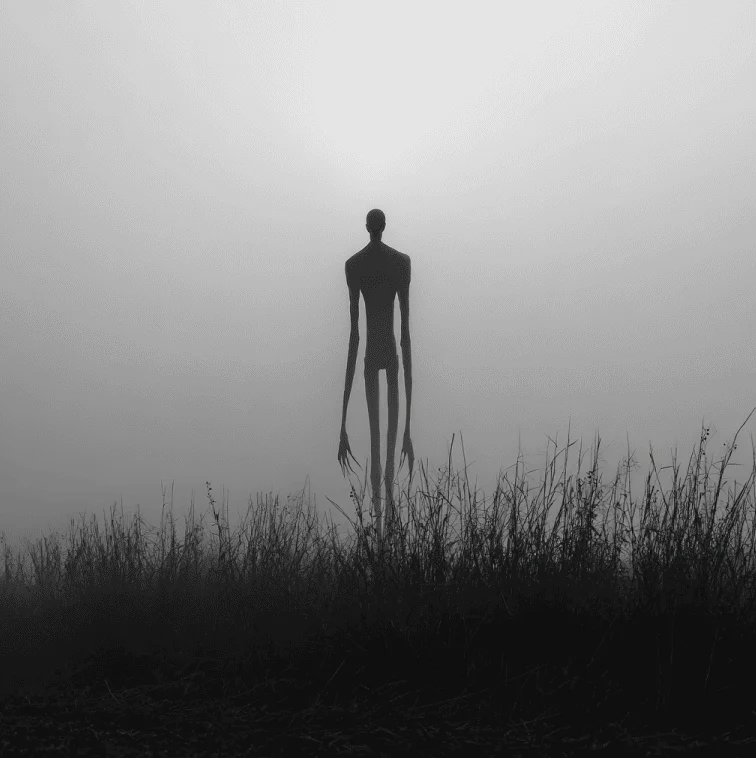
They struggle to describe it, yet they all describe the same thing.
A figure too tall to be human. Limbs too long to be natural. Hands that hang far below the waist, ending in shapes that look almost like fingers but not quite right. When witnesses speak about it, they rarely raise their voices. The fear is quieter than that. Heavier.
This creature does not run. It does not chase. It appears.
People report seeing it in forests at dusk, standing between trees as if measuring distance. Drivers glimpse it on empty roads, impossibly tall, its arms nearly touching the ground. Others see it near abandoned buildings or fields, motionless, watching without eyes they can clearly remember.
What disturbs witnesses most is proportion.
The body looks stretched, as if pulled upward. The arms bend where arms should not bend. The hands appear oversized, hanging loosely, sometimes flexing slowly. The head is often described as small for the body or oddly smooth, with facial features difficult to focus on, as if the brain refuses to finish rendering it.
Many encounters last only seconds.
Yet the memory stays vivid for years.
People report a sudden physical reaction before they see it. A pressure in the chest. A wave of nausea. The urge to freeze or turn away. Some say they felt noticed before they saw anything at all, as if attention itself arrived first.
The creature rarely approaches. It does not communicate. It does not display aggression. And that may be what makes it terrifying. It behaves as if humans are irrelevant, observed the way one might watch animals pass through a field.
Psychological explanations often point to misidentification. Shadows. Trees. Darkness combined with fear. The human brain filling in gaps under stress. But this explanation weakens when witnesses describe the same posture, the same limb length, the same unnatural stillness, across different locations and cultures.
In several cases, people report seeing the creature more than once in the same area. Always at similar times. Always silent. Always distant. As if it occupies a specific boundary rather than wandering freely.
Animals react strongly.
Dogs refuse to move forward. Horses panic. Wildlife goes silent. These reactions occur before humans notice anything visually, reinforcing the sense that something is present even when unseen.
What lingers after the encounter is not terror, but distortion.
People say familiar places feel wrong afterward. Depth perception feels altered. Nighttime becomes oppressive. Some develop an intense fear of tall shapes or long shadows. Others feel compelled to return to the location, drawn by a need to understand what they saw, even while dreading it.
Folklore across cultures contains fragments of similar beings. Tall watchers. Long-limbed figures that stand at the edges of roads or forests. Not monsters in the traditional sense, but boundary markers. Signs that one has wandered somewhere they were not meant to linger.
Modern witnesses rarely use mythical language. They do not claim it was supernatural. They simply say it did not belong.
And that may be the most unsettling part.
The creature does not behave like an animal. It does not move like a human. It does not act like a hallucination. It occupies space with a confidence that feels earned, not imagined.
Most encounters end without explanation. The figure steps back into darkness. Fog thickens. The road bends. The forest swallows depth. Normality returns abruptly, as if nothing happened.
Except something did.
Because those who have seen the tall creature with long hands agree on one thing.
They did not discover it.
They crossed paths with it.