

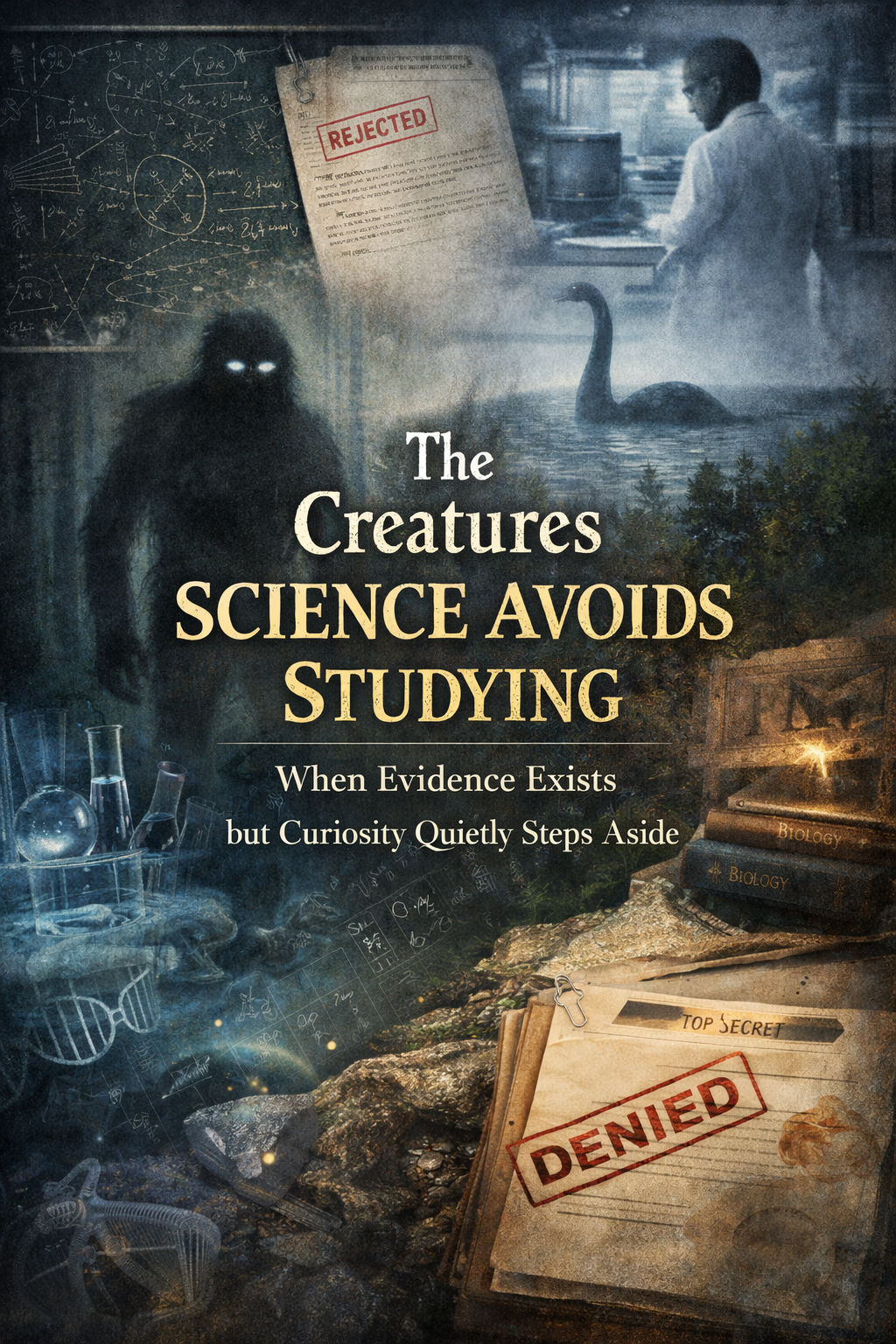
When Evidence Exists but Curiosity Quietly Steps Aside
Science is often portrayed as fearless, a discipline that rushes toward the unknown with instruments raised and notebooks open. But history tells a more complicated story. Some mysteries are not ignored because they lack evidence, but because they threaten existing models. They ask questions science is not yet ready to answer. And when that happens, silence can become a method.
Across decades, there have been recurring reports of unusual creatures and phenomena that sit uncomfortably between categories. They are not easily dismissed as myth, yet they resist being neatly defined as species. Witness accounts are consistent enough to be intriguing, physical traces appear just enough to unsettle, and yet formal study rarely follows. Funding disappears. Papers are rejected. Careers quietly pivot elsewhere.
This is not conspiracy. It is structure.
Modern science depends on frameworks. Hypotheses must be testable. Results must be repeatable. Phenomena must be isolatable under controlled conditions. But some encounters refuse all of this. Certain creatures appear sporadically, avoid prolonged contact, or manifest only under specific environmental or psychological conditions. They behave less like organisms and more like anomalies. And anomalies are dangerous to models built on predictability.
Consider how often science has historically resisted ideas that later proved foundational. Germ theory was mocked. Meteorites were dismissed as superstition because rocks “could not fall from the sky.” Continental drift was ridiculed for decades. In each case, evidence existed. What was missing was a framework willing to hold it.
Creatures that science avoids studying often suffer the same fate. They are labeled as folklore, misidentification, hoaxes, or neurological glitches long before thorough investigation occurs. The conclusion arrives first. The inquiry never fully begins.
There is also a quieter pressure at work. Academic survival depends on grants, peer approval, and institutional legitimacy. Studying something that sits outside accepted boundaries risks all three. A biologist who studies birds is safe. A biologist who studies something unnamed, inconsistently observed, and culturally loaded is not. Silence becomes the rational choice.
Yet avoidance has consequences.
When science turns away from certain mysteries, it does not make them disappear. It simply leaves interpretation to rumor, fear, or belief systems with fewer safeguards. Public fascination grows precisely because authoritative voices decline to engage. The gap between lived experience and institutional explanation widens. Distrust follows.
Some researchers argue that these creatures may not be biological in the traditional sense. They may involve environmental intelligence, rare cognitive phenomena, or interactions between human perception and complex ecosystems. Others suggest undiscovered species with extreme rarity or intelligence. None of these ideas are inherently unscientific. They are simply inconvenient.
What happens when science chooses silence over uncertainty is not neutrality. It is a choice to protect existing knowledge at the expense of expanding it.
This does not mean every strange report deserves equal weight. Skepticism remains essential. But skepticism is not the same as dismissal. True scientific rigor begins with curiosity, not avoidance. It asks why patterns repeat, why witnesses across cultures describe similar traits, why certain environments generate consistent anomalies.
The creatures science avoids studying remind us that knowledge is not only built by answers, but by the courage to ask questions that disrupt comfort. Silence may preserve models in the short term, but it also delays discovery. And history has shown, again and again, that what science avoids today often becomes tomorrow’s foundation.
Uncertainty is not the enemy of science. Fear of it is.




The slot graphics are stunning and the hits are frequent. It’s my new favorite spot to relax. Visit pkrumislotsgame now.