
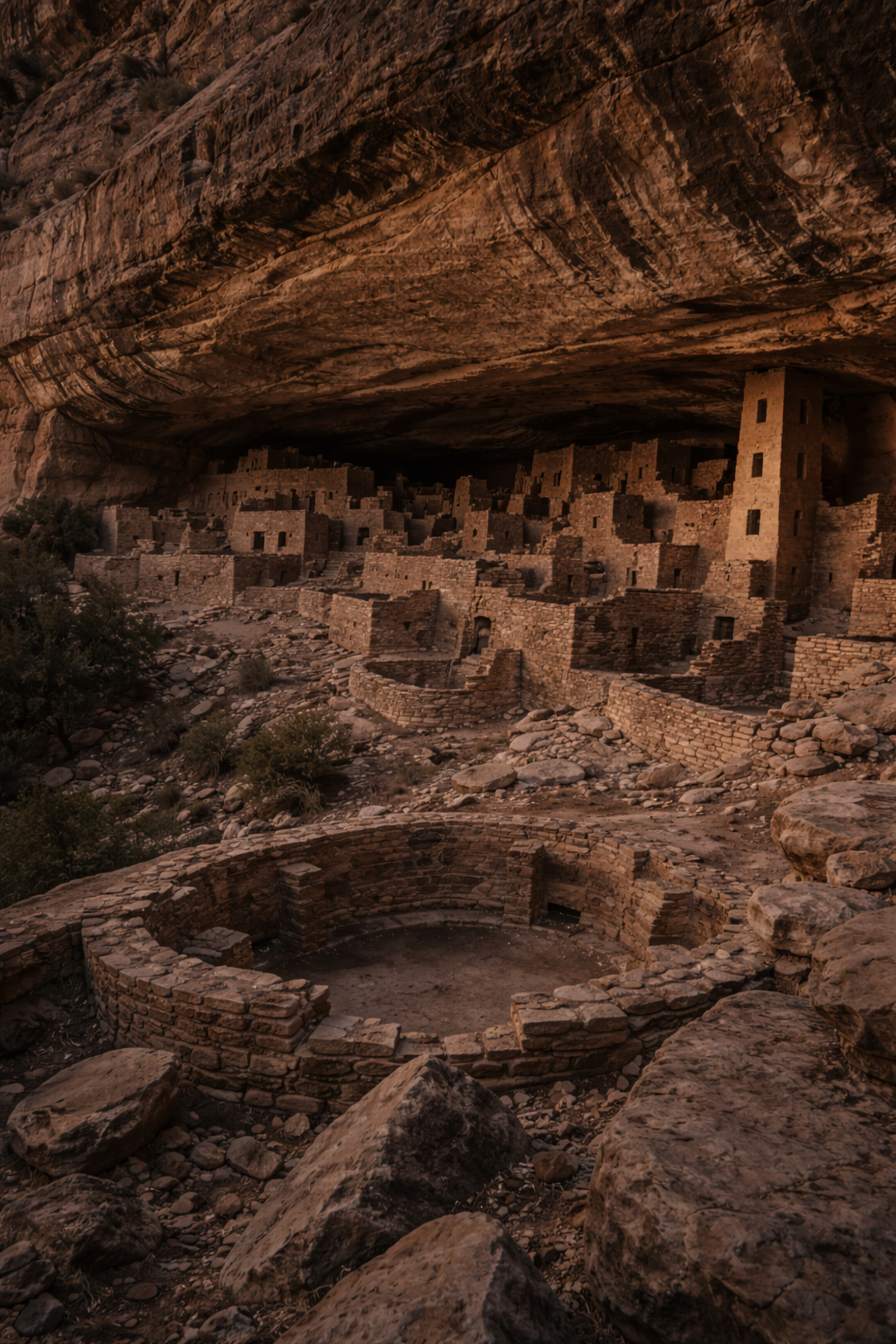
High on the cliffs and mesas of the American Southwest, an advanced society once built cities of stone, wood, and earth that seemed to grow directly from the rock itself. Today, these places stand empty. Carefully constructed homes sit silent. Kivas remain hollow. Doorways open to nothing but wind.
The Ancestral Puebloans did not vanish suddenly. They left.
And that decision still puzzles historians.
A Civilization Shaped by the Land
The Ancestral Puebloans, sometimes called the Anasazi, thrived between roughly 700 and 1300 CE across what is now the Four Corners region of the United States. They were farmers, builders, astronomers, and artists, deeply attuned to seasonal cycles and environmental limits.
Their architecture reflected patience and planning. Multi-story dwellings were built into cliff faces. Villages were aligned with solar and lunar events. Every structure suggested permanence.
Yet permanence did not come.
Cities in the Cliffs
Places like Mesa Verde and Chaco Canyon were not temporary shelters. They were complex urban centers with roads, ceremonial spaces, and regional influence. Some structures required generations to complete.
These were not people passing through.
They were people settling in.
A Delicate Environmental Balance
The Ancestral Puebloans lived in a fragile ecosystem. Rainfall was unpredictable. Farming required precise timing and cooperation. For centuries, they adapted successfully.
But in the late 1200s, prolonged drought struck the region. Crop failures became common. Resources thinned. Tensions likely grew.
Nature did not destroy the cities.
It made them harder to sustain.
Social Strain and Cultural Change
Archaeological evidence suggests increasing stress toward the end of occupation. Defensive structures appear more frequently. Settlements became more compact and isolated. Signs of conflict and scarcity emerge.
This was not a sudden collapse.
It was pressure building over time.
A Choice, Not a Catastrophe
What makes the Ancestral Puebloans unique is how they responded. Rather than fight for diminishing resources or cling to failing systems, they migrated. Entire communities relocated south and east, integrating into regions with more reliable water and farmland.
They carried traditions with them.
They did not abandon their identity.
Continuity Through Movement
Modern Pueblo peoples trace their ancestry directly to these migrants. Stories, rituals, and cultural memory survived, even if cities did not. Leaving was not an end.
It was a transformation.
Why the Cities Were Left Intact
There is little evidence of widespread destruction. Homes were not burned. Sacred spaces were not defiled. Many belongings were taken carefully.
This was a planned departure.
Not an escape.
A Different Definition of Success
Western history often measures civilizations by what they build and how long it lasts. The Ancestral Puebloans challenge that idea. Their success may lie in knowing when to leave, when to adapt, and when survival required change.
They valued continuity over monuments.
The Final Reflection
The empty cities of the Ancestral Puebloans are not symbols of failure. They are evidence of resilience. When the land could no longer support them, they chose life over location.
Stone was left behind.
Culture endured.
And in that quiet choice, they remind us that sometimes the most powerful act a civilization can take is knowing when to walk away.