
How Mistrust, Media, and Cold War Psychology Fueled Disbelief
On July 20, 1969, humanity watched as Neil Armstrong stepped onto the lunar surface during Apollo 11, fulfilling a promise made at the height of the Cold War. It should have been a unifying triumph.
Instead, it eventually became one of the most questioned achievements in modern history.
The moon landing conspiracy didn’t begin with evidence of deception. It began with something more powerful: mistrust.
The Cold War mindset
The moon landing occurred during an era defined by secrecy, propaganda, and rivalry. The United States and the Soviet Union were locked in a psychological and technological battle where perception mattered as much as reality.
Governments lied often and openly about weapons, wars, and surveillance. Citizens learned, through experience, that official narratives were not always complete or honest.
When trust erodes, skepticism becomes instinct.
The moon landing asked people to believe that the same institutions capable of deception had suddenly become transparent. For some, that leap felt too large.
Television made it feel unreal
For the first time, a global audience experienced history through live television.
Grainy black-and-white footage. Strange camera angles. Silent movements in an airless environment. To viewers accustomed to Hollywood realism, the images felt artificial.
Ironically, the more extraordinary the achievement, the more it resembled fiction.
People weren’t doubting science.
They were doubting what they were seeing.
Media repetition without explanation
Early broadcasts focused on spectacle, not education.
Few viewers understood how rockets worked, why shadows behaved differently on the Moon, or how film exposure functioned in extreme lighting. Without context, visual anomalies became “proof” of fakery.
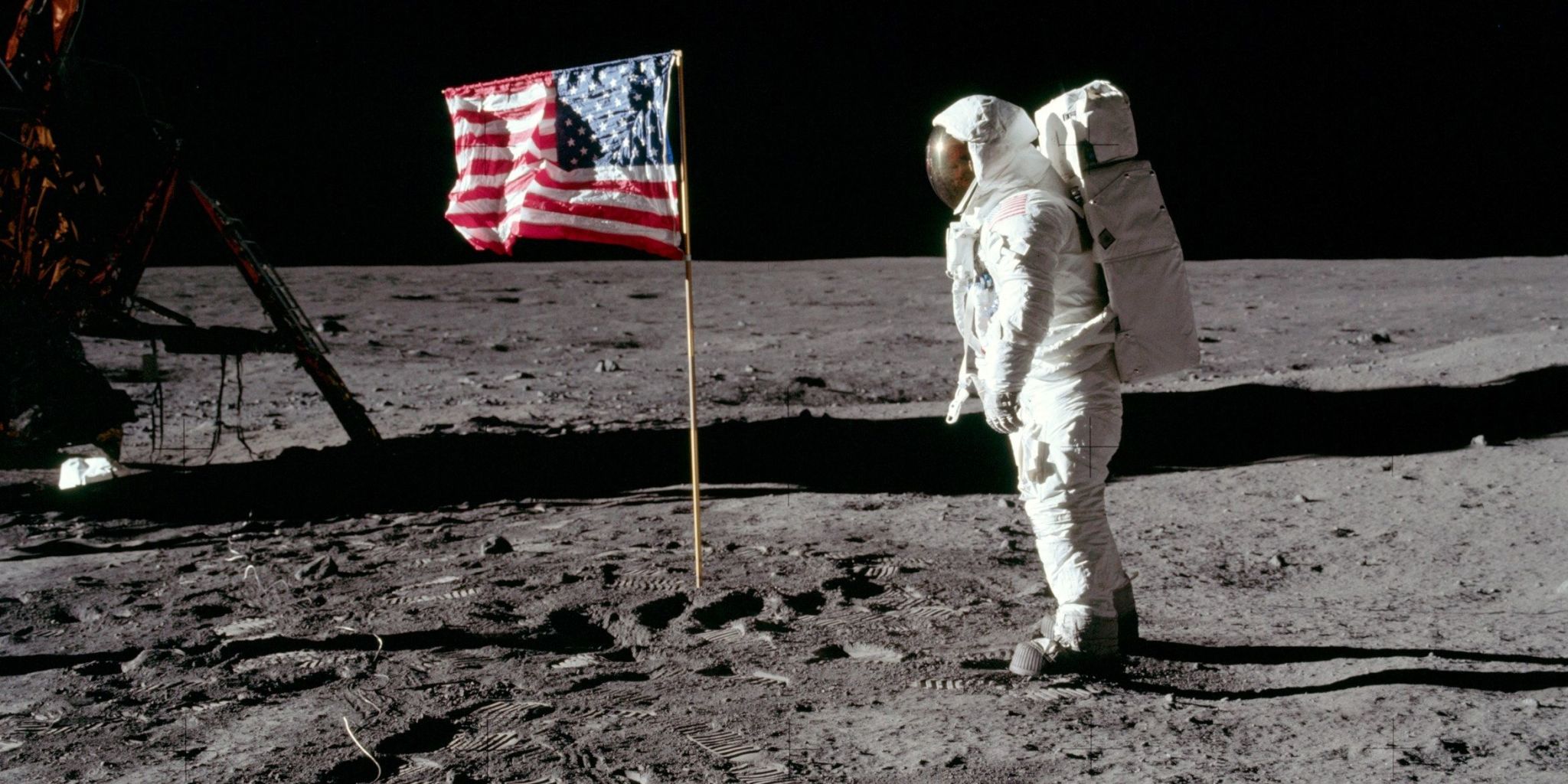
The flag appeared to wave.
Shadows looked misaligned.
Stars were missing from the sky.
Each detail had a scientific explanation. But explanations rarely traveled as far as doubt.
Hollywood didn’t help
The rise of behind-the-scenes filmmaking and special effects added fuel to suspicion.
If movies could convincingly fake alien worlds, why not the Moon? Some conspiracy theories even claimed the landing was staged by a famous director, blurring the line between entertainment and reality.
The question shifted from “Did we go?” to “Could they fake it?”
And once that question existed, belief fractured.
Mistrust became cultural inheritance
Moon landing denial surged decades later, not immediately after 1969.
Why?
Because mistrust deepened. Vietnam. Watergate. Intelligence scandals. Each revelation reinforced the idea that governments manipulate truth when it suits them.
The moon landing was retroactively pulled into this climate.
Doubt wasn’t born in 1969.
It matured in the years that followed.
What the evidence actually shows
Despite claims, the moon landings are among the most documented events in history.
Independent tracking by multiple countries confirmed spacecraft trajectories. Moon rocks brought back have chemical compositions distinct from Earth. Laser reflectors placed on the lunar surface are still used today to measure the Moon’s distance.
Thousands of scientists, engineers, and technicians across different institutions would have had to maintain silence forever.
Conspiracies scale poorly. Reality does not.
Why disbelief persists
Moon landing conspiracies survive not because of missing evidence, but because of emotional logic.
They offer empowerment through “secret knowledge.”
They simplify a complex achievement into deception.
They satisfy a narrative where authority is always suspect.
Believing the landing was faked feels safer to some than accepting that institutions can sometimes accomplish something extraordinary.
The deeper truth
The conspiracy says less about the Moon and more about Earth.
It reflects fractured trust, media illiteracy, and the psychological residue of the Cold War. It shows how disbelief can grow not from ignorance, but from experience with being misled elsewhere.
The Moon didn’t become suspicious.
Authority did.
What really happened
The moon landing was real.
The conspiracy was a byproduct.
What really happened behind the moon landing conspiracy was the collision of achievement with distrust, amplified by media gaps and historical anxiety.
And that collision created a myth powerful enough to orbit truth for generations.
Not because the Moon was unreachable.
But because trust, once broken, is much harder to restore.