
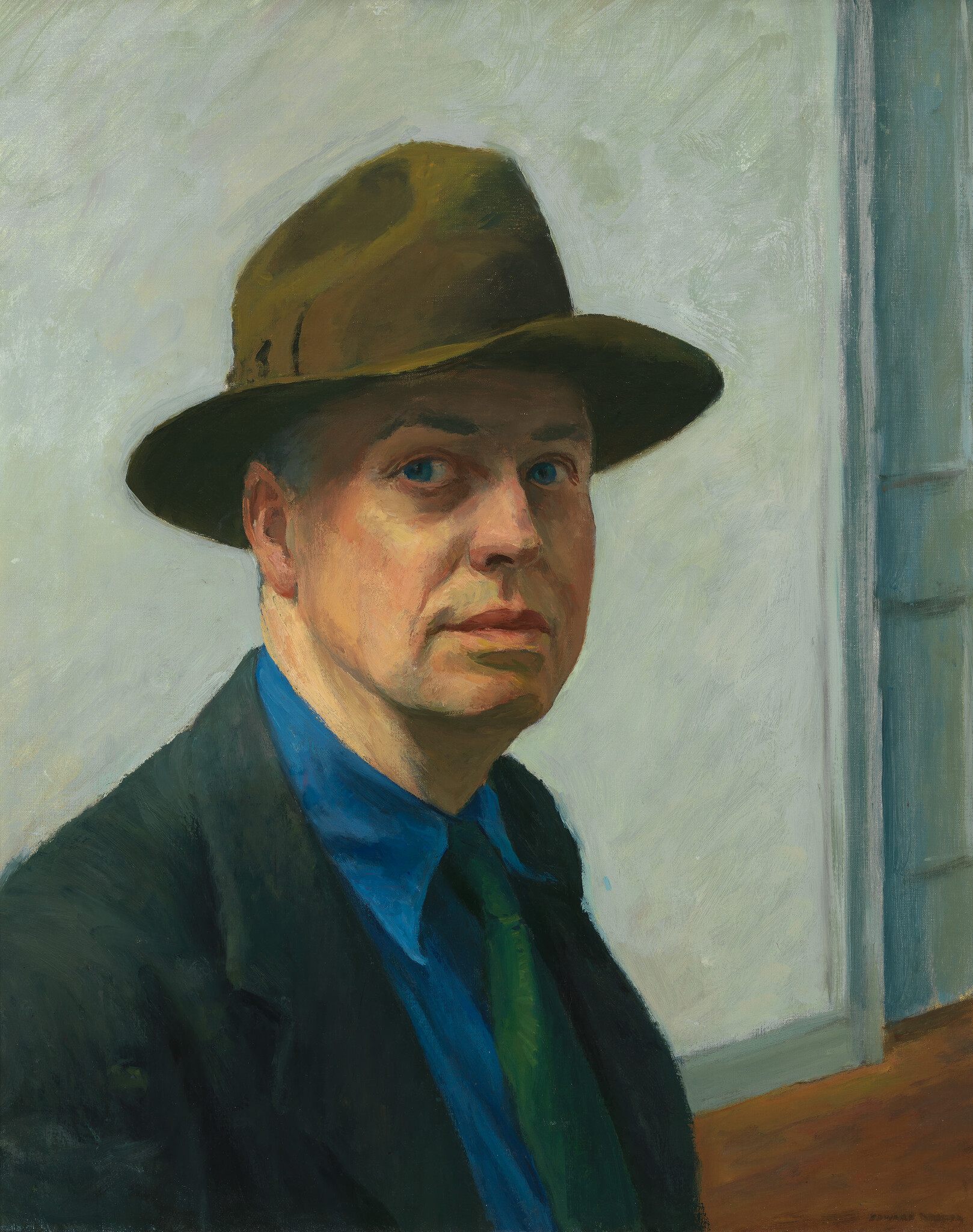
Edward Hopper painted what people rarely talk about.
Born in 1882 in New York, Hopper became one of the most recognizable voices in American art by focusing on moments that feel empty, paused, or unfinished. His paintings do not tell stories with clear beginnings or endings. Instead, they capture the space in between, when nothing is happening on the surface and everything is happening underneath.
Hopper’s world is one of quiet interiors, lonely diners, hotel rooms, gas stations, and city streets washed in sharp light. His figures often sit alone, even when others are nearby. They do not interact. They wait. Windows separate inside from outside. Light cuts across walls like a question. Hopper was less interested in action than in atmosphere, less interested in narrative than in mood.
What makes Hopper’s work so powerful is restraint. He avoided drama, exaggeration, and symbolism that explains itself. His compositions are simple, almost cinematic, yet emotionally charged. The stillness in his paintings feels heavy, as if time has slowed or stopped altogether. Viewers are left to project their own thoughts into the silence.
Light was Hopper’s main instrument. He used it to carve space, to isolate figures, to suggest emotional distance. Artificial light often clashes with darkness, creating tension rather than comfort. Daylight feels exposed rather than warm. In Hopper’s hands, light reveals rather than reassures.
Although his work is often described as lonely, Hopper resisted that label. He saw himself as recording modern life honestly. The growing American city, with its anonymity and separation, fascinated him. His paintings reflect a society where people live close together yet remain emotionally distant. This sense of quiet isolation would later resonate deeply in film, photography, and contemporary art.
Hopper worked slowly and deliberately, often revisiting themes for years. He believed that painting was a mental process as much as a visual one. If he could say something clearly in words, he once remarked, there would be no reason to paint. His images communicate what language struggles to reach.
Today, Hopper’s influence is everywhere, from cinema to advertising to photography. Filmmakers borrow his framing, his lighting, his tension-filled stillness. Yet no imitation fully captures what makes his work endure: emotional honesty without explanation.
Edward Hopper gave form to modern solitude. He showed that silence can speak, that emptiness can be meaningful, and that the quietest moments often carry the deepest weight.
His paintings do not ask for attention. They wait. And in that waiting, they reveal us to ourselves.