

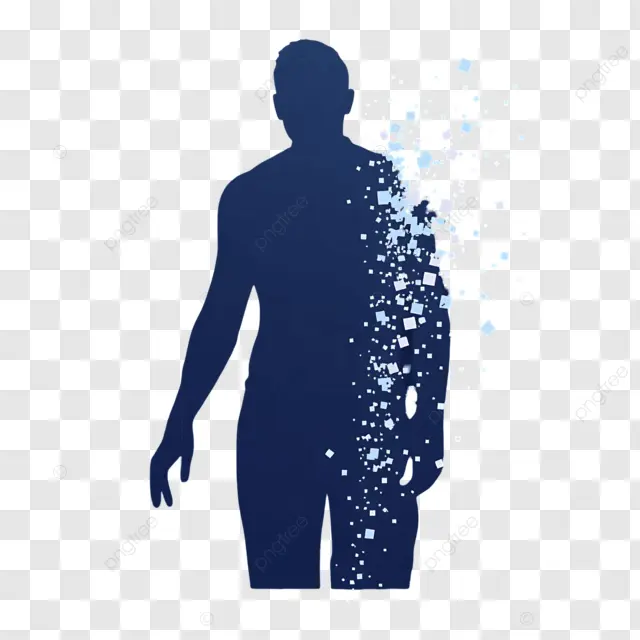
Every age tells a story about what it means to be human. Some stories are written in stone, others in laws, machines, or ideas. Ours is being written in data. To understand where we are going, we must trace where we began, not just technologically, but existentially.
This is not the story of progress.
It is the story of identity.
From Flesh
Human identity began in the body. Flesh was not symbolic, it was reality. Survival, memory, and meaning were inseparable from physical presence. Identity lived in movement, touch, voice, and endurance.
The body remembered through sensation.
Time passed through seasons and scars.
Meaning came from being alive among others.
To be human was to be embodied.
To Story
As societies formed, identity expanded beyond the body into narrative. Reputation, memory, and social roles emerged. Identity became something carried in stories, what others remembered, forgave, or celebrated.
Mistakes faded. Growth was possible.
Change was expected.
Identity was not fixed. It unfolded.
To Systems
With civilization came structure. Records replaced memory. Institutions defined roles. Identity became documented, regulated, and classified.
Still, the human self remained central. Systems described people, but did not replace them.
That balance has now shifted.
To Code
The Digital Age transformed identity from narrative into profile.
Algorithms no longer ask who are you, but what do you do repeatedly. Data replaced memory. Patterns replaced intention. Prediction replaced possibility.
Identity fractured across platforms, scores, and models. A person became a collection of probabilities.
The self became legible to machines, but less visible to itself.
Bodies Revisited
As identity moved into code, the body reasserted itself.
Exhaustion, burnout, illness, and disconnection revealed a truth technology could not erase: humans still live in bodies. Bodies feel pressure before systems register harm. Bodies resist acceleration through fatigue.
The body became the last site of truth.
Slowness, rest, and presence emerged not as lifestyle choices, but as acts of survival.
Ethics Enter the Room
When identity, memory, labor, and decision-making moved into automated systems, ethics could no longer remain abstract.
The Ethical Age began when humanity realized that capability without responsibility leads to collapse.
Who owns intelligence?
Who decides outcomes?
Who bears consequences?
Ethics stopped being philosophical and became infrastructural.
Choice Over Progress
For centuries, humanity asked what can we build next. Today, the more urgent question is what should we refuse.
Progress without restraint erodes meaning. Automation without dignity erodes worth. Prediction without mercy erodes freedom.
The next age will not be defined by innovation alone, but by choice.
Choosing limits.
Choosing accountability.
Choosing humanity over efficiency.
The Human Advantage
Machines will calculate faster, remember more, and optimize better. But humans remain unmatched in judgment, empathy, moral responsibility, and the ability to hold contradiction.
The human advantage is not intelligence.
It is wisdom.
Wisdom knows when not to act.
When to wait.
When to care.
When to protect what cannot be optimized.
What It Means to Be Human Now
To be human now is to live at the intersection of flesh and code, speed and reflection, power and responsibility.
It means:
-
Insisting on the right to change
-
Defending the right to be unrecorded
-
Valuing rest in a world that demands performance
-
Drawing ethical lines where systems see none
-
Remembering that identity is a process, not a profile
To be human now is to choose presence over prediction, dignity over efficiency, and meaning over scale.
The Future Is Not Technological
Technology will continue to advance. That is inevitable.
What is not inevitable is how humanity responds.
The future will not be decided by machines alone. It will be decided by values. By restraint. By courage. By the willingness to slow down and ask what kind of life is worth building.
The future is not technological.
It is human.
And that future begins wherever humans choose to remember who they are, not as data points or profiles, but as living, changing, embodied beings.
That choice, more than any invention, will define the age to come.




Getting logged into jljl1login? Piece of cake! The interface is user-friend and easy. No more fussing around. jljl1login