

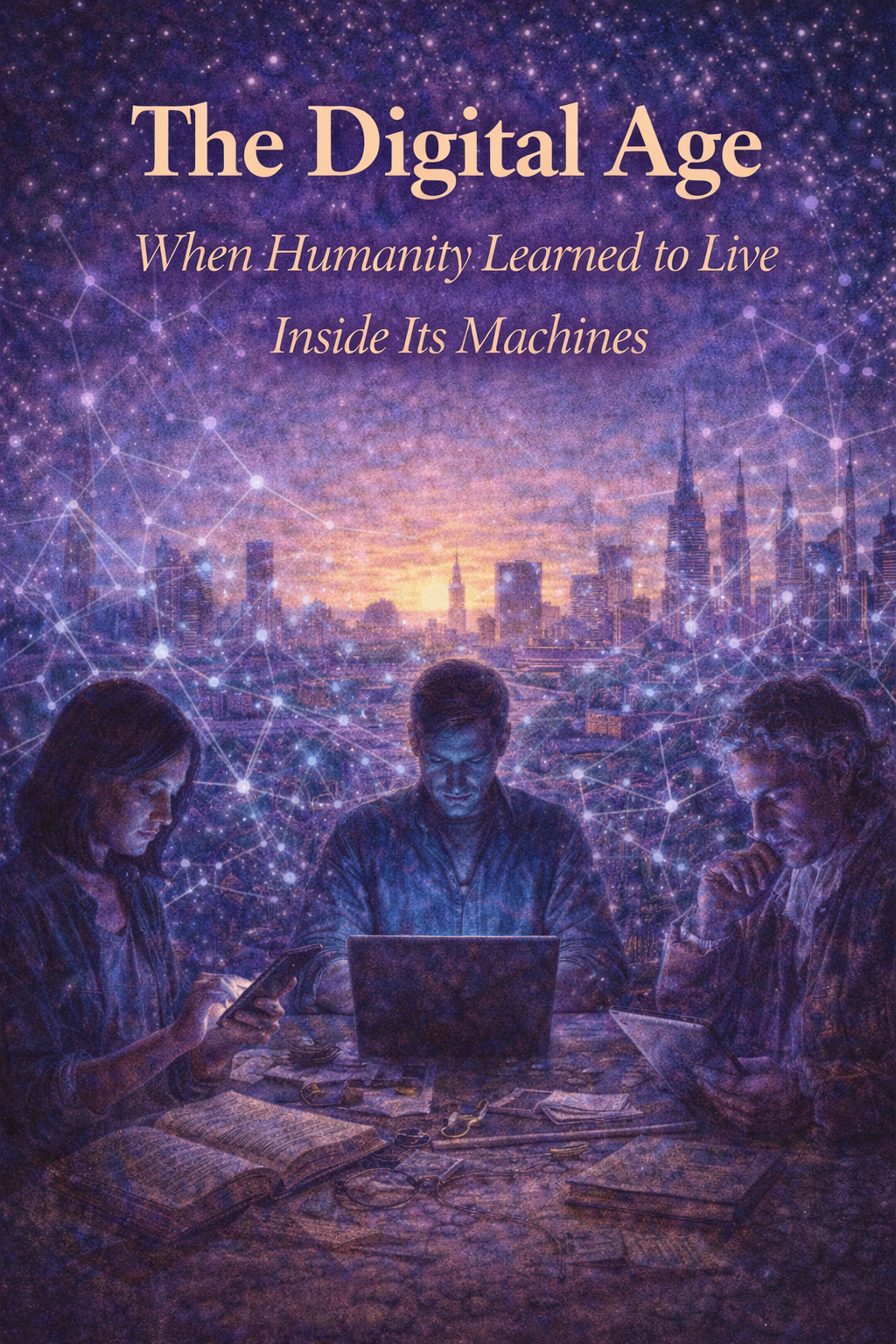
The Digital Age is not defined by a single invention. It is defined by a shift in how humans think, communicate, and exist. Unlike previous ages shaped by materials or ideas alone, the Digital Age reshaped reality itself, compressing distance, accelerating time, and merging human life with technology.
If the Enlightenment taught humanity how to think, the Digital Age taught humanity how to connect.
What Is the Digital Age?
The Digital Age began in the late 20th century with the rise of computers, digital communication, and information networks. It accelerated rapidly with the invention of the internet, personal devices, and global connectivity.
This age is defined not by physical tools, but by information.
Data became the new resource. Speed became the new power.
The World Before Digital
Before the Digital Age, information moved slowly. Knowledge was stored in books, libraries, and institutions. Communication depended on physical presence, paper, or delayed transmission.
Memory was external and fragile.
The Digital Age changed that by making information:
-
Instantly accessible
-
Infinitely replicable
-
Globally shared
-
Constantly updated
For the first time in history, humanity could store more knowledge than it could fully understand.
The Birth of Digital Thinking
The Digital Age did not begin with smartphones or social media. It began with mathematics, logic, and early computing.
Binary code, the language of computers, reduced reality to ones and zeros. This abstraction allowed machines to process information faster and more reliably than humans.
Once machines could store, calculate, and communicate information, society reorganized around them.
The Internet: A New Environment
The internet did not merely connect computers. It created a new environment for human life.
Work, relationships, identity, commerce, and culture migrated into digital space. Geography became less important. Time zones blurred. Presence no longer required physical proximity.
Human experience expanded beyond the physical world.
Power, Access, and Inequality
Like every age before it, the Digital Age redistributed power.
Those with access to technology gained:
-
Economic advantage
-
Influence
-
Visibility
-
Speed
Those without access were left behind.
Digital literacy became as important as reading and writing once were. Inequality did not disappear; it changed form.
Identity in the Digital Age
One of the most profound changes of the Digital Age is how humans understand identity.
People now exist simultaneously:
-
Offline and online
-
Public and private
-
Local and global
Identity became editable, performative, and permanent. Every action could be recorded, shared, and remembered.
The Digital Age blurred the boundary between who we are and how we are seen.
Knowledge Without Borders
Education transformed. Information once locked behind institutions became widely available. Anyone with a connection could learn, publish, and teach.
At the same time, misinformation spread just as easily.
The Digital Age democratized knowledge, but it also challenged truth.
Who Created the Digital Age?
No single person created the Digital Age.
It emerged from:
-
Scientists and engineers
-
Governments and corporations
-
Universities and military research
-
Collective human adoption
The Digital Age is a collaboration between humans and machines.
The Speed of Change
Unlike previous ages that unfolded over centuries, the Digital Age moves at breathtaking speed. Technologies become obsolete within years. Cultural norms shift rapidly. Generations experience entirely different realities.
This speed creates opportunity, but also anxiety.
Human biology did not evolve as fast as technology.
Why the Digital Age Still Matters
We are still inside the Digital Age. Unlike past ages, we cannot fully define it yet. We are participants, not observers.
It matters because it shapes:
-
How we think
-
How we relate
-
How we govern
-
How we remember
The Digital Age forces humanity to ask new questions:
-
What is privacy?
-
What is truth?
-
What is human when machines can imitate us?
An Unfinished Age
The Digital Age has no clear ending yet. It is still unfolding, still redefining itself.
Like the Stone Age shaped survival, the Enlightenment shaped reason, and the Industrial Age shaped production, the Digital Age is shaping consciousness.
It is the age where humanity looks at its own reflection through a screen and asks not just what can we do, but who are we becoming.




crkne3