

When Einstein Warned Us About the End of Progress
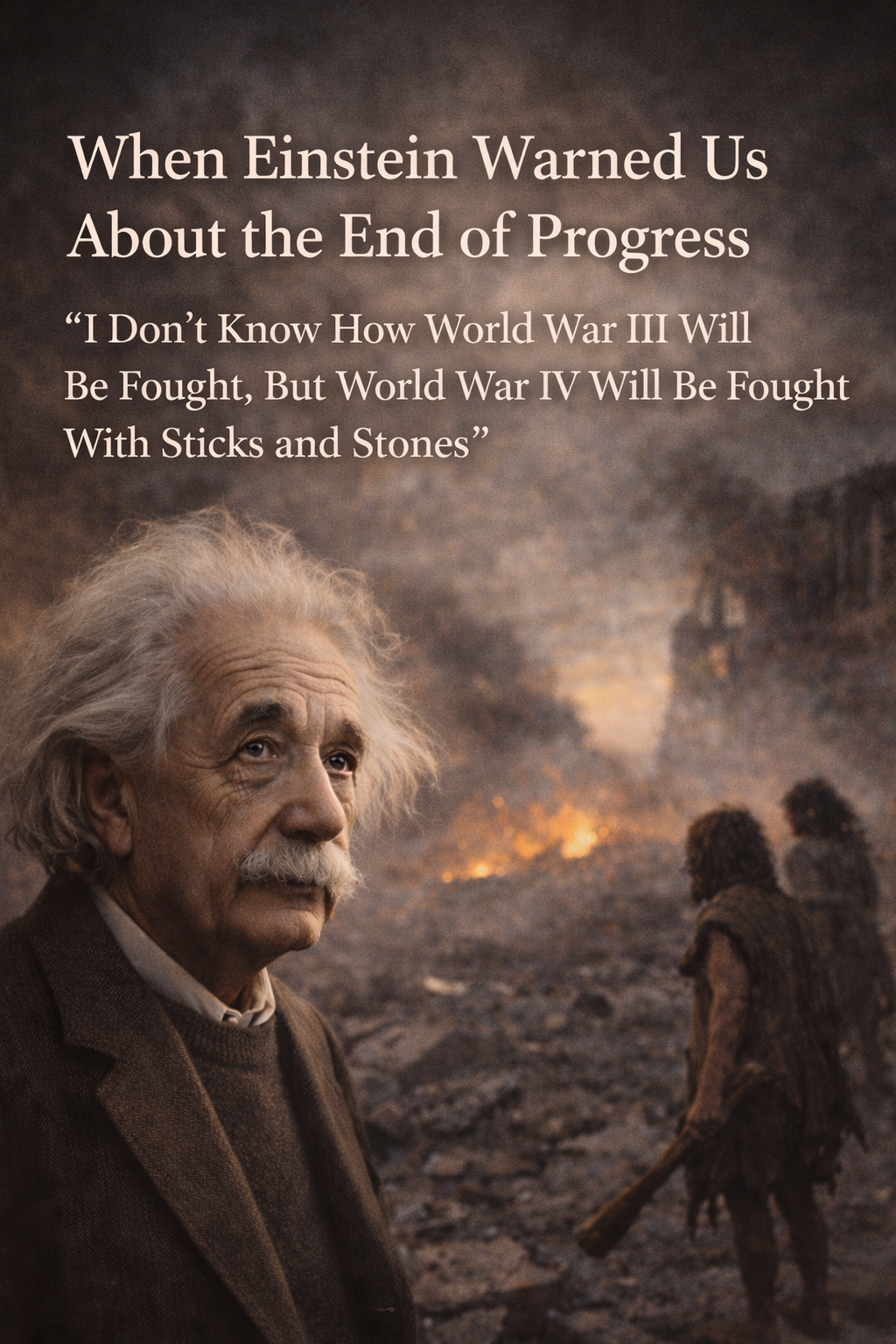
When asked how World War III would be fought, Albert Einstein reportedly gave an answer that still unsettles the modern world: he did not know the weapons of the next great war, but he was certain that the war after it would be fought with sticks and stones.
It was not a prediction of tactics. It was a warning about consequence.
A Statement About Collapse, Not Curiosity
Einstein was not speculating about future battlefields. He was describing regression. The image of sticks and stones is not primitive nostalgia. It is the aftermath of destruction so complete that civilization itself no longer functions.
Technology, infrastructure, knowledge, and social order would not merely be damaged. They would be erased.
World War IV, in this vision, is not a continuation of progress. It is what remains after progress destroys itself.
The Fear of Intelligence Without Wisdom
Einstein lived at a turning point in history. He witnessed the birth of nuclear physics and understood its implications more clearly than most. Scientific brilliance had outrun moral restraint.
His statement reflects a deep concern that human intelligence was accelerating faster than human responsibility. Weapons were evolving. Ethics were lagging behind.
The danger was not ignorance. The danger was capability without wisdom.
Why “Sticks and Stones” Matters
Sticks and stones symbolize more than primitive weapons. They represent a return to survival-level existence. No systems. No institutions. No memory of what was lost.
This is not just physical destruction. It is cultural amnesia.
Languages disappear. Knowledge vanishes. History resets.
Einstein’s warning suggests that the ultimate cost of total war is not death alone, but the erasure of everything that made life complex, creative, and meaningful.
A Critique of Modern Warfare
The quote remains powerful because it speaks directly to modern anxiety.
Each advancement in warfare promises precision, efficiency, and deterrence. Yet the scale of destruction grows alongside that promise. The more “advanced” war becomes, the less room there is for recovery.
Einstein was questioning the assumption that technological progress automatically equals human progress.
If the end result is ruin, progress has failed its purpose.
The Fragility of Civilization
Civilization feels permanent when systems work. Electricity flows. Information travels instantly. Cities glow at night. But Einstein’s words remind us how fragile this stability truly is.
Complex societies depend on cooperation, restraint, and shared survival. Total war breaks those foundations.
Once broken, rebuilding is not guaranteed.
The warning is not that war is destructive. That is obvious. The warning is that some forms of destruction are irreversible.
Why the Quote Still Resonates
Decades later, the quote continues to circulate because the conditions that inspired it have not disappeared. If anything, they have multiplied.
Weapons are faster. More powerful. More automated. Decisions are compressed into seconds. Consequences remain permanent.
Einstein’s fear was not about one war. It was about a pattern of escalation that eventually leaves nothing left to escalate.
A Moral Challenge, Not a Prophecy
This statement should not be read as fatalism. It is not saying collapse is inevitable. It is saying collapse is possible.
The power of the quote lies in its challenge. If humanity can imagine the end of civilization, it can also imagine preventing it.
Wisdom, restraint, and collective responsibility become survival tools as vital as any technology.
What Einstein Ultimately Asked of Us
Einstein was not asking us to fear the future. He was asking us to take responsibility for it.
The real question behind his words is simple and unsettling:
If we are capable of ending everything, are we capable of choosing not to?
World War IV fought with sticks and stones is not a future written in stone. It is a future written by choices.
And choices, unlike wars, can still be changed.