

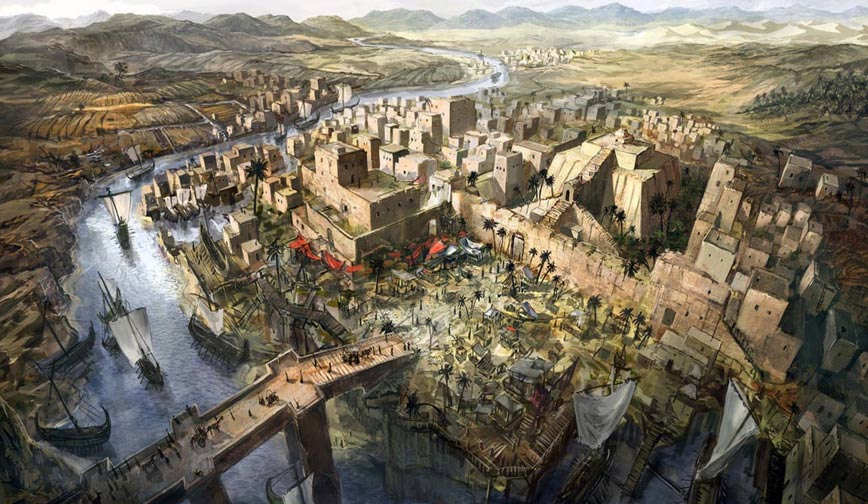
Long before empires, before pyramids, before written history as we know it, there was Sumer. Rising between the Tigris and Euphrates rivers in what is now southern Iraq, the Sumerians built the world’s first known civilization. They invented writing, cities, law, and complex religion. And yet, unlike dramatic collapses filled with fire and conquest, Sumer did not fall loudly.
It faded.
The Birth of Civilization
Around 3500 BCE, the Sumerians transformed scattered agricultural villages into city-states such as Uruk, Ur, Lagash, and Eridu. These were not primitive settlements. They had monumental temples, organized labor, long-distance trade, and sophisticated administration.
The Sumerians gave humanity cuneiform writing, the wheel, advanced mathematics, timekeeping, and some of the earliest literature, including the Epic of Gilgamesh. In many ways, they built the blueprint for civilization itself.
A Fragile Environment
Sumer’s greatness depended on irrigation. The rivers that sustained life also carried danger. Seasonal flooding required constant management, and irrigation slowly poisoned the soil through salinization. Over centuries, fertile land became less productive.
Wheat failed. Barley replaced it. Eventually, even barley yields declined.
Environmental stress crept in quietly.
City-States, Not a United Empire
Sumer was never truly unified. It consisted of rival city-states locked in cycles of alliance and war. While this competition fueled innovation, it also weakened collective resilience.
When external pressures increased, Sumer lacked a single coordinated response.
Division made survival harder.
Invasions Without Annihilation
Around 2300 BCE, Sumer was conquered by the Akkadian Empire under Sargon of Akkad. But conquest did not erase Sumerian culture. Their language, religion, and administration continued under new rulers.
This pattern repeated.
Sumer was absorbed, not destroyed.
Climate Change and Collapse
Evidence suggests a severe climate shift around 2200 BCE, known as the 4.2-kiloyear event. Prolonged drought devastated agriculture across the region. Cities emptied. Trade collapsed. Political structures weakened.
The land could no longer sustain its population.
Nature did what armies could not.
Cultural Disappearance, Not Sudden Death
Sumerians didn’t vanish overnight. They gradually merged into later Mesopotamian cultures, especially the Babylonians and Assyrians. The Sumerian language ceased to be spoken but survived as a sacred and scholarly language, much like Latin centuries later.
Their identity dissolved into continuity.
Their ideas endured.
Why Sumer Feels Forgotten
Unlike civilizations with dramatic ruins or iconic monuments, Sumer left behind mudbrick cities eroded by time. Their disappearance lacked spectacle. No single catastrophic moment marks the end.
Quiet endings don’t linger in memory.
But they shape history just as profoundly.
What the World Inherited
Almost everything foundational in civilization traces back to Sumer: writing systems, legal codes, bureaucracy, urban planning, and recorded history. Later civilizations did not replace Sumerian ideas. They built on them.
Sumer didn’t fail humanity.
Humanity moved forward using Sumer’s tools.
The Lesson of a Quiet Vanishing
The Sumerians remind us that civilizations don’t always collapse through drama. Sometimes they erode through environmental stress, internal division, and gradual adaptation until the original identity disappears.
Survival doesn’t always look like continuity.
Sometimes it looks like transformation.
The Final Reflection
The world’s first civilization did not end in flames or legend. It ended in absorption, adaptation, and silence. And yet, every time we write, measure time, record law, or build cities, we echo Sumer.
They vanished quietly.
But they never truly left.