

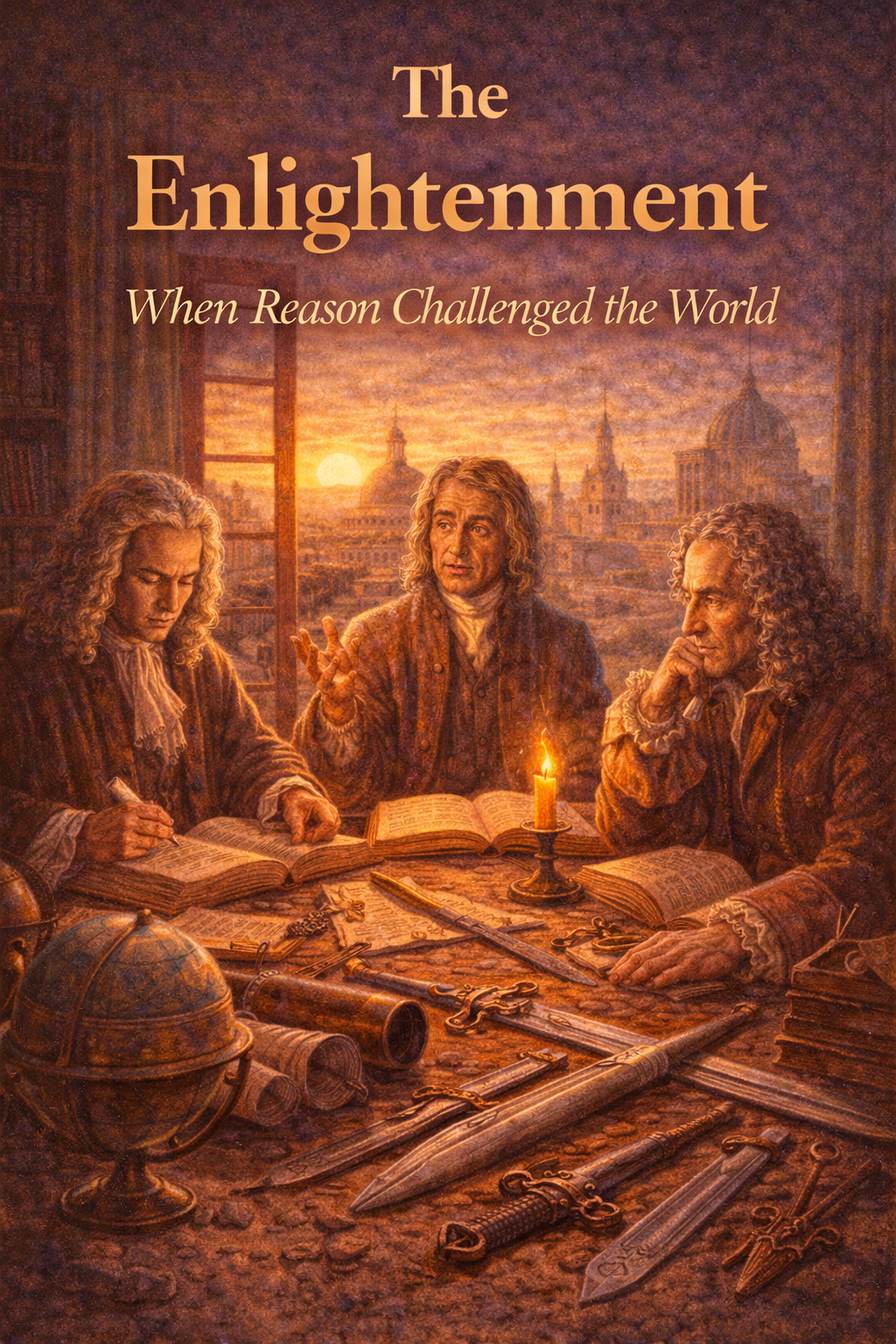
The Enlightenment was not an age of tools or weapons. It was an age of ideas. Emerging in Europe during the late 17th and 18th centuries, the Enlightenment marked a turning point when humanity began to question authority, tradition, and inherited truth, and to replace them with reason, evidence, and individual thought.
If earlier ages shaped how humans lived, the Enlightenment reshaped how humans thought.
What Was the Enlightenment?
The Enlightenment was an intellectual and cultural movement rather than a strictly defined period. It flourished roughly between the late 1600s and the late 1700s, spreading across Europe and later influencing the wider world.
Its central belief was radical for its time:
human beings could understand the world through reason rather than unquestioned tradition.
The World Before the Enlightenment
Before the Enlightenment, knowledge was largely controlled by religious institutions and monarchies. Truth was inherited, not investigated. Social hierarchy was considered divinely ordained, and authority was rarely challenged.
Science existed, but it was constrained. Questioning established beliefs could mean exile, imprisonment, or death.
The Enlightenment began when thinkers decided that knowledge should be examined, not accepted.
The Birthplace of Enlightenment Thinking
The Enlightenment did not begin in one single place, but it gained momentum in France, England, and parts of Germany.
Coffeehouses, salons, universities, and printing presses became centers of discussion. Ideas moved faster than armies.
Books and pamphlets allowed thought to travel freely, crossing borders and challenging power structures.
The Thinkers Who Defined an Age
Several figures became symbols of Enlightenment thought, not because they agreed on everything, but because they shared a commitment to reason.
John Locke argued that humans are born with natural rights, life, liberty, and property, and that governments exist to protect them.
Voltaire challenged religious intolerance and defended freedom of speech, famously insisting that disagreement must still allow expression.
Immanuel Kant defined Enlightenment as humanity’s escape from self-imposed ignorance, urging people to think for themselves.
Isaac Newton showed that the universe followed discoverable laws, reinforcing the belief that reason could unlock nature’s secrets.
Together, these thinkers transformed philosophy, science, and politics.
Science, Reason, and Progress
The Enlightenment embraced the scientific method. Observation, experimentation, and evidence replaced superstition and dogma.
This shift led to:
-
Advances in physics and astronomy
-
Medical progress
-
New understandings of nature and motion
-
Confidence that progress was possible
For the first time, history was seen not as decline from a golden past, but as advancement toward a better future.
Political Revolutions
Enlightenment ideas did not remain theoretical. They reshaped the world.
The belief in equality before the law, separation of powers, and representative government influenced major political transformations, including the American and French Revolutions.
Power was no longer justified solely by birth or divine right, but by consent and reason.
Religion and the Enlightenment
The Enlightenment did not universally reject religion, but it questioned its authority over knowledge. Many thinkers supported deism, the belief in a creator who does not intervene in daily affairs.
Faith became personal rather than institutional.
This shift permanently altered the relationship between belief, science, and governance.
Who “Started” the Enlightenment?
No single person started the Enlightenment.
It emerged when conditions aligned:
-
Increased literacy
-
Printing technology
-
Expanding trade
-
Scientific discovery
-
Political tension
The Enlightenment was a collective awakening.
Why the Enlightenment Still Matters
Modern ideas of:
-
Human rights
-
Democracy
-
Freedom of speech
-
Scientific inquiry
-
Education for all
are direct descendants of Enlightenment thinking.
Even when its ideals fall short in practice, they continue to shape global values and debates.
The Age of Questioning
The Enlightenment did not give humanity all the answers. What it gave was something more enduring: the permission to ask questions.
It taught humanity that authority must be examined, truth must be tested, and progress depends on the courage to think independently.
In that sense, the Enlightenment is not over.
It is a mindset, one that continues every time someone dares to ask why.