

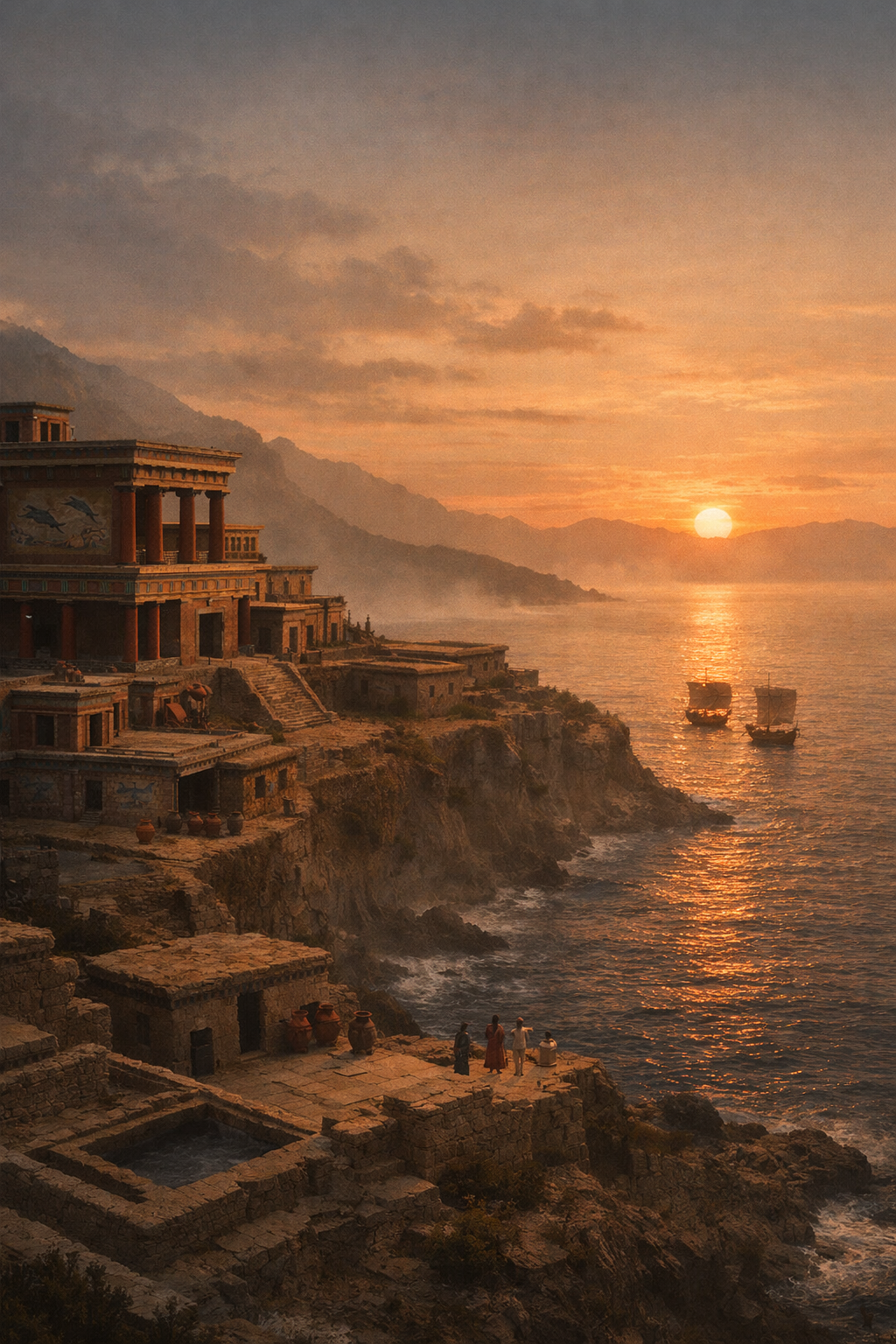
Long before classical Greece, before Athens and Sparta shaped Western imagination, there was another civilization flourishing in the Aegean. Centered on the island of Crete, the Minoans built Europe’s first great civilization. They were master sailors, skilled artists, and sophisticated urban planners. Their world was colorful, fluid, and deeply connected to the sea.
And then, it was gone.
Not conquered in a single battle.
Not erased overnight.
But slowly overwhelmed by forces rising from the water and the land beneath it.
A Civilization Shaped by the Sea
The Minoans emerged around 3000 BCE and reached their peak between 2000 and 1450 BCE. Their power was maritime. Unlike land-based empires, they controlled trade routes, not territory. Their ships connected Crete to Egypt, Anatolia, and mainland Greece.
The sea was their highway, their defense, and their identity.
This dependence made them wealthy.
It also made them vulnerable.
Palaces Without Walls
Minoan cities, especially the palace complexes such as Knossos, were architectural marvels. Multi-story structures with advanced drainage, light wells, and intricate frescoes covered in vibrant color.
Strikingly, these palaces lacked defensive walls.
This suggests confidence, perhaps even peace.
Or faith that the sea would protect them.
Art, Ritual, and a Different Power Structure
Minoan art depicts movement, nature, and ritual rather than war. Bull-leaping scenes, dancers, and priestess-like figures dominate their visual language. Weapons are rare. Kings are invisible.
Power may have been ceremonial rather than militaristic.
A civilization organized around ritual, trade, and symbolism.
The Volcanic Catastrophe
Around 1600 BCE, one of the largest volcanic eruptions in human history occurred on the island of Santorini, then known as Thera. The explosion sent ash across the eastern Mediterranean and triggered massive tsunamis.
Coastal settlements were devastated.
Fleets were destroyed.
Trade networks collapsed.
The sea that sustained the Minoans turned against them.
Collapse Without Immediate Erasure
The eruption did not instantly end Minoan civilization. Crete survived, weakened but standing. However, economic disruption and population loss left it exposed.
Within generations, Mycenaean Greeks from the mainland moved in.
Not as sudden conquerors.
But as inheritors of a wounded system.
Absorption Into Another World
By around 1450 BCE, Minoan palaces were destroyed or repurposed. Their script faded. Their political independence disappeared. But their influence lived on.
Minoan art, religion, and architecture shaped Mycenaean culture and, later, classical Greece.
They vanished politically.
They endured culturally.
Why the Minoans Feel Mythic
Much of what we know about the Minoans comes from archaeology, not texts. Their language remains undeciphered. Their stories are inferred, not recorded.
This silence invites myth.
Many believe the legend of Atlantis echoes the Minoan collapse.
A powerful island civilization lost to the sea.
A Different Kind of Ending
The Minoans didn’t collapse through brutality or decadence. They were undone by environmental catastrophe and geopolitical shift. Their end was gradual, layered, and quiet.
History favors drama.
But reality often chooses erosion.
What the Minoans Teach Us
The Minoans remind us that sophistication does not guarantee permanence. Connection can become dependence. Prosperity can mask fragility.
Civilizations tied too tightly to a single system risk collapse when that system fails.
The Final Reflection
Europe’s first great civilization didn’t fall because it was weak. It fell because it was interconnected, exposed, and shaped by forces larger than itself.
The sea gave the Minoans everything.
And in time, it took everything back.
What remains are fragments, colors, and questions drifting through history, reminding us that even the most graceful civilizations can disappear without a final battle, leaving only echoes beneath the waves.