

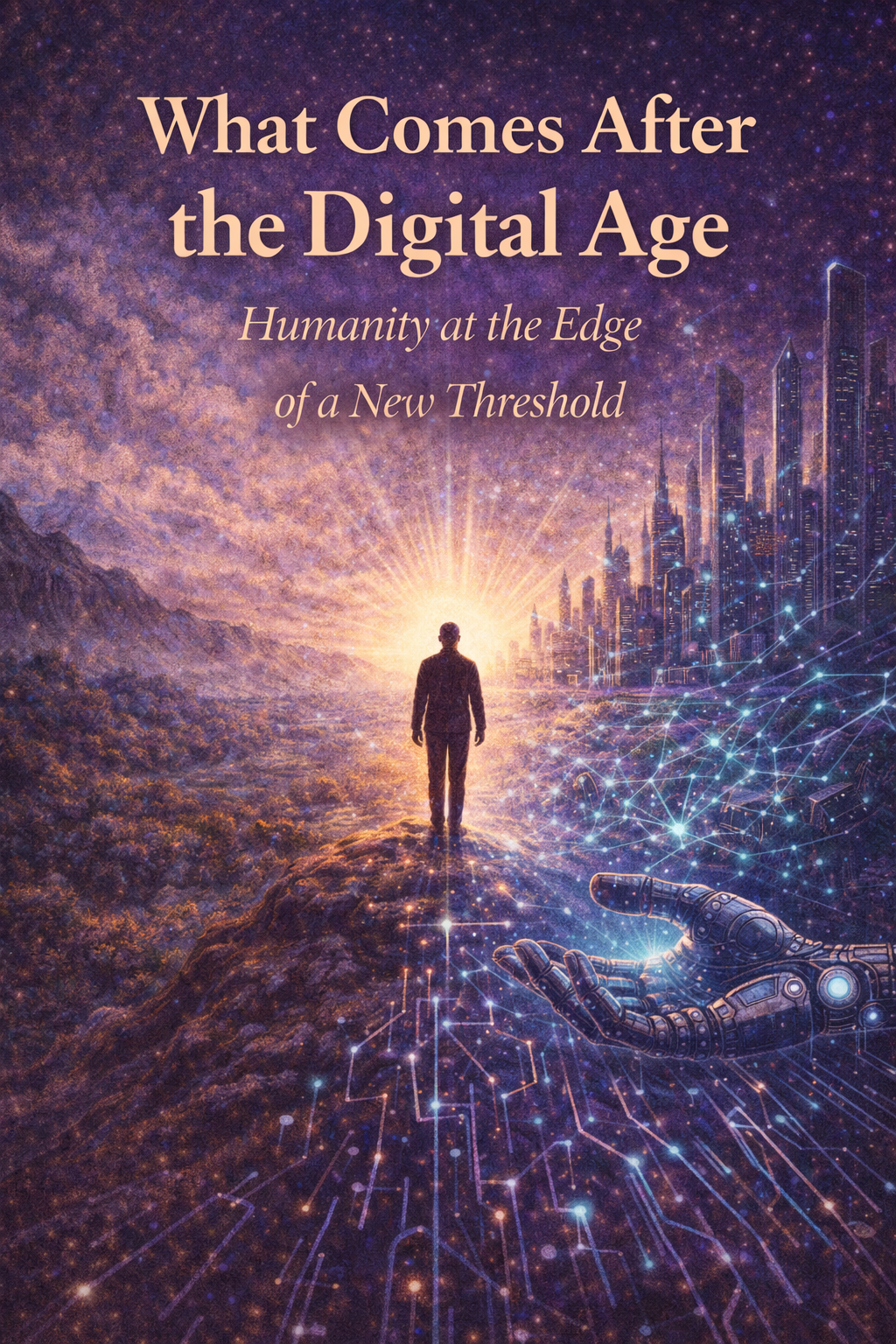
The Digital Age taught humanity how to connect, compute, and compress reality into data. But every age carries the seed of its own transformation. As technology accelerates beyond screens and networks, a new question emerges, not what can machines do, but what becomes of humanity when machines think, decide, and evolve alongside us.
The age after the Digital Age will not be defined by devices. It will be defined by integration.
The End of “Digital” as a Distinction
One of the clearest signs that an age is ending is when its defining feature becomes invisible. Electricity is no longer an “electric age.” It is simply life.
The same is happening with digital technology.
When everything is connected, digital stops being special. It becomes background. The next age begins when technology is no longer something we use, but something we live within.
The Age of Intelligence
Most thinkers agree that what follows the Digital Age will center on intelligence, not just artificial intelligence, but intelligence everywhere.
This emerging age is often described as:
-
The Age of Artificial Intelligence
-
The Cognitive Age
-
The Age of Augmented Humanity
-
The Post-Digital Age
The name is still unsettled because the transformation is still unfolding.
What is clear is this: intelligence is becoming distributed between humans and machines.
From Tools to Partners
Previous technologies extended the body. The Digital Age extended the mind’s reach. The next age extends decision-making itself.
Machines now:
-
Learn from data
-
Predict outcomes
-
Generate language, images, and ideas
-
Adapt without direct instruction
This marks a fundamental shift. Technology is no longer reactive. It is participatory.
Humans are no longer the only thinkers in the system.
The Human Question Returns
Every great age eventually forces humanity to look inward.
After mastering stone, metal, industry, and information, the next age asks:
-
What is uniquely human?
-
What should machines never decide?
-
How do we preserve meaning in an automated world?
This age will not be about faster progress, but about values.
The Ethical Age
As intelligence spreads, ethics move to the center.
Questions once philosophical become practical:
-
Who is responsible for automated decisions?
-
How do we protect privacy when prediction is constant?
-
How do we define truth when reality can be simulated?
The next age will require moral frameworks as sophisticated as its technology.
Without ethics, intelligence becomes power without direction.
Identity After the Digital Age
In the Digital Age, identity became editable and performative. In the next age, identity becomes hybrid.
People will live across:
-
Physical bodies
-
Digital representations
-
Algorithmic profiles
Memory, creativity, and even emotion may be shared between humans and machines.
This will force a redefinition of self.
The Return of the Human Scale
Paradoxically, the more advanced technology becomes, the more humans crave grounding.
Many signs already point toward:
-
Renewed interest in nature
-
Slow living and intentional design
-
Meaning over efficiency
-
Presence over constant connection
The next age may be both hyper-intelligent and deeply human.
No Single Name, Yet
Just as people living in the Stone Age did not know they were in it, we cannot fully name what comes next.
Ages are always named in hindsight.
What we can say is that the age after the Digital Age will be defined not by what we invent, but by how we choose to live with what we have invented.
Standing at the Threshold
Humanity has always crossed thresholds without fully understanding them. Each age feels uncertain while it is happening.
This moment is no different.
The next age will be shaped by:
-
Conscious choice
-
Ethical courage
-
Collective responsibility
-
A renewed understanding of what it means to be human
The Digital Age taught us how to connect the world.
What comes next will determine whether we know why.