

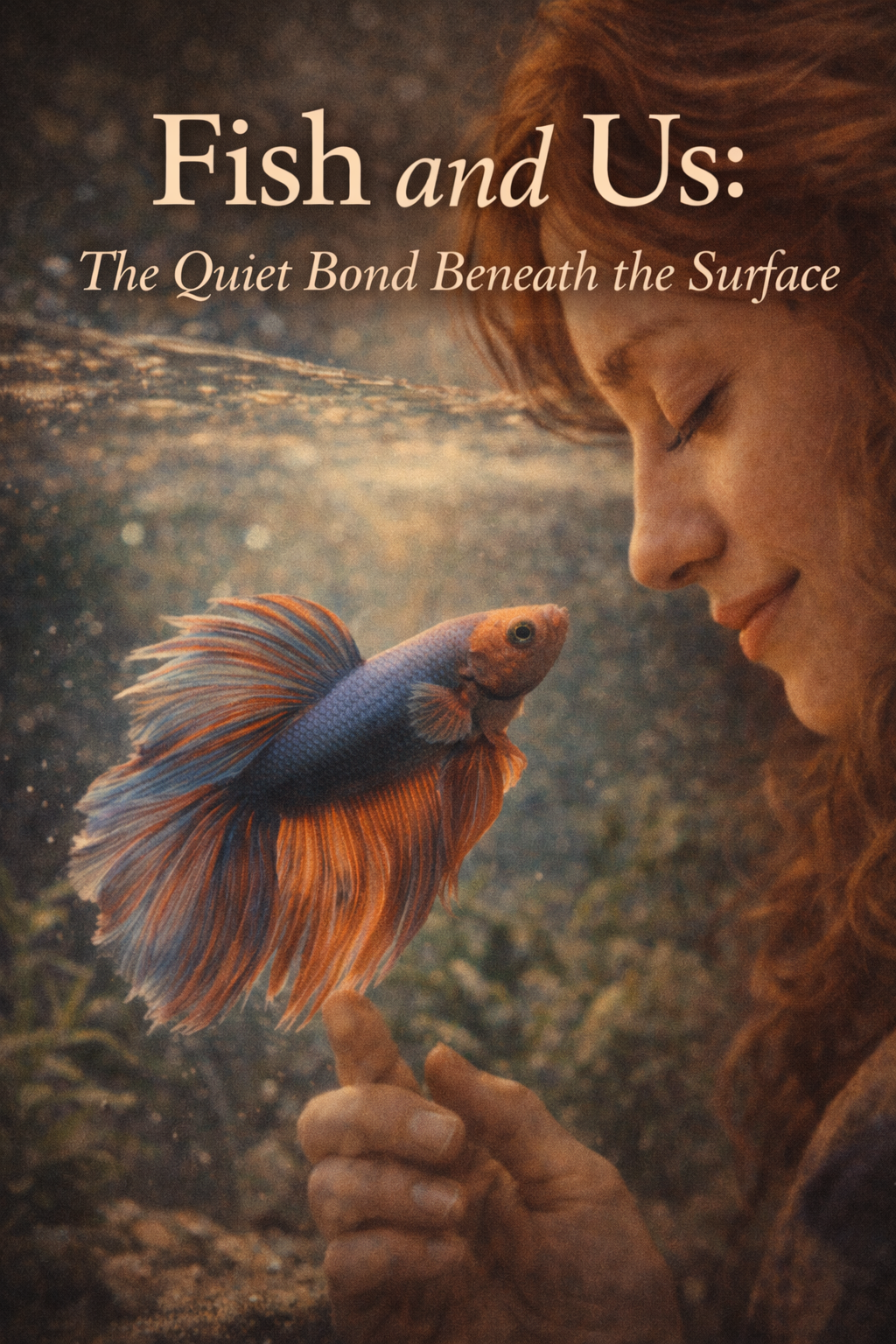
Fish were part of the human story long before homes had walls. They fed us, guided us, inspired myths, and shaped entire civilizations. Yet among all animals connected to human life, fish remain the most quietly present. They do not seek affection. They do not mirror us emotionally. And still, humans continue to be drawn to them.
The relationship between fish and humans is not loud or sentimental.
It is ancient, instinctive, and deeply symbolic.
From Survival to Stewardship
For early humans, fish represented survival. Rivers, lakes, and oceans provided nourishment when land failed. Fishing shaped migration, settlement, and trade. Entire cultures formed around water, tides, and seasons dictated by fish movement.
Over time, fish became more than food. They became indicators of balance. When waters were healthy, fish thrived. When ecosystems collapsed, fish disappeared. Humans learned to read the environment through them.
This made fish not companions, but signals.
Why Humans Are Drawn to Fish
Unlike animals that interact directly with us, fish invite observation. Their appeal lies in motion, rhythm, and silence. Watching fish swim slows the nervous system. Their repetitive, fluid movements create a meditative state, lowering stress and calming the mind.
Aquariums are often placed in hospitals, offices, and homes not for decoration, but for regulation. Fish offer presence without demand. They exist independently, yet share space beautifully.
Humans are drawn to fish because they remind us how to breathe again.
The Emotional Distance That Comforts
Fish do not require validation, touch, or constant engagement. For many people, especially in overstimulated lives, this distance feels safe. Fish allow companionship without emotional responsibility.
There is comfort in caring for a living being that does not expect emotional reciprocity. Feeding, cleaning, maintaining water quality. These acts provide structure and routine without emotional negotiation.
In this way, fish offer a different kind of connection. One rooted in responsibility rather than attachment.
Fish as Symbols Across Cultures
Throughout history, fish have symbolized abundance, transformation, intuition, and the subconscious. In many cultures, fish represent prosperity and renewal. In others, they are spiritual guides or messengers between worlds.
Their association with water links them to emotion, depth, and the unseen. Humans have always projected meaning onto fish because they live where we cannot go, in spaces that feel mysterious and infinite.
Fish remind us that much of life exists beyond our control.
Modern Life and the Fish-Human Relationship
Today, fish are both wild and domestic. Some are encountered in oceans and rivers, others behind glass walls. Yet the relationship remains largely observational.
People form attachments to fish in quieter ways. Through routine. Through care. Through presence. Fish don’t recognize us individually, but they respond to consistency, light, and environment.
That subtle responsiveness creates a sense of partnership, even without emotion.
What Fish Teach Humans
Fish teach patience.
They teach balance.
They teach respect for systems larger than ourselves.
They remind us that life does not need to mirror us to matter. That beauty does not require interaction to be meaningful. And that calm is not emptiness, but a different kind of fullness.
The relationship between fish and humans is not one of companionship in the traditional sense. It is a relationship of coexistence, stewardship, and reflection.
We do not look to fish to understand ourselves.
We look to them to remember how vast the world truly is.