
The ground looks still.
Mountains sit on the horizon like stone guardians, ancient and silent.
But some of them are not just mountains. They are wounds. Doors. Throats.
And when they open, the Earth speaks in fire.
A volcanic eruption is one of the most dramatic ways our planet shows that it is alive—from rivers of glowing lava to ash-filled skies that can darken the sun.
What is a volcanic eruption, really?
Deep below the surface, parts of the Earth’s mantle are so hot that rock doesn’t stay solid. It melts into magma—a thick, glowing mixture of molten rock, crystals, and gas.
This magma:
– Collects in underground chambers
– Builds pressure over time
– Searches for weaknesses in the crust
When the pressure becomes too great, the magma forces its way upward through cracks and vents. The moment it reaches the surface, it becomes lava, and the eruption begins.
A volcanic eruption is, at its core, this:
Magma, ash, and gases exploding or flowing out of the Earth, released through a volcano that acts like a vent between the underground and the open sky.
Not all eruptions look the same
We often imagine a classic cone-shaped volcano spitting lava, but eruptions come in many styles, some slow and almost gentle, others sudden and catastrophic.
-
Effusive eruptions – the rivers of fire
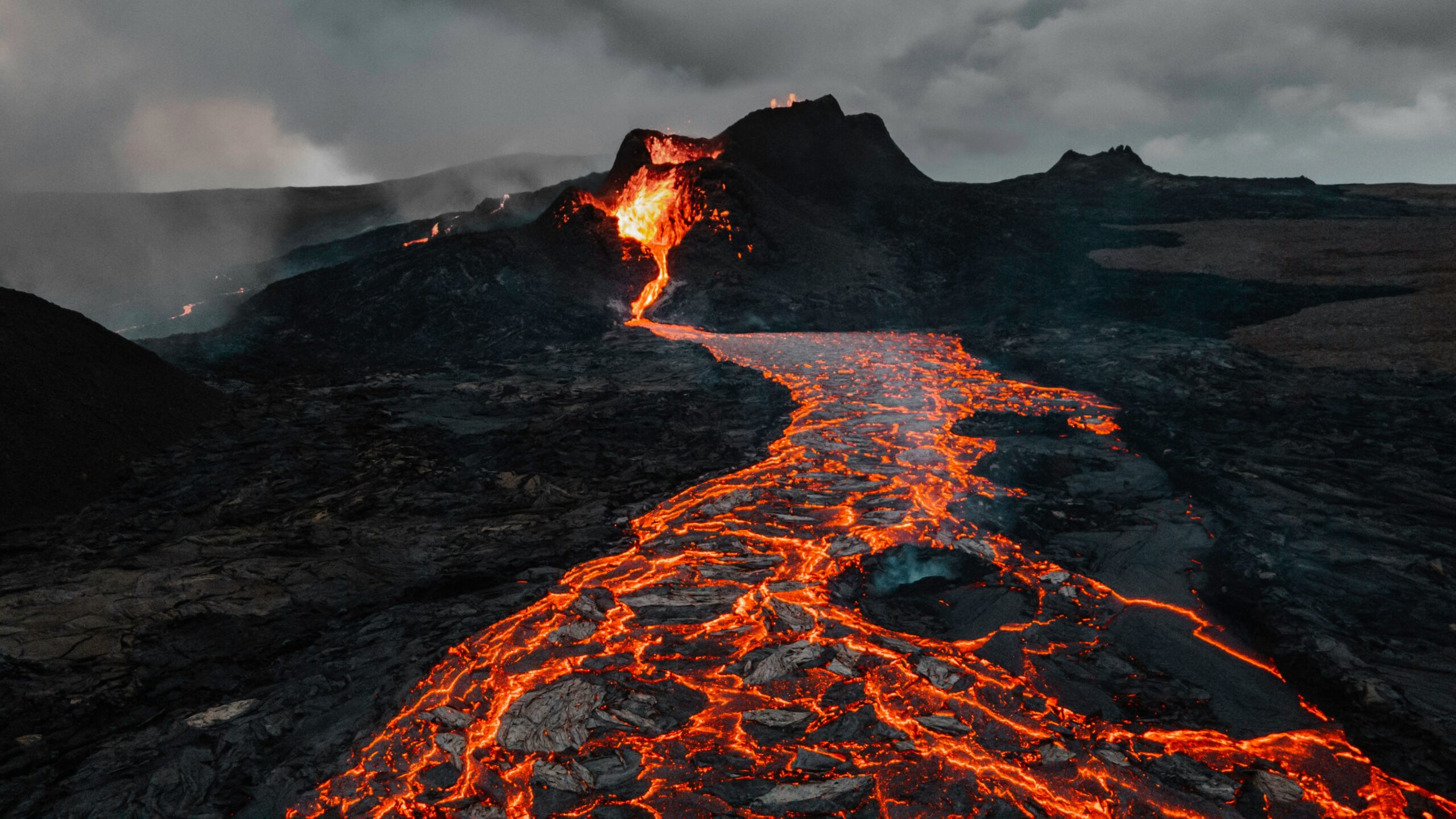
– Lava oozes or pours out of vents, flowing down the slopes like a bright, slow-moving river.
– Basaltic lava, like that seen in Hawaii, can travel long distances.
– These eruptions can destroy homes and roads, but they often give people time to evacuate. -
Explosive eruptions – the sky turned to stone
– Thick, gas-rich magma gets clogged near the surface. Pressure rises until it bursts violently.
– Ash, rock, and gas shoot into the sky in towering columns.
– These eruptions can blow apart the top of the volcano itself and send deadly clouds racing down the slopes. -
Pyroclastic flows – the ground-level avalanche of death
– These are fast, searing-hot currents of ash, gas, and fragments of rock that race down the volcano at speeds over 100 km/h (or more).
– They are impossible to outrun and can obliterate everything in their path.
– Many of history’s deadliest volcanic disasters were caused by pyroclastic flows. -
Hidden killers – gases and mudflows
– Volcanoes release gases like sulfur dioxide, carbon dioxide, and others. In high concentrations, they can suffocate people and animals or create toxic air.
– Ash mixed with rain can create lahars—volcanic mudflows that surge down valleys, burying towns, fields, and roads in heavy, cement-like sludge.
The ash that reaches the sky
Volcanic ash is not soft powder. It’s made of tiny, sharp particles of glass and rock. When a large eruption sends ash high into the atmosphere, it can:
– Collapse roofs under its weight
– Damage airplane engines (jets flying through ash clouds can lose power)
– Irritate eyes and lungs, especially in children, the elderly, and people with respiratory problems
– Cover crops and contaminate water supplies
If the ash reaches high enough into the stratosphere, it can spread around the globe.
There, it can reflect sunlight back into space, cooling the Earth slightly for months or even a few years.
When volcanoes change the climate
Most eruptions affect only local regions. But the largest ones—the truly powerful events—can have a measurable effect on the planet’s temperature.
Such eruptions release vast amounts of ash and sulfur dioxide into the upper atmosphere.
The tiny particles and droplets that form can:
– Block part of the sunlight
– Slightly lower global temperatures
– Disturb weather patterns
History holds quiet reminders in old records:
– “The year without a summer,” when crops failed and frost came at strange times
– Strange colors in sunsets
– Unusual cold spells following big eruptions
Volcanoes can’t rewrite climate forever on their own, but they can give the planet a temporary chill.
Why volcanoes exist at all
Volcanoes are not random. They tend to appear in specific places:
– Along tectonic plate boundaries, where plates collide or pull apart
– Over “hot spots,” places where extra-hot mantle material rises toward the surface
They are part of Earth’s deep recycling system:
– Old crust sinks back into the mantle at subduction zones
– New crust is created at mid-ocean ridges and volcanic arcs
– Gases like water vapor and carbon dioxide are released to the atmosphere
Without volcanism, the Earth’s surface and atmosphere would be very different. Volcanoes helped build the continents and contributed to the air we breathe.
Living in the shadow of fire
For millions of people, volcanoes are not distant curiosities. They are neighbors.
Volcanic regions often have:
– Fertile soils, rich in minerals, perfect for agriculture
– Geothermal energy for heating and electricity
– Beautiful landscapes that attract tourism
People live, farm, and raise families in these places, accepting the risks for the benefits they bring.
Because of this, monitoring volcanoes becomes a matter of life and death.
How we watch the giants
Volcanologists and monitoring agencies use many tools to keep an eye on active volcanoes:
– Seismometers to detect small earthquakes caused by moving magma
– GPS and satellite measurements to see if the ground is swelling or deforming
– Gas sensors to measure changing levels of volcanic gases
– Cameras and drones to observe vents and lava domes
Often, a restless volcano will give warnings:
– Increased seismic activity
– Changes in gas emissions
– Ground inflation
– New cracks or small eruptions
But not every volcano behaves the same, and prediction is never perfect.
Scientists can often say, “The risk is increasing” or “An eruption is likely soon,” but they can rarely give an exact date and size.
The human cost—and the human response
Volcanic eruptions can:
– Bury towns in ash
– Cut off roads and airports
– Displace entire communities
– Take lives in minutes when pyroclastic flows or lahars strike without warning
Yet after the disaster, you also see something else:
– Villages rebuilding, sometimes on the same slopes
– People returning to their land, attached to their homes and fields despite the danger
– New forests growing on old lava, life reclaiming black, barren rock
Volcanoes destroy, but they also create. They build new land, enrich soils, and shape some of the most stunning landscapes on Earth.
A planet with fire in its veins
Volcanic eruptions are reminders that this world is not a cold, dead stone floating in space.
Beneath our feet, there is motion, heat, and constant transformation.
When a volcano erupts, it can feel like the end of the world for those nearby:
– Ash falling like dark snow
– Red rivers of lava swallowing roads
– A sky lit in orange and black
But in the longer story of the Earth, eruptions are part of a never-ending process of destruction and creation.
We live on a planet with fire in its veins.
Our challenge is not to silence that fire, but to understand it—to respect the mountains that are not just mountains, and to build lives that can endure in the shadow of their quiet, smoking peaks.
Photo by Tetiana GRY on Unsplash