
The storm is already there—dark clouds, heavy rain, distant thunder.
You think you know its shape. You’ve seen storms before.
Then the sky twists.
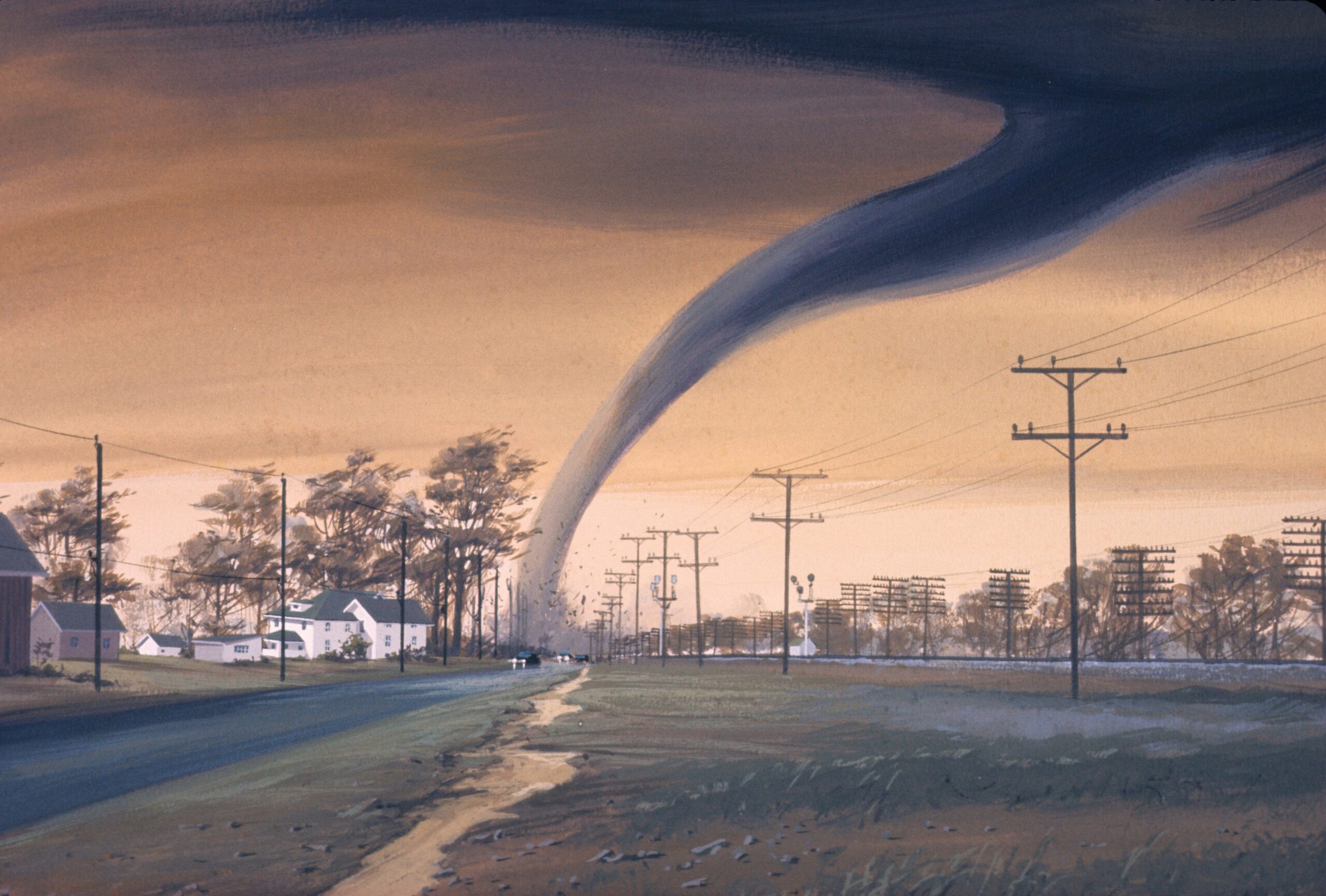
A funnel begins to reach down, thin at first, like a ghostly finger searching for the ground.
When it touches, the world changes in seconds.
That is the moment a tornado is born.
What is a tornado, really?
A tornado is a narrow, violently rotating column of air that extends from a thunderstorm cloud down to the ground. It is not just “strong wind.” It is organized chaos—a spinning engine of air that can rip houses apart, fling cars into fields, and strip trees of their branches in minutes.
Most tornadoes are relatively small and brief, lasting only a few minutes and traveling a short distance.
But in those minutes, along that narrow path, they can do damage that looks like a giant took a claw and dragged it across the landscape.
How does the sky twist itself into a tornado?
Tornadoes usually form from powerful thunderstorms, especially supercell storms—those massive, rotating storms with a deep, spinning updraft.
Several ingredients have to come together:
-
Warm, moist air near the ground
This rises and fuels strong thunderstorms. -
Cooler, drier air higher up
This contrast in temperature makes the atmosphere unstable, encouraging strong updrafts. -
Wind shear
Wind that changes speed or direction with height can create a horizontal “roll” of air.
When a thunderstorm grows, its strong updraft can tip that roll upright, creating a rotating column of air inside the storm. -
Focusing that rotation
Under just the right conditions, that broad rotation tightens and intensifies.
A funnel cloud forms and stretches downward.
If it reaches the ground, it becomes a tornado.
To someone watching, the moment feels unreal: a dark, twisting shape connecting sky and earth, moving silently at a distance or roaring like a freight train up close.
A monster with many faces
Tornadoes are not all the same. They can appear as:
– Thin, pale “ropes” that seem almost delicate—until you see what they did to the buildings beneath them.
– Wide, dark wedges that look less like funnels and more like moving walls.
– Multiple vortices—several small whirls spinning around a larger core, like smaller demons orbiting a larger one.
They can be partly hidden by rain or dust, especially in “rain-wrapped” storms, making them harder to see and more dangerous for people on the ground.
The scale of destruction
Scientists classify tornadoes using the Enhanced Fujita (EF) Scale, based on the damage they leave behind:
– EF0: Light damage, broken branches, minor roof damage
– EF1 to EF3: Moderate to severe damage—roofs torn off, homes badly damaged, cars lifted or thrown, trees snapped
– EF4 and EF5: Devastating to incredible damage—well-built houses swept from their foundations, steel-reinforced structures heavily damaged, large objects hurled long distances
Unlike hurricanes, which can affect huge regions, tornadoes usually cut narrow paths—sometimes only a few dozen meters wide, sometimes a kilometer or more. But where they pass, the destruction is often absolute.
One street may be untouched, while the next one over looks like a bomb went off.
The strange signatures of a tornado’s path
Walk through the aftermath of a strong tornado, and you see scenes that almost defy logic:
– A house gone, its concrete foundation swept clean, while a single interior wall stands alone.
– Trees stripped bare, bark ripped off, as if sandblasted by the wind.
– Cars twisted, tossed, or stacked in unnatural positions.
– Debris—shingles, photos, furniture—carried kilometers away from where they once belonged.
And, sometimes, the eerie details:
– A glass bottle unbroken next to a house that no longer exists.
– A book resting in an open field, its pages still turning in the breeze.
These images show both the power and the randomness of a tornado’s fury.
Why some places see more tornadoes
Tornadoes occur in many parts of the world, but some regions are especially known for them.
Anywhere with:
– Strong thunderstorms
– Moist, warm air near the ground
– Cooler, dry air above
– Wind shear
…has the ingredients.
Some areas of the central United States, sometimes called “Tornado Alley,” are well-known for frequent and powerful tornadoes. But they can also strike in Europe, Asia, South America, Africa, Australia—almost anywhere thunderstorms can grow strong and deep.
Predictable and unpredictable at the same time
Meteorologists are getting better at forecasting the risk of tornadoes. They can often say:
– “This region has a high chance of severe storms today.”
– “Conditions are favorable for tornado development this afternoon.”
Radar technology can detect rotation within thunderstorms, giving forecasters hints that a tornado might form or is already on the ground. Warning systems can issue tornado watches and warnings, sometimes with enough lead time for people to seek shelter.
But the exact moment and location where a tornado will touch down remains difficult to predict. A storm that looks perfect for tornado formation may never produce one. Another storm may suddenly spin up a tornado with little visible warning.
That uncertainty is part of what makes tornadoes so frightening: you can know the day is dangerous, but not which street, which town, which farm will be under the funnel.
How to survive the sky’s blade
Because tornadoes are fast and unpredictable, survival depends on simple, practiced actions:
– Get low, get inside, get away from windows.
– The safest places: interior rooms on the lowest floor of a sturdy building, storm cellars, or specially built tornado shelters.
– Mobile homes and cars are extremely vulnerable; if possible, seek a stronger structure before storms arrive.
– In public buildings, follow posted tornado safety plans and head to designated shelter areas.
The goal is to protect yourself from flying debris—the broken pieces of the world that the tornado turns into weapons.
The silence after the roar
When the funnel lifts and the storm passes, survivors step out into a transformed world:
– Familiar streets now unrecognizable
– Neighbors’ homes gone or scattered
– Power lines down, sirens wailing in the distance
In those first hours, shock and disbelief mix with relief and grief.
But then, as always, human beings begin the slow work of recovery:
– Checking on neighbors
– Digging through rubble
– Salvaging photos, documents, and memories from mud and splinters
– Rebuilding, sometimes on the same land, under the same wide sky
Living under unfinished skies
Tornadoes are reminders that even the air above us can turn violent, shaping the land not with water or fire, but with pure motion.
They do not last long.
A tornado can live and die in less time than a coffee break.
But in those brief minutes, it can permanently rewrite the story of a town, a family, a life.
We cannot stitch shut the sky or tame every storm.
What we can do is listen to the warnings, learn the patterns, build shelters, and remember that under these unfinished skies, our greatest strength is not the walls we build—
but how we stand together when the wind has passed.