

For much of the last century, cities were designed for speed, density, and domination. Concrete replaced soil. Cars replaced conversation. Efficiency replaced well-being. Urban life became louder, faster, and more exhausting, even as it promised opportunity.
Now, something is shifting.
Across the world, cities are rediscovering a simple truth they once forgot: a city is not a machine. It is a living environment. And like any living thing, it needs air, rhythm, and room to breathe.
From concrete arteries to green corridors
One of the most visible signs of change is the rise of green corridors. These are continuous networks of trees, parks, bike paths, and planted walkways that reconnect fragmented urban spaces.
Green corridors do more than beautify neighborhoods. They cool overheated districts, absorb pollution, support biodiversity, and create safe routes for pedestrians and cyclists. They stitch nature back into places where it was cut out.
But their most powerful effect is psychological.
When people move through greenery instead of traffic, the city feels less hostile. Stress lowers. Time slows. Urban life becomes navigable again, not just survivable.
Car-free zones and the return of human scale
Few changes transform a city as quickly as removing cars from its heart.
Car-free zones replace traffic noise with footsteps, voices, and street life. Cafés spill outward. Children play safely. Small businesses thrive. Streets become social spaces rather than transit channels.
This is not anti-technology or anti-progress. It is a recalibration of priorities.
When cities reduce car dominance, they rediscover human scale. Distances feel shorter. Neighborhoods feel connected. People feel present rather than rushed through.
The absence of cars reveals something unexpected. Cities were never meant to be experienced at high speed.
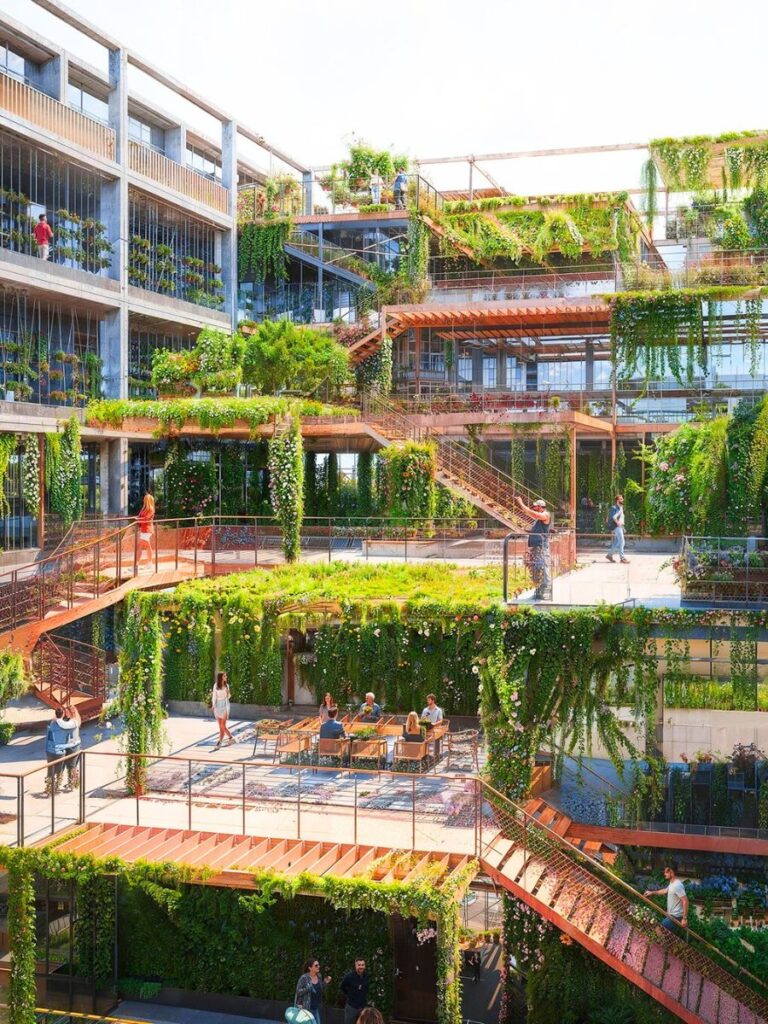
Vertical gardens and living architecture
As cities grow upward, nature is following.
Vertical gardens, green façades, and living walls are transforming buildings from inert surfaces into active participants in urban ecosystems. These structures regulate temperature, improve air quality, reduce noise, and visually soften hard skylines.
They also change how buildings are perceived.
A structure covered in greenery does not feel imposed. It feels integrated. It signals care, not conquest. Even a single green wall can psychologically offset the heaviness of surrounding concrete.
Urban architecture is no longer content with being efficient. It is learning to be kind.
Public space as mental infrastructure
Eco-friendly cities understand that sustainability is not only environmental. It is neurological.
Parks, plazas, waterfronts, and shaded walkways act as mental infrastructure. They offer pause in a culture addicted to motion. They provide unstructured space, which the human brain needs to recover from constant stimulation.
Cities that invest in walkability, seating, greenery, and silence are investing in public mental health.
Livability is not an abstract concept. It is how a city makes people feel at the end of the day.
The psychology of breathable cities
Research consistently shows that access to nature reduces anxiety, improves focus, and strengthens social bonds. When cities prioritize green space, residents are more likely to walk, interact, and feel a sense of belonging.
Eco-friendly urban design shifts the emotional tone of a city. It replaces vigilance with ease, isolation with encounter, exhaustion with restoration.
A city that breathes teaches its people to do the same.
Technology as support, not spectacle
Smart city technology plays a role, but its purpose is changing.
Sensors that manage traffic flow, lighting systems that respond to usage, and energy-efficient infrastructure now work quietly in the background. The goal is not to impress, but to support human life seamlessly.
The best urban technology is barely noticed. Its success is measured by comfort, not attention.
Where cities are headed next
The future city will not be defined by height, speed, or density alone. It will be defined by balance.
Urban spaces are learning to give back what they once took. Air, shade, silence, and connection are returning as core design principles. Nature is no longer treated as decoration. It is recognized as infrastructure.
Eco-friendly cities are not becoming rural. They are becoming humane.
And as they relearn how to breathe, the people within them are remembering how to live.