

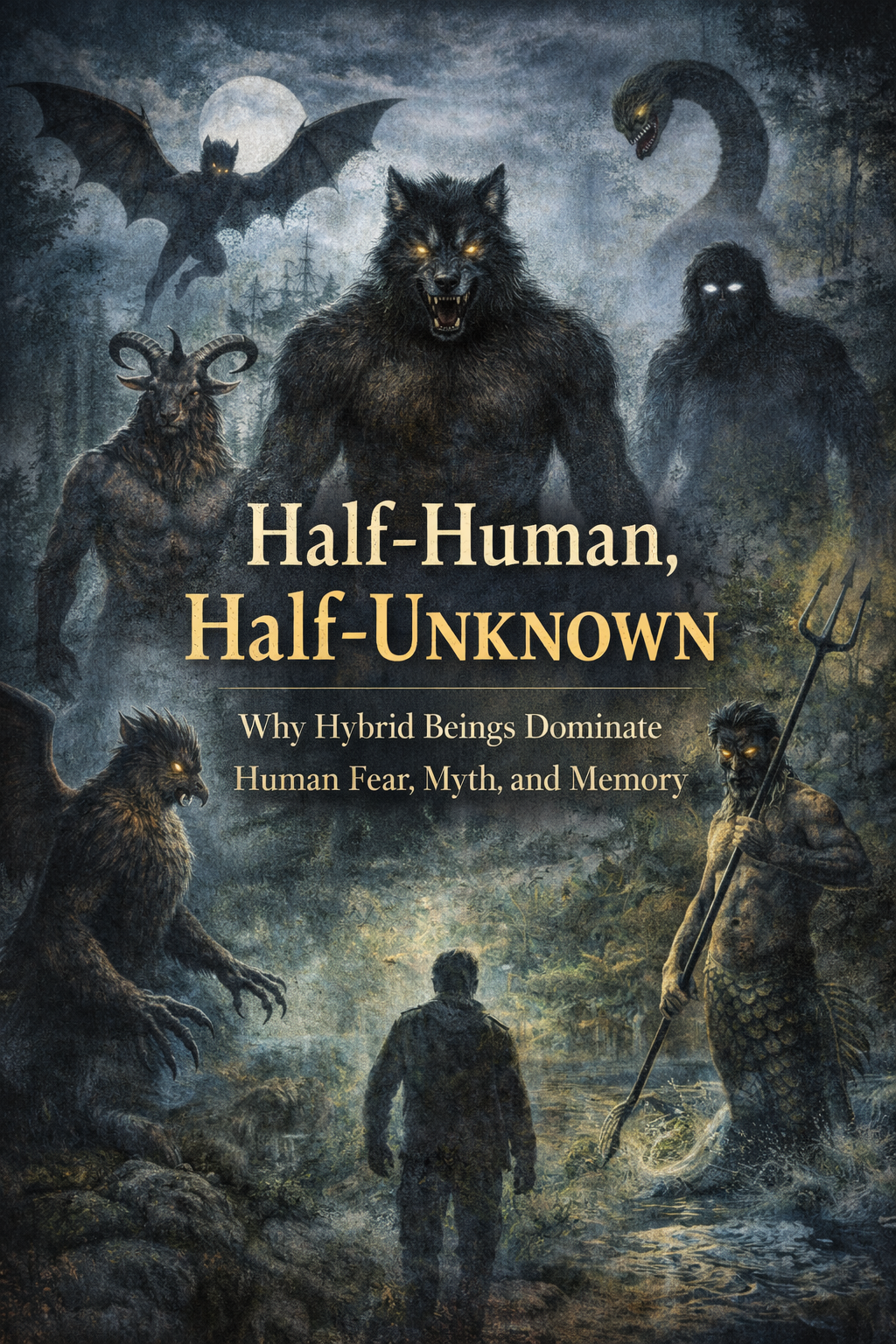
Why Hybrid Beings Dominate Human Fear, Myth, and Memory
Across every continent and nearly every era, humans have told stories of beings that are neither fully human nor fully animal. They walk upright but growl. They speak but do not belong. They think like us, yet move with instincts we fear. These hybrid creatures appear in ancient cave art, sacred texts, tribal lore, and modern cinema, repeating with uncanny persistence.
What is striking is not just their variety, but their consistency.
From wolf-men and serpent-bodied figures to bird-humans, goat-legged guardians, and ape-like watchers of the forest, the half-human, half-unknown form has haunted the human imagination longer than written language. Cultures separated by oceans and millennia invented remarkably similar beings, without contact, without exchange. This raises an unsettling question: why this form, again and again?
At its core, the hybrid creature exists at a boundary. Humans have always been creatures of thresholds, standing between instinct and reason, nature and civilization, survival and meaning. The animal represents raw force, hunger, sexuality, violence, freedom. The human represents order, language, morality, self-awareness. When the two merge, the result is deeply unsettling because it mirrors an internal conflict we never fully resolve.
These beings are rarely portrayed as purely evil or purely benevolent. Instead, they are unpredictable. They test travelers. Guard sacred places. Punish arrogance. Protect forests. Lure humans away from safety. Their danger lies not in their strength alone, but in their ambiguity. You cannot reason with them fully, nor fight them without consequence.
Psychologically, hybrid creatures may reflect humanity’s fear of losing control. To become part-animal is to surrender language, law, and identity. It is regression, but also liberation. That duality terrifies and fascinates. The hybrid stands as a warning: civilization is thin, and instinct waits just beneath it.
Anthropologists note that many of these beings appear during moments of transition. Adolescence. War. Exile. Wilderness journeys. Nighttime. They emerge where identity is unstable. In some cultures, encountering a half-human being marks a transformation, madness, enlightenment, or death. The creature is not just external, but symbolic of crossing a psychological threshold.
Yet symbolism alone does not explain everything.
Many legends describe these beings with anatomical detail, behavioral patterns, territories, and rules of engagement. They are said to avoid villages but observe them. They punish hunters who take too much. They react to disrespect of land. These are not random monsters, but consistent presences tied to ecosystems. Some researchers suggest these stories may preserve memories of encounters with now-extinct hominins or rare primate species. Others argue they encode environmental ethics, turning nature itself into a sentient guardian.
Still, the question remains: why half-human, not entirely other?
Because a fully alien creature can be dismissed. A fully animal one can be hunted. But a being that resembles us forces recognition. It confronts us with the possibility that humanity is not separate from nature, only temporarily elevated. The hybrid erases the comforting boundary that says “we are different.”
In modern culture, these figures persist because the fear persists. As technology accelerates and humans grow more detached from the natural world, the hybrid returns as a reminder of what we suppress. Films, books, and urban legends resurrect the same forms ancient people carved into stone. Different costumes, same anxiety.
The half-human, half-unknown creature dominates folklore because it represents the question humans avoid asking directly: what are we really, when stripped of comfort, law, and story?
These beings endure not because they are imagined monsters, but because they reflect something unresolved within us. They are mirrors made monstrous, standing at the edge of forests, myths, and memory, waiting for us to notice that the line between human and animal was never as clear as we hoped.