

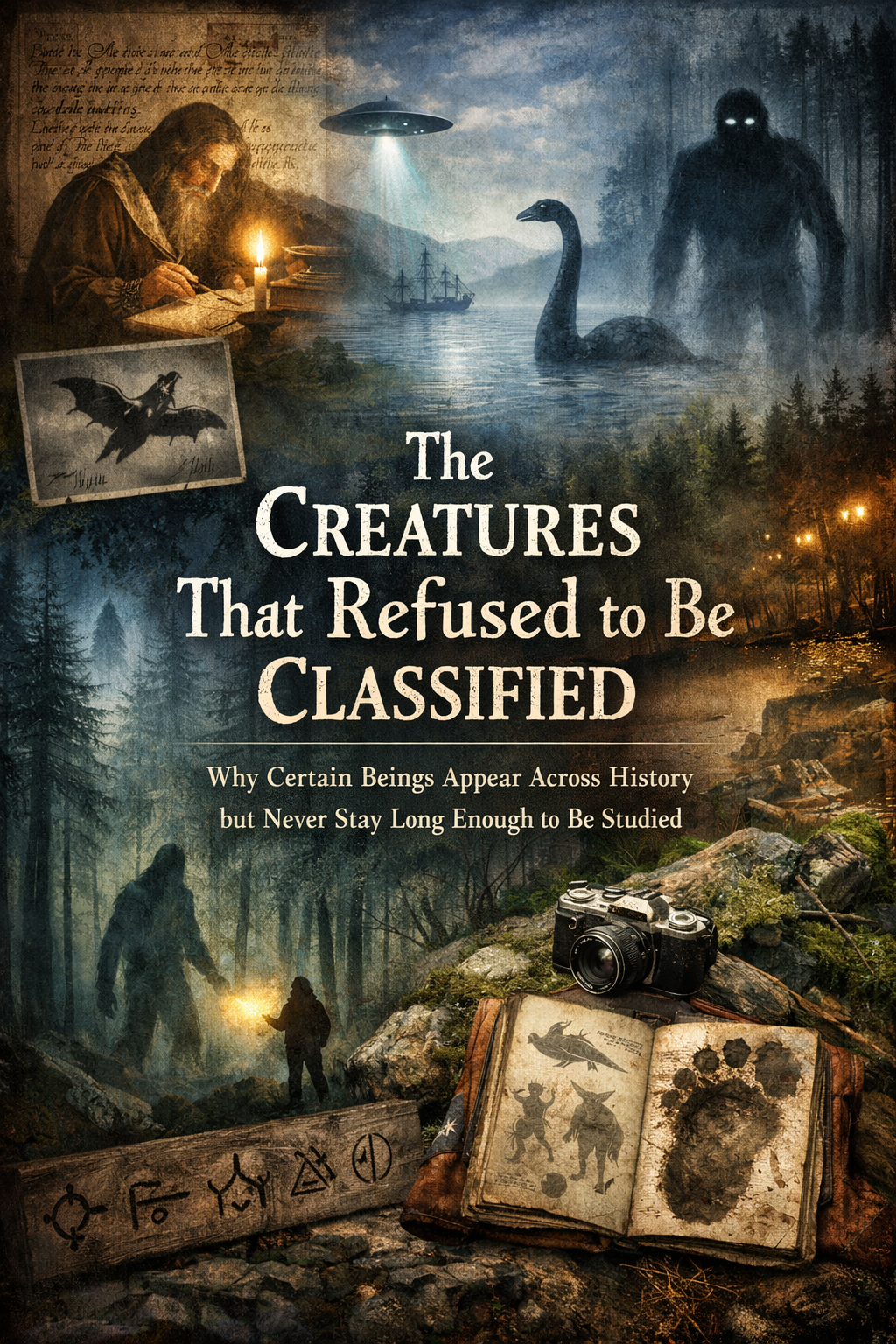
Why Certain Beings Appear Across History but Never Stay Long Enough to Be Studied
Throughout history, humans have cataloged almost everything they encounter. Plants were pressed into books. Animals were sketched, hunted, measured, named. Stars were mapped. Even invisible forces were given equations. Yet some beings have always slipped through this net. They appear, are witnessed, described with striking similarity across cultures, and then vanish again, leaving behind stories instead of specimens.
These are the creatures that refuse classification.
Ancient chronicles speak of them without hesitation. Medieval monks wrote about them in margins of manuscripts. Sailors recorded them in logbooks alongside wind speeds and cargo lists. Indigenous oral histories describe them with precision and restraint, not fantasy. And in modern times, they reappear in eyewitness reports, grainy footage, and sudden encounters that end before proof can be collected.
What makes these creatures remarkable is not just their mystery, but their consistency.
Across continents and centuries, descriptions echo each other. Large, upright beings seen at the edges of forests. Serpentine forms surfacing briefly in deep waters. Winged figures appearing at night near remote settlements. Humanoid shapes that move too fast, vanish too cleanly, or leave environments strangely altered. The names change. The traits do not.
Science struggles here not because of superstition, but because of method. To classify a creature, it must be repeatable, observable, and collectable. These beings defy all three. They appear rarely. They avoid prolonged contact. They leave behind no bones, no nests, no reliable biological traces. They behave less like animals and more like events.
This raises an uncomfortable question. What if not all phenomena are meant to persist?
Many of these creatures appear in liminal spaces, forests at dusk, waters at depth, borders between civilizations, moments of environmental or psychological transition. They emerge when human presence is thin or distracted. They disappear the moment attention sharpens. Cameras malfunction. Sound cuts out. Witnesses feel watched rather than threatened. Time feels distorted. These patterns are reported again and again, even by people who have never read about similar encounters.
Some researchers argue that these beings are undiscovered species, extremely rare, highly intelligent, and evolutionarily adapted to avoid humans. Others suggest neurological explanations, the brain filling gaps under stress or isolation. But neither theory fully explains why the stories align so closely across cultures that never interacted, or why witnesses often describe the same emotions rather than the same details: awe, confusion, silence, restraint.
There is also the question of why classification itself might be the wrong goal.
Human knowledge systems are built to label and contain. A thing is real if it can be measured, stored, repeated. But history reminds us that many realities were once dismissed simply because they did not fit existing frameworks. Meteorites were called superstition. Germs were invisible nonsense. Continental drift was mocked. The refusal to classify is often less about lack of evidence and more about discomfort with uncertainty.
Some anthropologists suggest that these creatures persist not as biological entities, but as recurring symbols tied to human perception. Others propose that they represent encounters with environments themselves, forests, oceans, night skies, manifesting in forms the human mind can register. In this view, the creature is not separate from nature but an expression of it.
Yet even this explanation does not account for the physical interactions sometimes reported. Footprints. Broken branches. Disturbed water. Radar anomalies. Electromagnetic interference. The evidence is always incomplete, but never entirely absent.
Perhaps the reason these creatures repeat through history is because they occupy a category we have not yet named. Not myth. Not animal. Not hallucination. Something that exists at the edge of human systems of knowing.
And perhaps they never stay long enough to be studied because studying is not the kind of relationship they allow.
In a world obsessed with definition, these beings remain undefined. They remind us that mystery is not a failure of knowledge, but a boundary. Some things endure precisely because they cannot be pinned down. They survive not in cages or textbooks, but in the shared human experience of encountering something that refuses to explain itself.
And maybe that refusal is the point.