
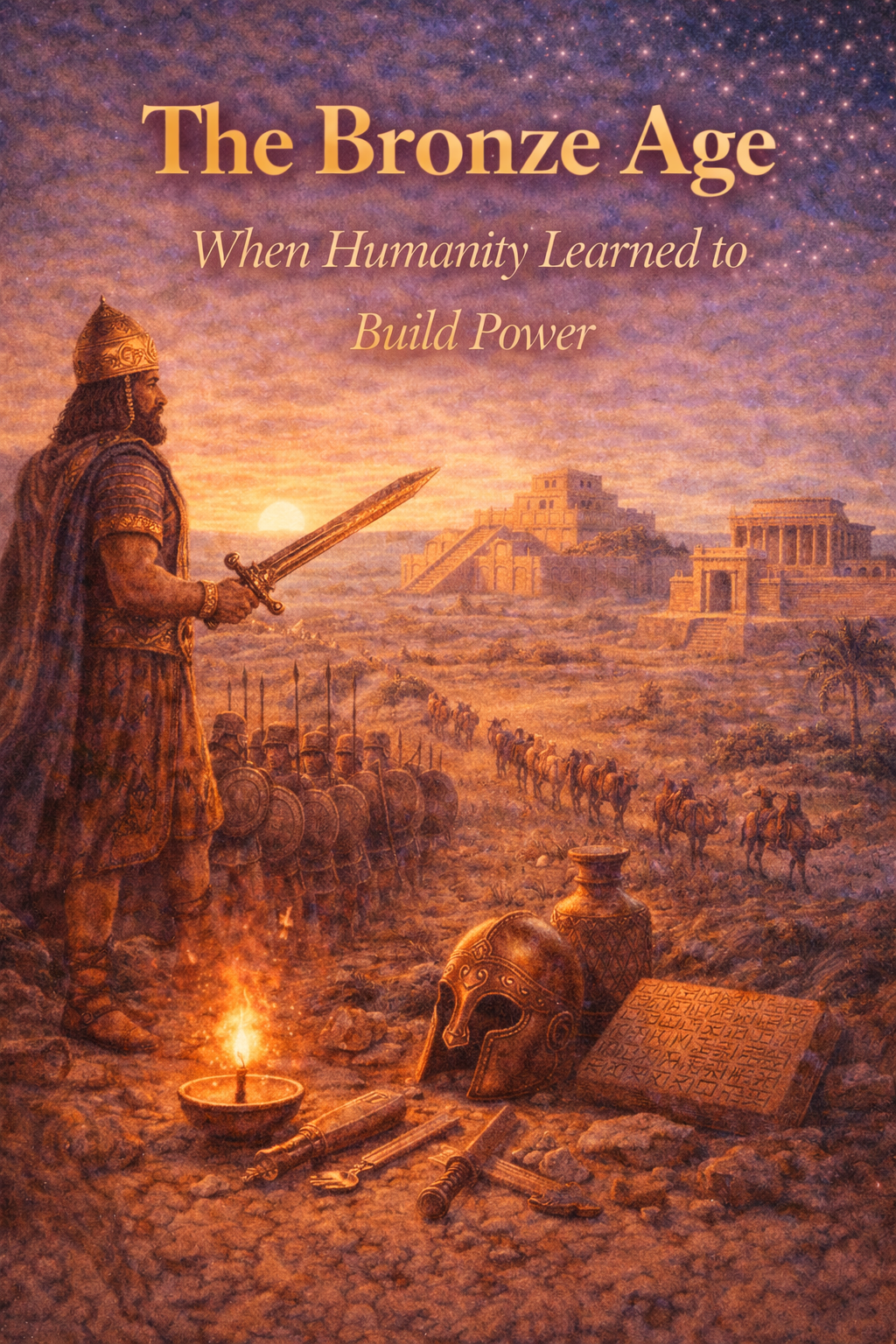
The Bronze Age marks one of the most decisive turning points in human history. It was the moment when humans moved beyond survival and experimentation and began to organize power, knowledge, and society on an entirely new level. If the Stone Age was about learning to shape tools, the Bronze Age was about learning to shape civilization itself.
This was the age when humanity discovered that progress could be engineered.
What Was the Bronze Age?
The Bronze Age began around 3300 BCE and lasted until approximately 1200 BCE, varying by region. It is defined by the discovery and widespread use of bronze, an alloy made by combining copper and tin.
This was more than a technological improvement. It was a revolution.
Bronze was:
-
Stronger than stone
-
More durable than copper
-
Easier to shape consistently
This allowed humans to create better tools, weapons, and objects of status.
Why Bronze Changed Everything
Unlike stone, bronze required knowledge, resources, and coordination. Copper and tin were rarely found together, meaning trade networks became essential.
This led to:
-
Long-distance trade routes
-
Specialized labor
-
Wealth accumulation
-
Social hierarchy
For the first time, technology created inequality and power structures.
The Rise of Cities and States
The Bronze Age saw the emergence of organized cities, kingdoms, and early states. Agricultural surplus allowed people to specialize beyond farming.
Society expanded to include:
-
Rulers and administrators
-
Soldiers and weapon makers
-
Merchants and traders
-
Priests and scribes
Writing systems flourished during this time, not for art, but for record-keeping, taxation, and governance.
Civilizations of the Bronze Age
Some of the most influential early civilizations rose during the Bronze Age.
In Mesopotamia, city-states like Ur and Babylon developed legal codes, mathematics, and astronomy.
In Ancient Egypt, centralized power, monumental architecture, and divine kingship defined society.
In the Indus Valley, cities displayed advanced urban planning, sanitation systems, and standardized measurements.
These civilizations did not simply exist. They administered, recorded, and controlled.
Warfare and Authority
Bronze transformed warfare. Weapons became sharper, deadlier, and symbolic of power. Armies became organized, and warfare shifted from survival conflict to territorial dominance.
With weapons came authority.
Kings, rulers, and elites justified power through:
-
Military strength
-
Control of resources
-
Religious legitimacy
The Bronze Age introduced the idea that power could be inherited, defended, and expanded.
Religion, Art, and Identity
Bronze Age societies developed complex religious systems. Gods were associated with natural forces, fertility, war, and kingship. Temples became centers of both worship and economic activity.
Art flourished in metalwork, sculpture, and jewelry, often reflecting social status and belief systems. Identity became tied not just to tribe, but to city, ruler, and class.
The Fragility of Complexity
Despite its achievements, the Bronze Age was fragile. Around 1200 BCE, many Bronze Age civilizations collapsed almost simultaneously, a phenomenon known as the Bronze Age Collapse.
Possible causes include:
-
Climate change
-
Trade disruption
-
Invasions
-
Internal rebellion
This collapse revealed a truth humanity would learn repeatedly: complex systems bring great power, but also great vulnerability.
Who “Invented” the Bronze Age?
No one invented the Bronze Age.
It emerged when humans discovered how to combine materials and organize societies around that knowledge. The people living in it did not know they were in an “age.” They were simply pushing the limits of what was possible.
Why the Bronze Age Still Matters
The Bronze Age matters because it introduced:
-
Organized government
-
Written law
-
International trade
-
Social hierarchy
-
Large-scale warfare
It was the foundation upon which later civilizations were built.
The Age of Structure
The Bronze Age was the moment humanity learned that progress could be planned, controlled, and scaled. It was the age when tools became systems and survival became civilization.
Everything that followed, empires, laws, cities, economies, traces its roots back to bronze.