

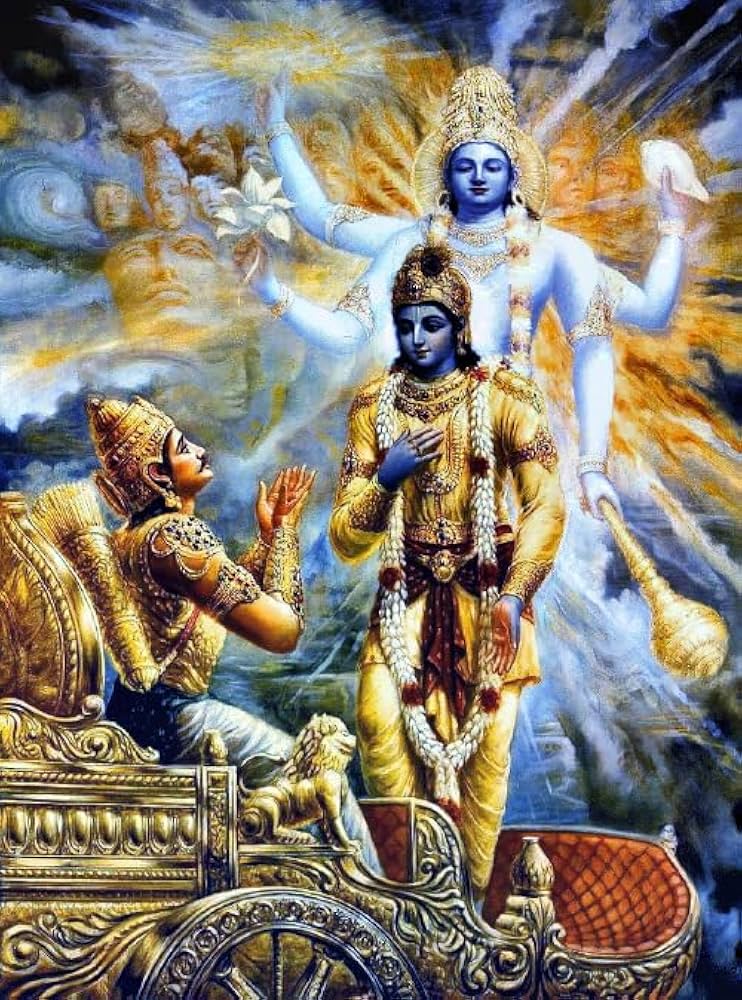
Mahabharata is one of the longest and most complex epics ever written, a vast narrative that refuses simplicity. Composed over centuries in ancient India, it is not merely a story of kings and battles, but a profound exploration of human life itself. Within its thousands of verses, duty collides with desire, morality fractures under pressure, and destiny unfolds in ways that are never clean or comforting. The Mahabharata does not offer a world divided neatly into good and evil. It presents a universe where every choice carries consequence and every virtue casts a shadow.
At the center of the epic lies a dynastic conflict between two branches of the same royal family, the Pandavas and the Kauravas. Their struggle for the throne leads inevitably to the great war of Kurukshetra. Yet the Mahabharata makes it clear from the beginning that this war is not born solely from ambition. It grows out of jealousy, pride, resentment, loyalty, love, and deeply personal wounds. Chaos emerges not as an accident, but as the natural result of unresolved human conflict.
Dharma as a shifting and painful obligation
The Mahabharata revolves around the concept of dharma, often translated as duty, law, or moral order. But dharma in this epic is never simple. What is right in one moment becomes wrong in another. Loyalty to family clashes with loyalty to justice. Truth conflicts with compassion. Characters are constantly forced to choose between competing duties, knowing that no option is free of guilt. The epic’s greatness lies in its refusal to offer clear answers. It shows that morality is lived, not declared.
Yudhishthira, the eldest Pandava, embodies this struggle most clearly. Devoted to truth and righteousness, he is also capable of devastating mistakes. His obsession with duty leads him to gamble away his kingdom, his brothers, and even his wife. Through him, the Mahabharata exposes how virtue, when rigid and unexamined, can become destructive.
Krishna and the paradox of divine guidance
At the heart of the epic stands Krishna, both divine guide and deeply involved participant. He does not remove suffering or prevent war. Instead, he explains it. In the Bhagavad Gita, one of the most influential philosophical texts in history, Krishna speaks to the warrior Arjuna on the battlefield. Arjuna is paralyzed by moral anguish, unable to fight against his own kin. Krishna’s response does not deny the horror of war, but reframes it. He teaches that action must be taken without attachment to outcome, that one must fulfill one’s duty without clinging to reward or fear.
This teaching is unsettling. It asks humans to act decisively in a morally broken world, accepting responsibility without illusion. Krishna does not promise that doing one’s duty will feel good. He promises only that refusing responsibility will deepen chaos.
War as tragedy, not triumph
When the war finally comes, it is catastrophic. Nearly every major character dies. Victory brings no joy, only devastation and grief. The Mahabharata lingers on the cost of violence, the widows left behind, the extinction of entire lineages. There is no celebration of conquest. The epic insists that even justified wars destroy more than they resolve. Fate may be fulfilled, but the price is unbearable.
Destiny woven with human choice
One of the Mahabharata’s most powerful insights is that destiny does not erase responsibility. Characters often believe events are preordained, yet they are still judged by the choices they make. Fate creates the stage, but humans write their lines. This tension between destiny and free will gives the epic its philosophical depth. Life is neither fully controlled nor fully chaotic. It is shaped through participation.
Why the Mahabharata still matters
The Mahabharata endures because it understands the world as it is, not as we wish it to be. It accepts contradiction. It allows heroes to fail, villains to speak truth, and gods to act ambiguously. In doing so, it reflects the moral complexity of real life. Duty is never pure. Order is born from chaos. Destiny unfolds through flawed hands.
Rather than offering comfort, the Mahabharata offers clarity. It tells us that living ethically is not about certainty, but about engagement. To act, to choose, and to accept the weight of those choices is the true burden of being human.