
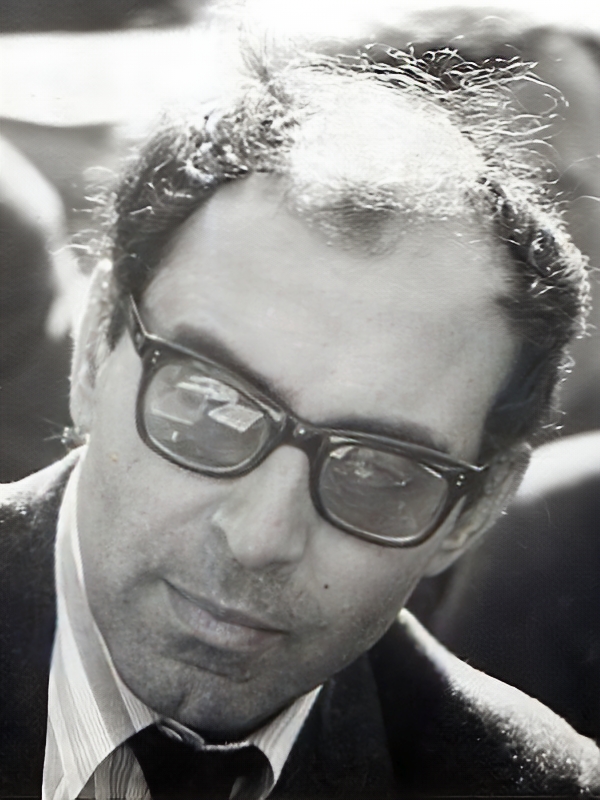
Jean-Luc Godard did not want cinema to behave. He wanted it to think.
Born in Paris in 1930, Godard emerged as the most disruptive force of the French New Wave, a movement that refused the polished conventions of traditional filmmaking. Where classical cinema sought smoothness, Godard introduced rupture. Where stories aimed for illusion, he exposed the mechanics behind the image. Film, for him, was not escape. It was interrogation.
Godard began as a critic before becoming a director, writing fiercely about cinema as both art and ideology. When he picked up a camera, he treated it like a pen. His early films shattered expectations with jump cuts, fragmented narratives, direct addresses to the audience, and characters who quoted philosophy as easily as they smoked cigarettes. Nothing was sacred. Everything was up for revision.
With works like Breathless, Godard rewired the grammar of film. Continuity no longer mattered. Meaning could be built from collision rather than flow. A scene could contradict itself. Sound could argue with image. Silence could speak louder than dialogue. Godard showed that cinema did not have to pretend to be real in order to reveal truth.
Politics entered his work not as slogans, but as structure. He questioned consumer culture, capitalism, war, colonialism, and the manipulation of images long before media saturation became the norm. In his films, characters are often aware they are being filmed, reminding viewers that images are never neutral. To watch a Godard film is to be made conscious of watching itself.
As his career progressed, Godard became even more radical. He abandoned traditional storytelling almost entirely, experimenting with essay films, video, sound collage, and dense philosophical montage. These later works are demanding, sometimes frustrating, but intentionally so. Godard believed cinema should not comfort the viewer. It should provoke awareness.
Godard’s influence on global cinema is immeasurable. Independent filmmakers, experimental artists, and even mainstream directors continue to borrow from his language of disruption. Yet imitation was never his goal. Godard resisted becoming a style. He preferred to remain a question.
Jean-Luc Godard treated cinema as a living argument, one that evolves, contradicts itself, and refuses closure. He proved that film could be poetry, philosophy, protest, and self-critique all at once.
In breaking cinema apart, Godard gave it new life.