

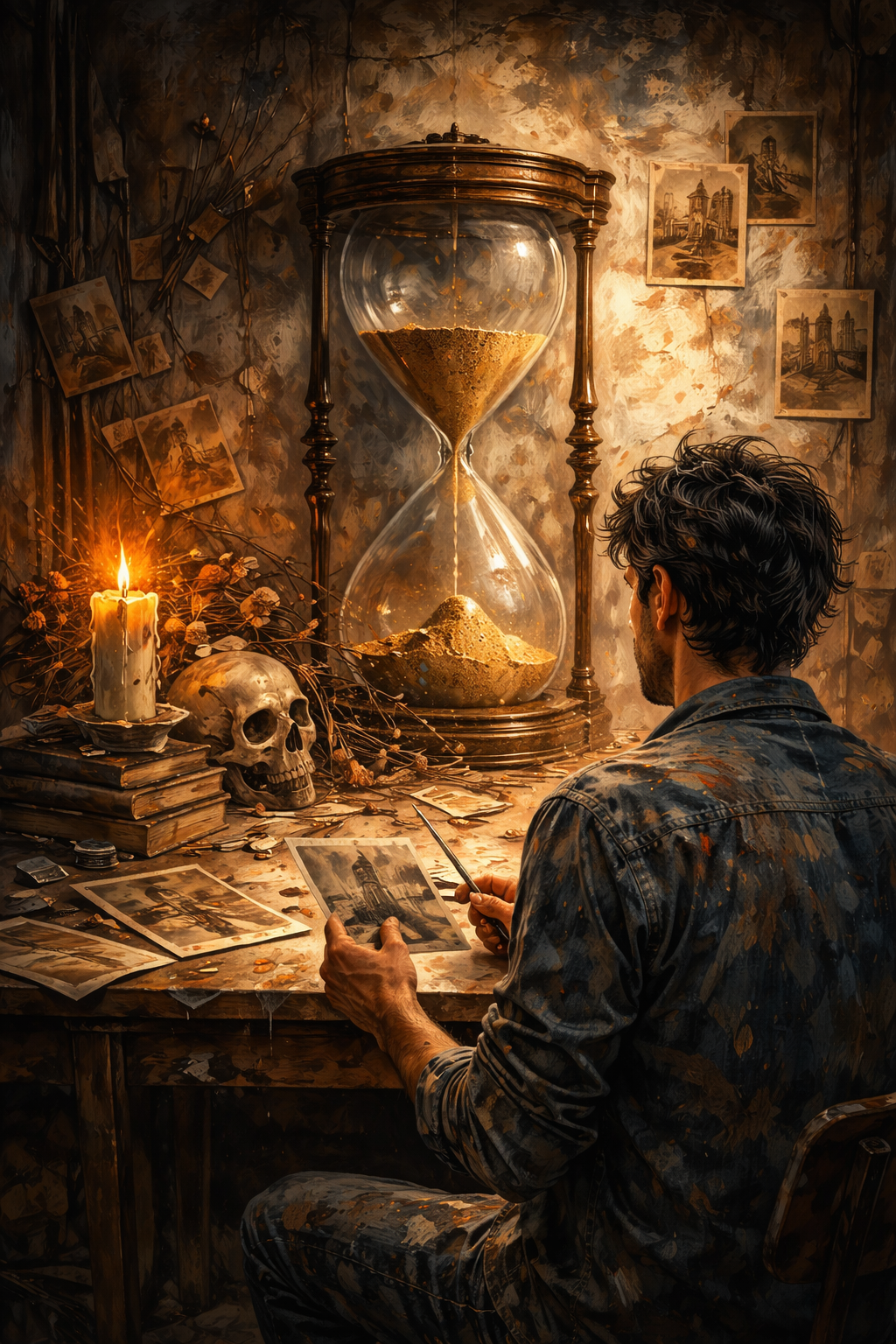
Across centuries and cultures, artists keep returning to the same quiet obsessions: time passing, memories fading, and things falling apart. Paint cracks. Bodies age. Buildings erode. Stories are forgotten or rewritten. This fixation is not accidental, nor is it simply aesthetic. It comes from art’s deepest function: to witness what cannot be stopped.
Artists don’t try to defeat time.
They try to make it visible.
Time Is the One Force No One Escapes
Time governs everything human. Creation, growth, love, loss, death. Artists are acutely aware of this because making art itself is an act against disappearance. Every artwork says, in some form: this moment mattered enough to be held.
Art exists because time erases.
Without impermanence, there would be little need to record, reflect, or preserve.
Memory Is Fragile and Unreliable
Memory is not a stable archive. It shifts, distorts, and fades. Artists are drawn to memory because it reveals how truth is shaped by emotion rather than accuracy. A memory is not what happened. It is what remains.
Art becomes a second memory.
Paintings, films, photographs, music, and stories act as external storage for feelings the mind can’t hold forever.
Decay Reveals Truth
Decay strips away illusion. When something deteriorates, its structure becomes visible. Cracks expose layers. Rust shows age. Silence reveals absence. Artists are fascinated by decay because it reveals reality without decoration.
Decay is honesty without language.
It shows what time does when no one intervenes.
Art as Resistance to Forgetting
Artists often work against forgetting, not by freezing time, but by acknowledging its movement. A portrait is not an attempt to keep someone young forever. It is an admission that youth passes.
Art says: this existed.
That acknowledgment itself is an act of resistance.
Why Beauty and Ruin Are So Close
There is a reason ruins feel beautiful. They carry evidence of life, effort, and collapse at once. Artists recognize that beauty often emerges where permanence fails.
Perfection feels sterile.
Imperfection feels human.
Decay adds emotional weight.
The Artist as Witness
Artists often see themselves as witnesses rather than controllers. They observe cycles: creation, use, decline, disappearance. By documenting these cycles, they give meaning to transition.
Time becomes subject, not enemy.
Mortality Drives Creation
Awareness of death sharpens perception. Artists feel this intensely. The knowledge that life is finite makes moments urgent. Details matter more. Expression becomes necessary.
Art is urgency translated into form.
Modern Obsession With Preservation
In a digital age obsessed with archiving everything, artists increasingly explore loss and decay as counterpoints. When nothing is allowed to disappear, meaning flattens.
Artists remind us that forgetting is part of being human.
Without loss, memory loses depth.
Personal History Becomes Universal
Artists often start with time and memory because they are personal. Childhood, aging parents, broken relationships, vanished places. But when translated into art, these experiences become universal.
Everyone understands time passing.
Everyone recognizes decay.
Why This Obsession Never Ends
Every generation believes it is living through unprecedented change. Artists respond by anchoring experience to time and memory, asking what survives transformation.
The question beneath the obsession is always the same:
What remains when everything moves on?
Art Doesn’t Stop Time, It Speaks to It
Art cannot halt decay. It cannot preserve life indefinitely. What it can do is create dialogue with impermanence. It can slow perception. It can deepen attention.
Artists don’t fight time.
They converse with it.
And in doing so, they give fleeting moments a second life, not by denying decay, but by honoring it.


5xwb2h