
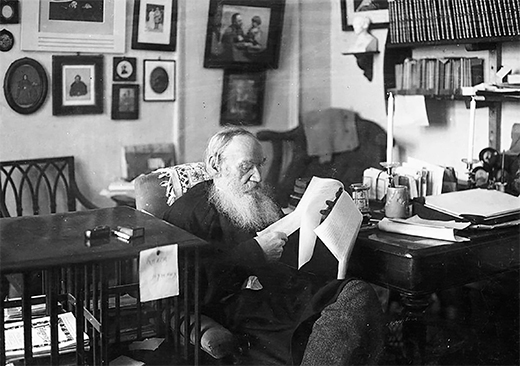
Leo Tolstoy did not write to entertain. He wrote to interrogate life itself.
Born in 1828 at his family estate of Yasnaya Polyana in Russia, Tolstoy became one of the greatest novelists in history, yet his ambition reached far beyond literary mastery. He sought truth. About love and death, war and peace, faith and doubt, power and conscience. His writing asks not how to live comfortably, but how to live honestly.
Tolstoy’s early success came with epic novels that reshaped what fiction could achieve. War and Peace is not merely a historical novel. It is a vast meditation on fate, free will, history, and the inner lives of ordinary people caught in extraordinary events. Anna Karenina, equally monumental, turns inward, exposing the emotional and moral tensions beneath society’s polished surface. Through intimate detail and psychological depth, Tolstoy revealed how private choices ripple outward into tragedy.
What makes Tolstoy enduring is not scale, but precision. He wrote with radical empathy. Peasants, aristocrats, soldiers, women, children, the faithful and the lost, all are treated with equal seriousness. He believed that every human life contained moral weight and narrative dignity. Nothing was too small to matter.
Later in life, Tolstoy underwent a profound spiritual crisis. Fame, wealth, and literary success no longer satisfied him. He rejected institutional religion, questioned private property, denounced violence, and embraced a philosophy rooted in simplicity, nonviolence, and moral responsibility. This transformation reshaped his writing, turning it increasingly toward essays, parables, and social critique.
Tolstoy’s ideas influenced figures far beyond literature. His writings on nonviolence and conscience shaped thinkers and activists around the world, proving that a novelist’s influence could reach into politics, ethics, and daily life. He believed that art should serve humanity, not ego, and that its highest purpose was moral awakening.
Yet Tolstoy was never simple. He lived in constant contradiction, torn between ideals and desire, discipline and doubt. This tension gives his work its power. He did not present himself as enlightened. He presented himself as searching.
Leo Tolstoy left behind more than masterpieces. He left a challenge. To examine our lives without illusion. To question authority without cruelty. To choose compassion over comfort.
His writing endures because it refuses to let us look away.