

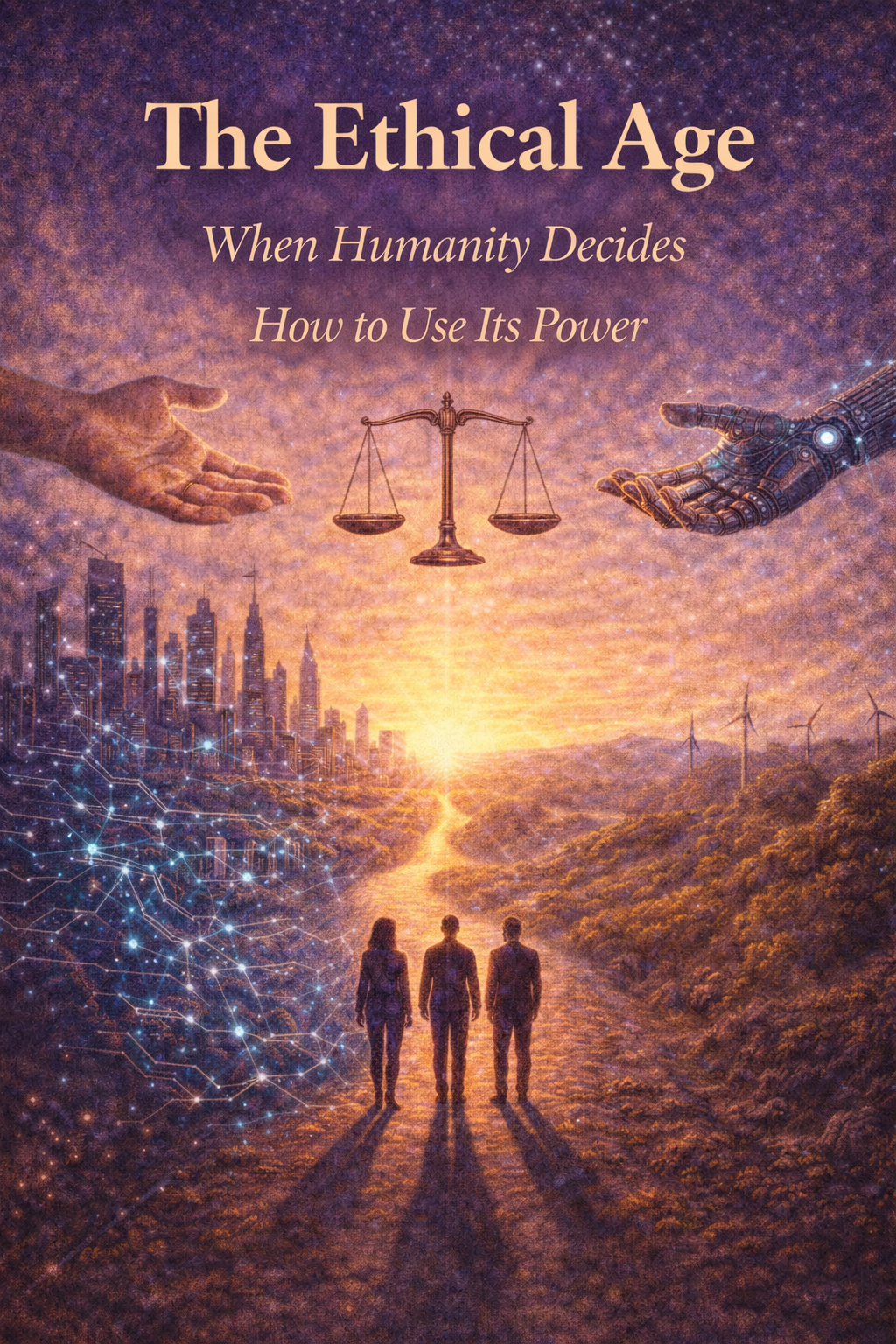
Every age gives humanity new abilities. Few ages ask humanity how to use them responsibly. The Ethical Age emerges not from invention, but from consequence. It is the moment when progress becomes so powerful that it demands moral direction.
If the Digital Age connected the world and the post-digital future amplifies intelligence, the Ethical Age asks a harder question: just because we can, should we?
What Is the Ethical Age?
The Ethical Age is not marked by machines, materials, or speed. It is defined by choice. It begins when societies recognize that technological capability without ethical frameworks leads to instability, inequality, and loss of meaning.
This age centers on:
-
Responsibility over efficiency
-
Values over acceleration
-
Human dignity over optimization
The Ethical Age is not anti-technology. It is human-centered.
Why the Ethical Age Becomes Necessary
History shows a pattern: power arrives before wisdom.
Humanity learned to shape stone before it learned to govern violence. It learned to build machines before it learned to protect labor. It learned to connect minds digitally before it learned to protect truth.
As artificial intelligence, automation, genetic engineering, and predictive systems expand, consequences multiply faster than laws or customs can adapt.
The Ethical Age arises when delay becomes dangerous.
From Capability to Accountability
In previous ages, technology answered how. The Ethical Age answers who and why.
Key questions define this shift:
-
Who is accountable for automated decisions?
-
Who owns data, identity, and digital memory?
-
Who benefits from progress and who is excluded?
-
Who decides the limits of machine authority?
Ethics becomes infrastructure.
Ethics Beyond Philosophy
In the Ethical Age, morality is no longer abstract. It becomes operational.
Ethics is embedded into:
-
Algorithms
-
Corporate governance
-
Medical technology
-
Environmental policy
-
Education systems
Decisions once made by individuals now scale globally. Ethical design becomes as critical as technical design.
Human Worth in an Automated World
One of the central tensions of the Ethical Age is the question of value.
When machines outperform humans in speed, memory, and prediction, what defines human worth?
The Ethical Age insists that value is not productivity alone. It emphasizes:
-
Empathy
-
Creativity
-
Judgment
-
Responsibility
-
Meaning
Humans are not replaceable functions. They are moral agents.
Power, Inequality, and Justice
Unchecked technology amplifies inequality. The Ethical Age confronts this directly.
Access to intelligence, healthcare, education, and opportunity becomes a moral issue, not just an economic one. Ethical frameworks aim to ensure that progress does not concentrate power while eroding dignity.
Justice becomes a technological concern.
A Global Moral Conversation
Unlike previous ages, the Ethical Age cannot belong to one culture or nation. Technology crosses borders instantly. Ethics must do the same.
This age requires:
-
Cross-cultural dialogue
-
Global standards
-
Shared responsibility
-
Collective restraint
Ethics becomes humanity’s common language.
Who Begins the Ethical Age?
No single inventor, leader, or institution begins it.
The Ethical Age begins when societies collectively decide that restraint is not weakness, and that wisdom is as valuable as innovation.
It begins in classrooms, boardrooms, laboratories, and daily choices.
Why the Ethical Age Will Define the Future
Technology will continue to advance whether ethics keep pace or not. The Ethical Age determines whether that future is humane.
This age does not promise perfection. It promises intention.
It recognizes that progress without conscience leads to collapse, and that the most advanced civilization is not the fastest, but the most responsible.
The Age of Choosing
The Ethical Age is the first age where humanity must consciously guide itself.
It is an age not of invention, but of discernment.
And in that choice lies the future of civilization itself.