
The Stone Age is not just the beginning of history. It is the beginning of humanity itself. Long before cities, writing, or calendars, humans learned to survive, adapt, and imagine during a period that lasted millions of years. Everything that came after civilization rests on what was learned during this age.
The Stone Age is the story of becoming human.
What Was the Stone Age?
The Stone Age is the earliest and longest period of human history. It is defined by the use of stone tools, not because stone was the only material available, but because it endured.
Wood, bone, and plant fibers were used extensively, but stone survived time.
The Stone Age began roughly 3 million years ago and ended around 3000 BCE, when metal tools began to replace stone.
Why Stone Mattered
Stone could be shaped, sharpened, and reused. It allowed early humans to:
-
Hunt more effectively
-
Process food
-
Protect themselves
-
Build shelters
-
Create tools that extended the body
Stone tools were not primitive accidents. They required planning, skill, and knowledge passed down through generations.
This was the first form of technology.
The Three Phases of the Stone Age
The Stone Age is divided into three main phases, each representing a major shift in human development.
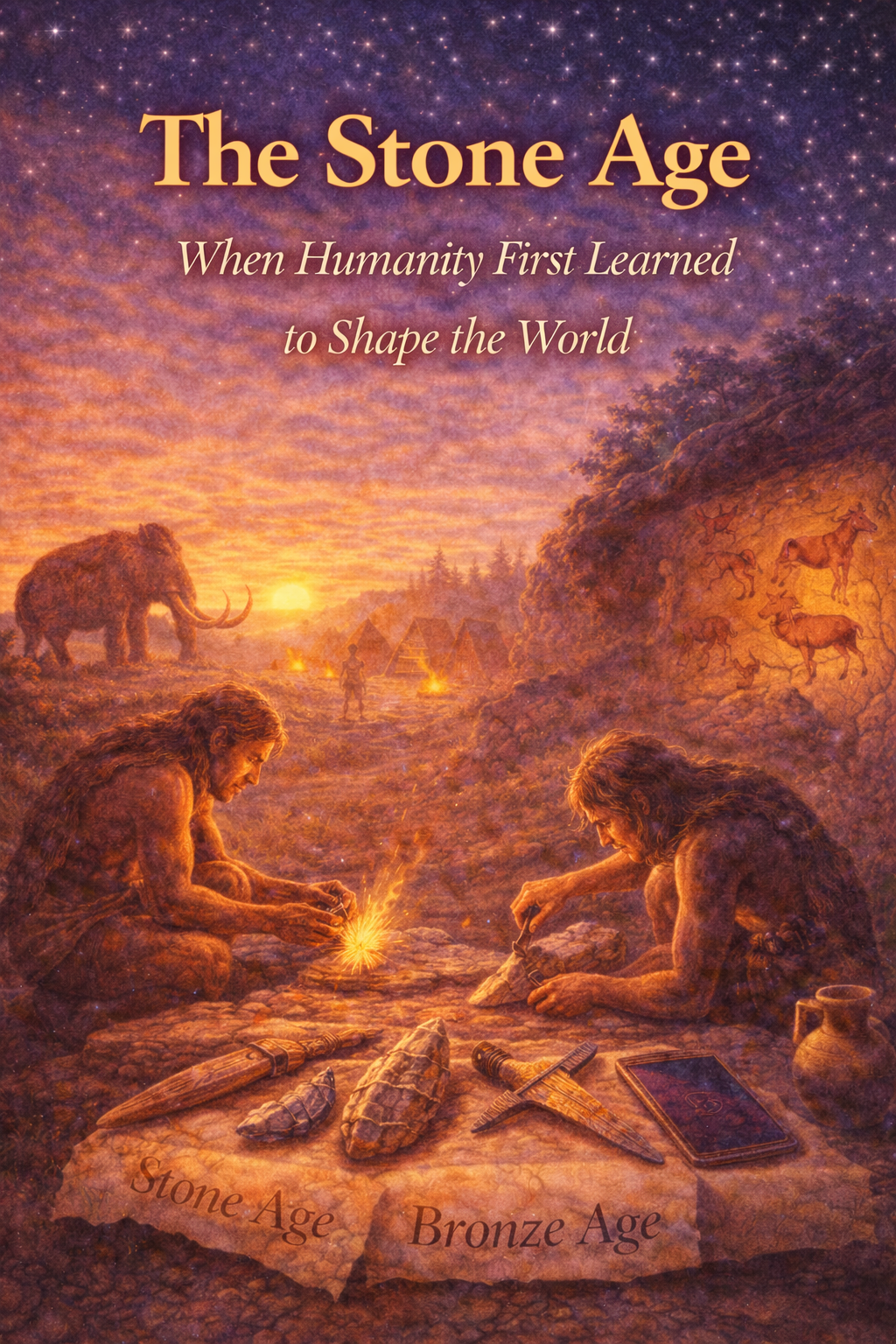
The Paleolithic period, or Old Stone Age, is when humans lived as hunter-gatherers. Survival depended on cooperation, mobility, and deep knowledge of the environment. This is when fire was mastered, language began to form, and art first appeared in caves and carvings.
The Mesolithic period marked a transition. As climates changed after the last Ice Age, humans adapted with new tools and strategies. Diets diversified, and semi-permanent settlements began to emerge.
The Neolithic period, or New Stone Age, transformed everything. Humans learned to farm, domesticate animals, and settle permanently. Villages formed, population grew, and social structures became more complex.
This shift laid the foundation for civilization.
Life in the Stone Age
Stone Age life was not simple or crude. It required intelligence, memory, creativity, and cooperation.
Early humans:
-
Understood seasonal patterns
-
Tracked animal behavior
-
Created symbolic art
-
Practiced rituals and burial customs
-
Shared knowledge through oral tradition
These behaviors reveal emotional depth and social awareness.
Stone Age humans were not waiting for civilization. They were building toward it.
Art, Symbolism, and Thought
Some of the earliest known art comes from the Stone Age. Cave paintings, carvings, and decorated tools show that early humans thought symbolically.
Art suggests:
-
Storytelling
-
Spiritual beliefs
-
Identity and community
-
A desire to record experience
This creative impulse is one of the strongest links between Stone Age humans and us.
Who “Invented” the Stone Age?
No one invented the Stone Age.
It is a label given much later by archaeologists to describe a vast span of time defined by tool use and human development. The people who lived during it did not know they were in an “age.” They simply lived.
The Stone Age is named not for what humans lacked, but for what they mastered.
Why the Stone Age Still Matters
The Stone Age matters because it shows how resilient and adaptive humans are. Every fundamental human behavior, cooperation, communication, creativity, and innovation, began here.
Modern technology may be faster, but the mindset that created it is ancient.
Understanding the Stone Age reminds us that progress is not sudden. It is layered, cumulative, and deeply human.
The First Chapter
The Stone Age is the longest chapter in the human story. It holds the moment when humans stopped simply reacting to the world and began shaping it.
Every city, every civilization, every invention carries the imprint of this age.
Before metal, before writing, before history, there was stone, and with it, the first spark of who we are.