

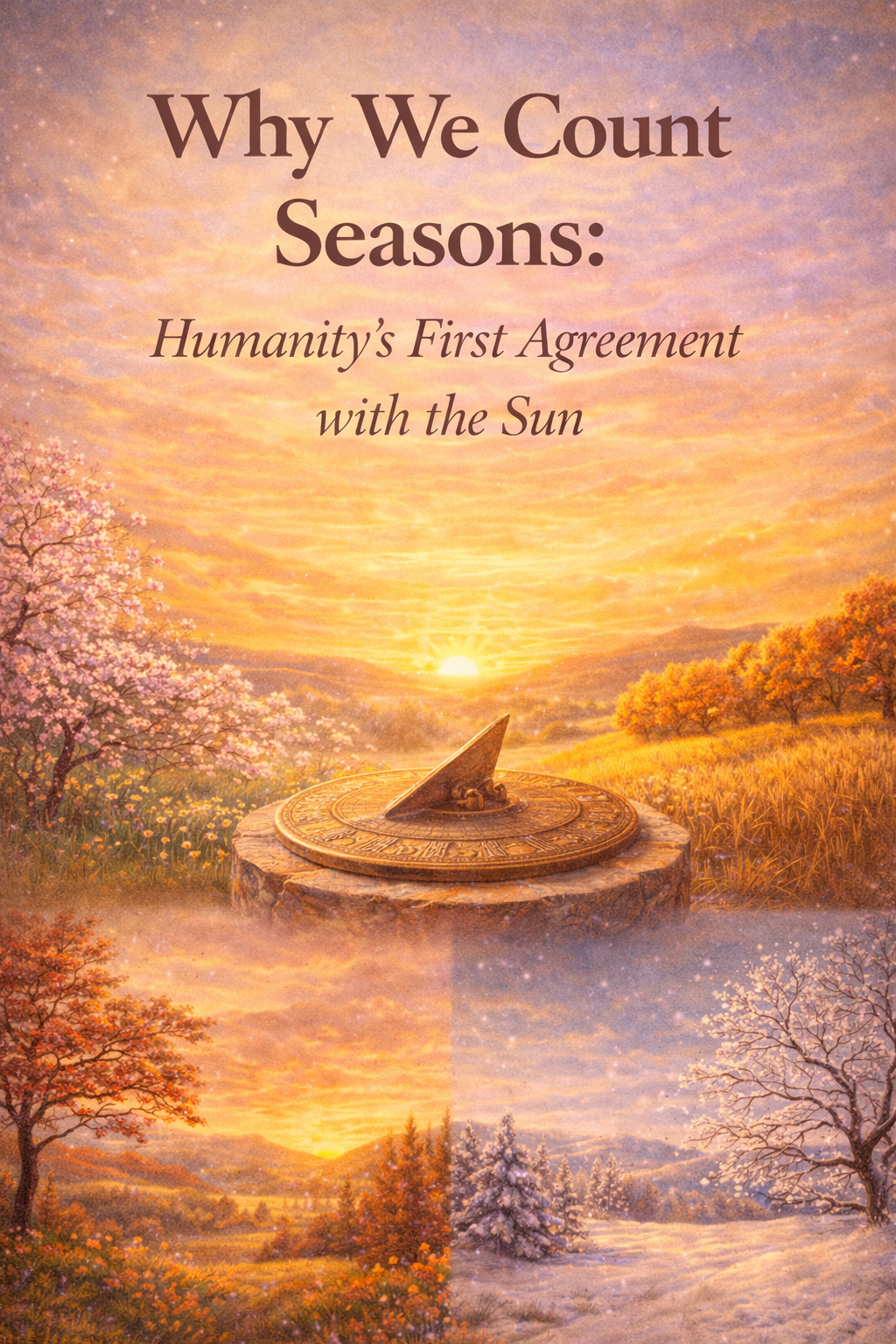
Before clocks, calendars, or written history, humans learned to read the Earth. Long before we counted years or months, we counted seasons. Not with numbers, but with instinct, survival, and sky-watching. Seasons are the oldest timekeeping system humanity ever used, and they remain one of the most powerful ways we understand the rhythm of life.
We count seasons because the planet moves, the Sun shifts, and life responds.
The Sky as the First Teacher
Seasons exist because Earth tilts on its axis as it orbits the Sun. This tilt changes how sunlight falls on different parts of the planet throughout the year, creating cycles of warmth, cold, growth, and rest.
Early humans did not know the physics, but they observed the effects:
-
Plants grew and died in patterns
-
Animals migrated and returned
-
Weather followed repeating cycles
-
Food availability changed predictably
Recognizing these patterns was essential for survival.
The First Seasonal Awareness
The earliest humans, tens of thousands of years ago, tracked seasons instinctively. Hunter-gatherers followed animal migrations and plant cycles, moving with the land. Over time, they learned that the year had distinct phases.
Seasonal awareness came before agriculture, not after it.
When humans began farming around 10,000 BCE, seasonal knowledge became vital. Planting too early or harvesting too late could mean starvation. Seasons became a shared social truth.
Where Seasonal Systems First Formed
Some of the earliest organized seasonal systems emerged in ancient civilizations:
-
In Mesopotamia, people tracked flooding cycles of the Tigris and Euphrates rivers, linking seasons to agriculture and religious rituals.
-
In Ancient Egypt, seasons were defined by the Nile’s flooding, which determined planting and harvest.
-
In Ancient China, seasons were closely tied to philosophy, medicine, and balance, forming the foundation of traditional Chinese cosmology.
These civilizations didn’t invent seasons. They formalized them.
The Four-Season Model
The familiar four-season system, spring, summer, autumn, and winter, developed most clearly in temperate regions where seasonal contrast was strong.
Ancient Greek philosophers were among the first to describe the seasons as a structured cycle tied to the Sun’s path. They connected seasons to balance, health, and human temperament.
Later, Roman thinkers integrated seasons into calendars, festivals, and civic life, embedding them into Western timekeeping.
Who “Discovered” the Seasons?
No single person discovered seasons.
Seasons were noticed, named, and agreed upon collectively over thousands of years. They are the result of shared observation, passed down through generations.
In this sense, seasons are one of humanity’s first scientific collaborations.
Seasons Beyond Timekeeping
Seasons became more than survival tools. They shaped:
-
Mythology and gods
-
Religious festivals
-
Art and poetry
-
Emotional symbolism
Spring became rebirth.
Summer became vitality.
Autumn became harvest and reflection.
Winter became rest and endurance.
These meanings still influence how we feel today.
Why We Still Count Seasons
In a modern world dominated by digital time, seasons remain deeply human because they are felt, not measured.
We count seasons because:
-
Our bodies respond to light and temperature
-
Agriculture still depends on them
-
Culture and emotion follow their rhythm
-
They remind us that life moves in cycles, not straight lines
Seasons are Earth’s way of teaching patience, timing, and balance.
A Living System
Unlike hours or minutes, seasons cannot be rushed or paused. They arrive when they are ready and leave when their purpose is complete.
When we count seasons, we are not just marking time. We are acknowledging our place inside a much older, ongoing story, one written by the Sun, the Earth, and every generation that learned to listen.


Anyone else tried 289winbet? I’m thinking of depositing a small amount to test the waters. Any experiences to share? 289winbet
As I website owner I believe the content material here is real excellent, thanks for your efforts.
I truly appreciate your work, Great post.