
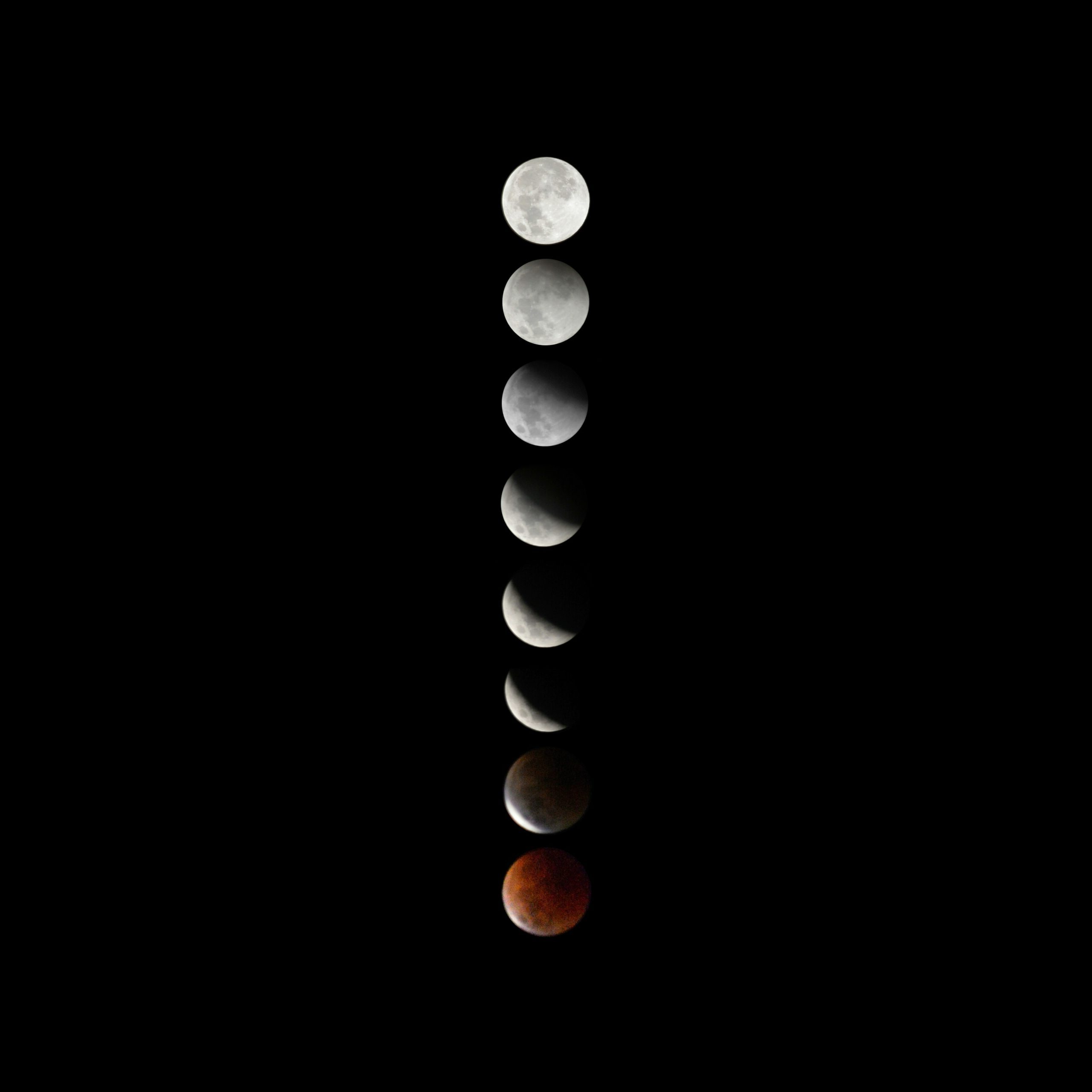
A lunar eclipse feels less like an event and more like a slow, deliberate ritual. Nothing suddenly vanishes. Nothing explodes. Instead, Earth quietly steps between the Sun and the Moon, and our own shadow begins to move across the lunar surface, turning a familiar object into something ancient and ceremonial.
Unlike solar eclipses, which demand special glasses and precise locations, lunar eclipses are generous. Anyone on the night side of Earth can witness them. The Moon remains safe to observe with the naked eye, inviting us to watch as it gradually darkens, then transforms into shades of copper, rust, and deep crimson.
This color shift is why lunar eclipses are often called “blood moons,” though the name is more poetic than ominous. The red glow comes from sunlight filtering through Earth’s atmosphere. Our planet scatters blue light and bends red wavelengths toward the Moon, bathing it in the same tones that color our sunsets. In a strange way, the Moon glows with Earth’s atmosphere, a reflection of ourselves projected into space.
There are three types of lunar eclipses, each with its own character. A penumbral eclipse is subtle, almost shy, with the Moon dimming slightly as it passes through Earth’s outer shadow. A partial lunar eclipse takes a more dramatic turn, with a visible shadow creeping across the Moon’s face. A total lunar eclipse is the most striking, when the Moon is fully immersed in Earth’s shadow and glows red for an extended period, often for over an hour.
Historically, lunar eclipses carried weight. They appeared in ancient texts, myths, and calendars, often linked to change, endings, or revelations. Unlike solar eclipses, which inspired fear, lunar eclipses tended to feel introspective. The Moon, long associated with emotion, cycles, and femininity, slipping into shadow felt symbolic rather than threatening.
Scientifically, lunar eclipses help astronomers study Earth’s atmosphere. By analyzing the color and brightness of the eclipsed Moon, scientists can learn about volcanic activity, atmospheric particles, and even long-term climate patterns. The Moon becomes a screen onto which Earth quietly projects its condition.
What makes lunar eclipses especially compelling today is their pace. They ask us to slow down. To sit, to watch, to notice subtle changes. In a world built on urgency, a lunar eclipse unfolds on its own schedule, indifferent to our notifications and deadlines.
A lunar eclipse reminds us that shadows are not always about disappearance. Sometimes they are about depth, texture, and perspective. The Moon does not vanish. It reveals another version of itself, one shaped by Earth, light, and time.