
A solar eclipse is the universe practicing restraint. No explosion, no thunder, no collapse. Just a quiet, precise alignment where the Moon drifts perfectly between Earth and the Sun and, for a few surreal minutes, rewrites daylight.
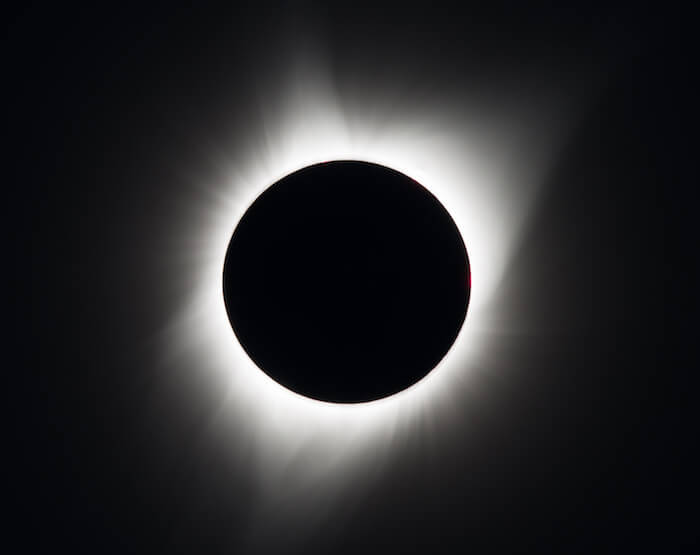
In that moment, time feels edited. The air cools. Colors thin out. Birds hesitate. Shadows sharpen into strange crescents. The Sun, usually impossible to look at directly, reveals its hidden halo, the corona, a luminous crown that seems almost intentional, as if the universe planned a private viewing.
Solar eclipses happen because of an extraordinary coincidence. The Sun is about 400 times larger than the Moon, yet also about 400 times farther away. From Earth, they appear nearly the same size, allowing the Moon to cover the Sun with uncanny precision. It is a cosmic balancing act so exact it feels designed rather than accidental.
There are different kinds of solar eclipses, each with its own mood. A partial eclipse is subtle, like the Sun taking a bite out of itself. An annular eclipse leaves a glowing ring, a “ring of fire,” when the Moon is slightly too far away to fully cover the Sun. A total solar eclipse is the rarest and most transformative. Day collapses into twilight, stars appear, and the Sun’s corona blooms like silver silk in motion.
For centuries, eclipses unsettled civilizations. They were seen as omens, warnings, divine interventions. Kings feared them. Priests interpreted them. Today, science has replaced superstition, but the emotional response remains. Even when we understand the mechanics, standing beneath a darkened Sun still feels deeply personal, as if the sky chose you for a secret.
Scientifically, solar eclipses are invaluable. They allow astronomers to study the Sun’s corona, solar winds, and magnetic fields in ways that are otherwise impossible. Some of our greatest discoveries about solar physics were born during these brief windows of darkness.
Yet eclipses are not only about data. They are communal events. People travel thousands of miles to stand in the path of totality, sharing silence with strangers, watching the sky together. In an era of constant noise, a solar eclipse offers collective stillness.
A solar eclipse reminds us that the universe does not need to be loud to be powerful. Sometimes, all it takes is perfect alignment and the courage to dim the light, just long enough for us to notice what is usually hidden.