
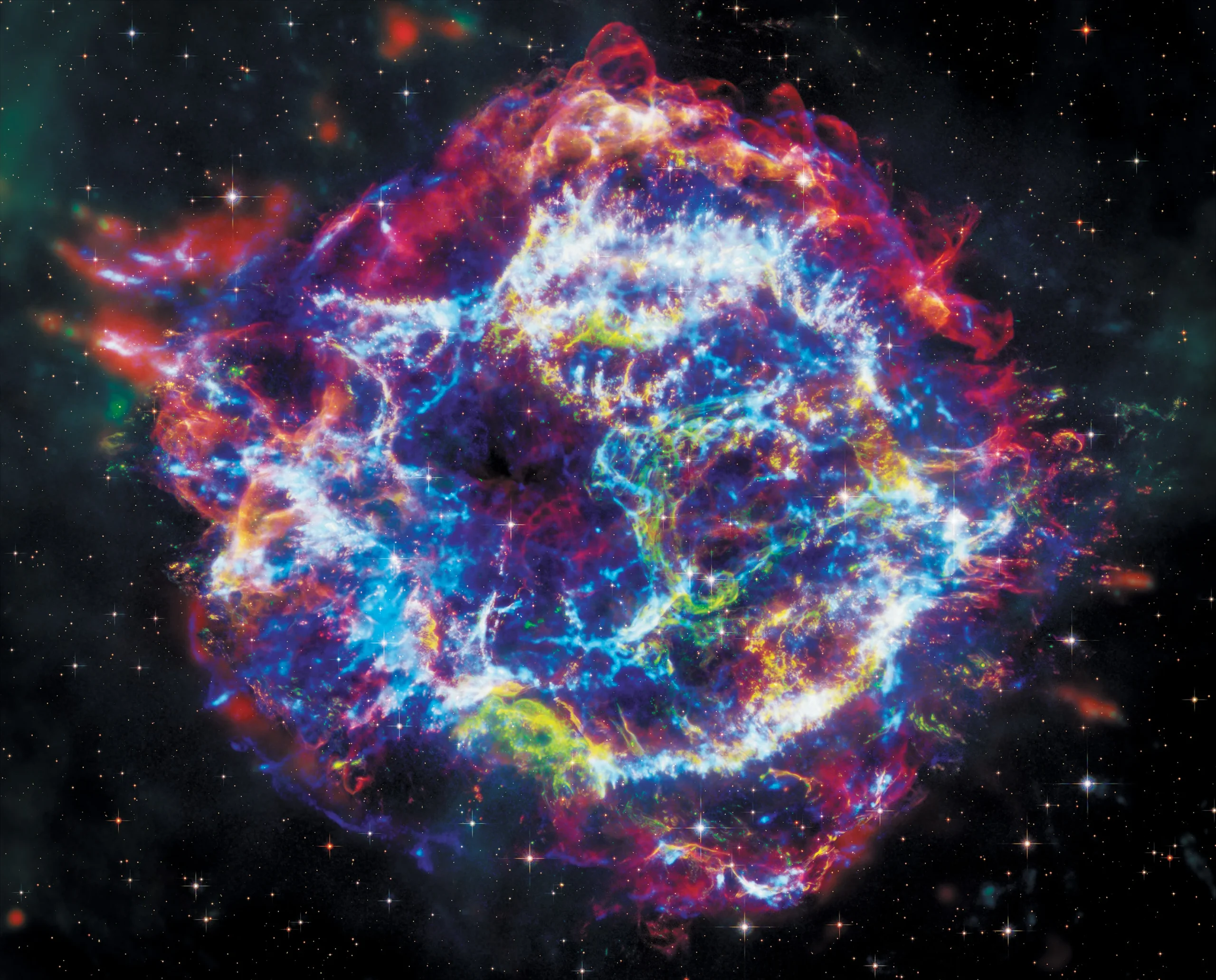
In the quiet ateliers of the cosmos, stars spend millions of years tailoring themselves. They stitch hydrogen into helium, pressure into light, gravity into balance. And then, one night in the universe’s calendar, the fitting ends. The star steps onto the grandest runway imaginable and becomes a supernova.
A supernova is not just an explosion. It is a cosmic statement piece. The death of a star so luminous it can briefly outshine an entire galaxy, throwing color, energy, and meaning across space like sequins under a spotlight. For a few weeks or months, this stellar finale becomes the brightest thing in the sky, a reminder that even in science, drama matters.
There are different ways a star can reach this final look. Some massive stars collapse under their own weight, their cores folding inward before rebounding in a violent release of energy. Others, smaller but no less ambitious, steal material from a neighboring star until they reach a breaking point and detonate in a perfect, catastrophic symmetry. Different origins, same result: brilliance born from collapse.
What makes supernovae truly glamorous is what they leave behind. Every element heavier than iron, gold in your jewelry, calcium in your bones, oxygen in your breath, was forged in these explosions. Supernovae are the universe’s master jewelers, scattering raw materials across galaxies so planets, oceans, and eventually life can form. Fashion may recycle trends, but the cosmos recycles stars.
Astronomers treat supernovae like rare couture collections. Each one is observed, measured, archived. Their light helps scientists calculate cosmic distances, map the expansion of the universe, and understand time itself. A single supernova can tell us how fast the universe is growing, and how it once looked billions of years ago. In that sense, it is both vintage and futuristic, an archival piece with forward vision.
There is also something deeply human about them. Supernovae remind us that endings are not failures. They are transformations. What collapses in one form returns in another, brighter, richer, more complex. The universe does not waste material or moments.
So the next time you look up at the night sky, remember: somewhere out there, a star is preparing its final appearance. No applause, no audience noise, just light traveling across time to reach us. A cosmic reminder that even destruction, when done with purpose, can be breathtakingly beautiful.