

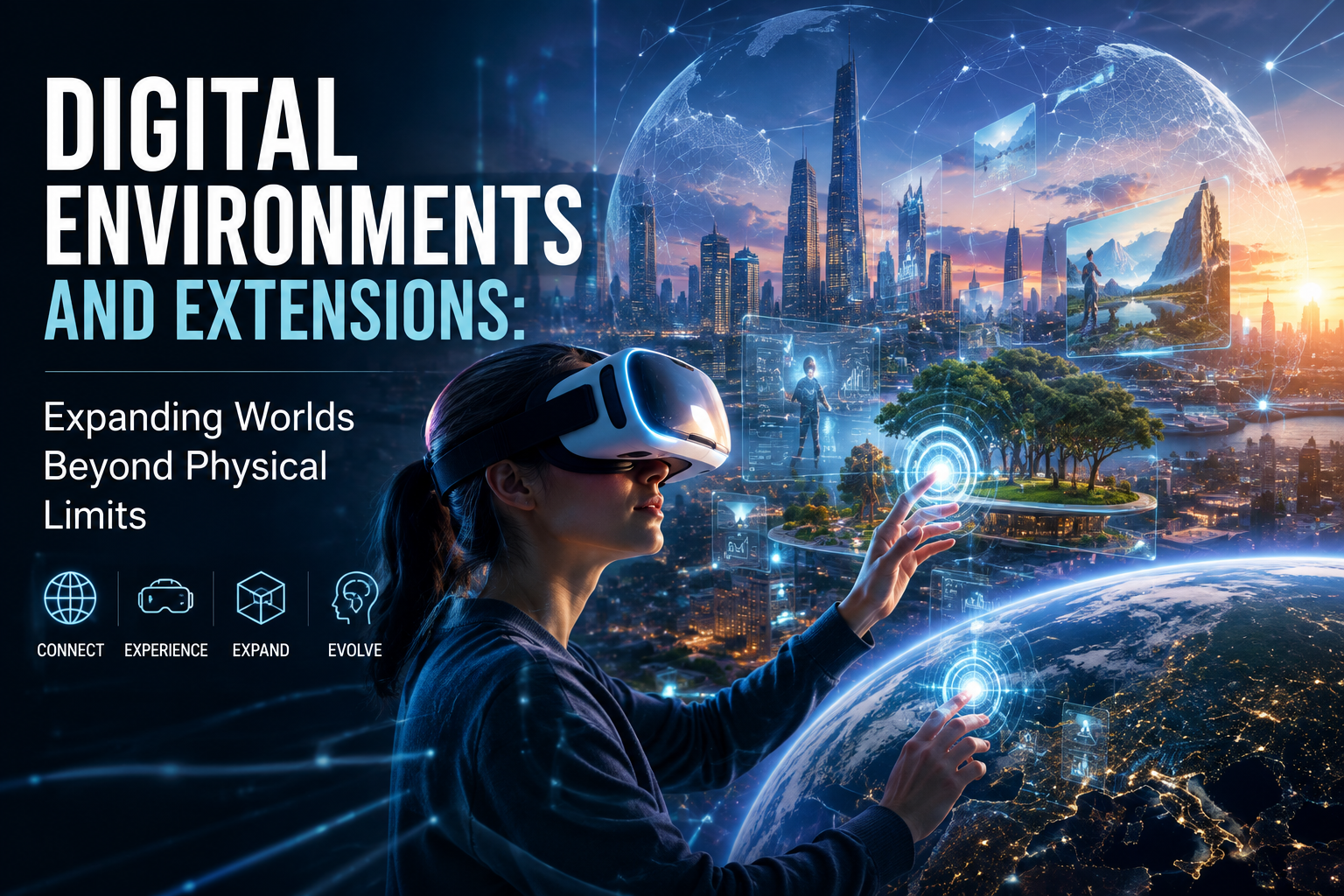
When audiences look at a vast city skyline, an endless battlefield, or a towering interior hall, they often assume they are seeing reality captured at scale. In truth, many of these spaces exist only partially or not at all. Digital environments and extensions allow filmmakers to expand physical locations into believable worlds that would be impossible, unsafe, or prohibitively expensive to build.
These digital spaces don’t replace reality. They complete it.
What Digital Environments Really Are
Digital environments are computer-generated spaces that either fully replace or extend real locations. Extensions add depth, scale, or detail to sets that physically exist only in part. A single wall becomes a palace. A small street becomes a metropolis. A few extras become a crowd of thousands.
The goal is not to impress the audience.
The goal is to make the world feel complete.
Why Physical Sets Are Never Enough
Practical sets are limited by budget, space, and logistics. Even large productions cannot build everything they imagine. Digital extensions allow filmmakers to dream beyond constraints while maintaining visual continuity with the real world.
This freedom expands storytelling possibilities.
It allows stories to exist at the scale they demand.
The Illusion of Continuity
The most important aspect of digital environments is integration. Lighting, texture, perspective, and camera movement must match the physical footage perfectly. If the transition between real and digital is noticeable, immersion breaks.
Seamlessness is success.
The audience should never question where reality ends and digital begins.
Extending Reality, Not Replacing It
Most digital environments begin with real footage. Photographs, scans, and reference materials inform digital construction. Real-world imperfections are intentionally preserved to avoid artificial perfection.
Dust, wear, irregular geometry, and uneven light make digital spaces believable.
Reality is messy. Digital worlds must be too.
Scale as Emotional Tool
Digital extensions are not just about size. They influence emotion. A character dwarfed by a massive environment feels vulnerable. A confined digital space feels oppressive. An endless horizon suggests freedom or isolation.
Environment becomes character.
The space shapes how the story is felt, not just where it occurs.
Camera Movement and Believability
Modern digital environments must respond to camera movement convincingly. Parallax, depth, and perspective shifts need to behave as they would in real space.
This requires careful planning before filming. Camera paths are designed with digital extensions in mind.
The environment moves with the story.
Time, Weather, and Impossible Conditions
Digital environments allow filmmakers to control time and weather. Day can become night. Storms can rise on command. Worlds can exist under impossible physical conditions.
These tools enhance mood without putting cast or crew at risk.
Nature becomes expressive rather than obstructive.
Invisible Storytelling
The best digital environments draw no attention to themselves. They exist to support story, not to dominate it. When audiences remember the emotion of a scene rather than the effect itself, the environment has done its job.
Spectacle is secondary.
Believability is everything.
Why Audiences Rarely Notice
When digital environments work, they feel natural. The brain accepts them as real because they follow the rules of light, space, and texture the brain expects.
Only failure is visible.
Success feels invisible.
The Evolution of Cinematic Space
Digital environments have quietly reshaped cinema. They allow intimate stories to exist in vast worlds and epic stories to remain grounded in realism.
They expand imagination without breaking trust.
The Quiet Expansion of Story Worlds
Digital environments and extensions are the architecture of modern cinema. They give stories room to breathe, worlds to exist, and emotion to resonate at scale.
They are not about replacing the physical world.
They are about extending it just far enough to let the story live fully.
And when done right, the audience never notices where reality ends.
They simply believe.
NY Glamour Recommends
“A carefully selected collection of products inspired by today’s story.”