
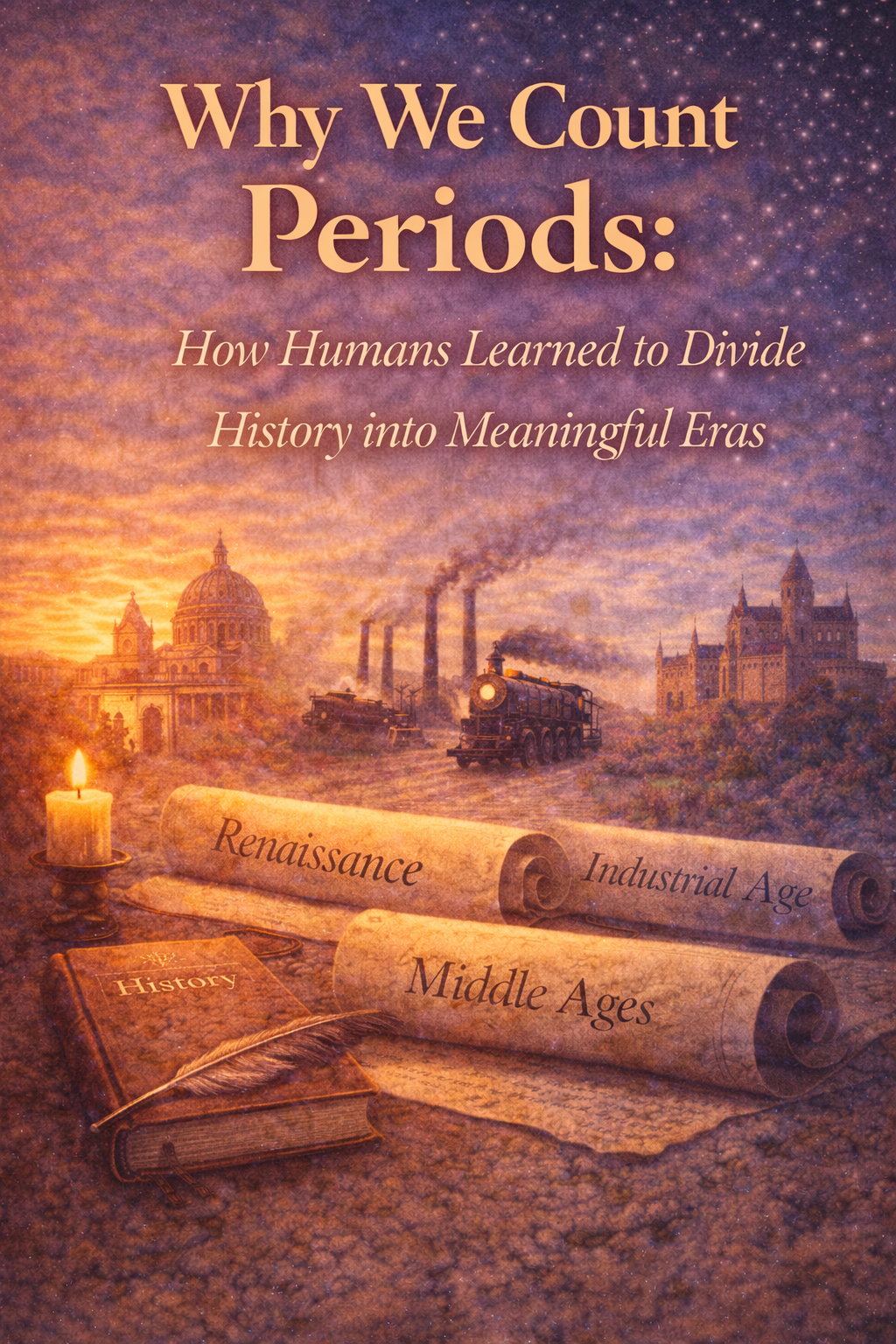
A period is not a number. It has no fixed length. It doesn’t follow the Sun, the Moon, or mathematics. And yet, periods are among the most powerful ways humans understand time.
We count periods because numbers alone cannot explain change.
Periods Are About Meaning, Not Measurement
Unlike days, years, or centuries, a period is defined by character, not duration. A period begins when something changes and ends when something else replaces it.
A period might last:
-
A few years
-
Several decades
-
Multiple centuries
What matters is not how long it lasts, but what defines it.
Periods help humans answer a deeper question:
What kind of time was this?
The Birth of Period Thinking
Early humans did not divide history into periods. They lived inside cycles and stories. Time was remembered as:
-
Before the great migration
-
During the age of the ancestors
-
After the war or flood
As writing developed and societies grew more complex, people needed a way to describe long stretches of shared experience. Periods emerged naturally as storytelling tools.
They allowed historians, philosophers, and artists to say:
“This time felt different from the one before.”
Historical Periods
As civilizations advanced, periods became essential for understanding history.
Examples include:
-
Ancient periods
-
Medieval periods
-
Industrial periods
-
Modern periods
Each one reflects:
-
Social structure
-
Technology
-
Belief systems
-
Power dynamics
-
Cultural values
Periods make history readable.
Without them, the past would feel like an endless list of events with no pattern.
Who Decides When a Period Begins or Ends?
No single person decides this in real time.
Periods are usually named after they are over, when enough distance exists to recognize a shift. Historians look back and identify moments when:
-
Old systems collapsed
-
New ideas emerged
-
Society changed direction
Periods are agreements made in hindsight.
Periods Beyond History
Periods are not limited to textbooks.
We use them in everyday life:
-
Creative periods
-
Healing periods
-
Transitional periods
-
Difficult periods
A period becomes a container for experience. It allows people to understand their lives not as chaos, but as chapters.
Periods and Human Psychology
Humans think in periods because they need emotional clarity.
Periods help us:
-
Process change
-
Create closure
-
Understand growth
-
Accept transformation
Saying “that was a period in my life” gives distance and meaning to experience.
Why Periods Matter More Than Ever
In the modern world, change happens fast. Technology, culture, and identity shift rapidly. Periods help slow our understanding of time.
They allow us to step back and say:
-
What era are we in?
-
What defines this moment?
-
What are we leaving behind?
Periods offer orientation in uncertainty.
Who Invented Periods?
No one invented periods.
They emerged because humans are storytellers. We don’t just want to know when something happened. We want to know what it meant.
Periods are how humanity turns time into narrative.
Time with a Soul
A period is time with personality.
It has a mood, a rhythm, and a memory. It captures not just events, but atmosphere. When we count periods, we are not measuring clocks. We are measuring human experience.
And that may be the most meaningful way to understand time at all.