
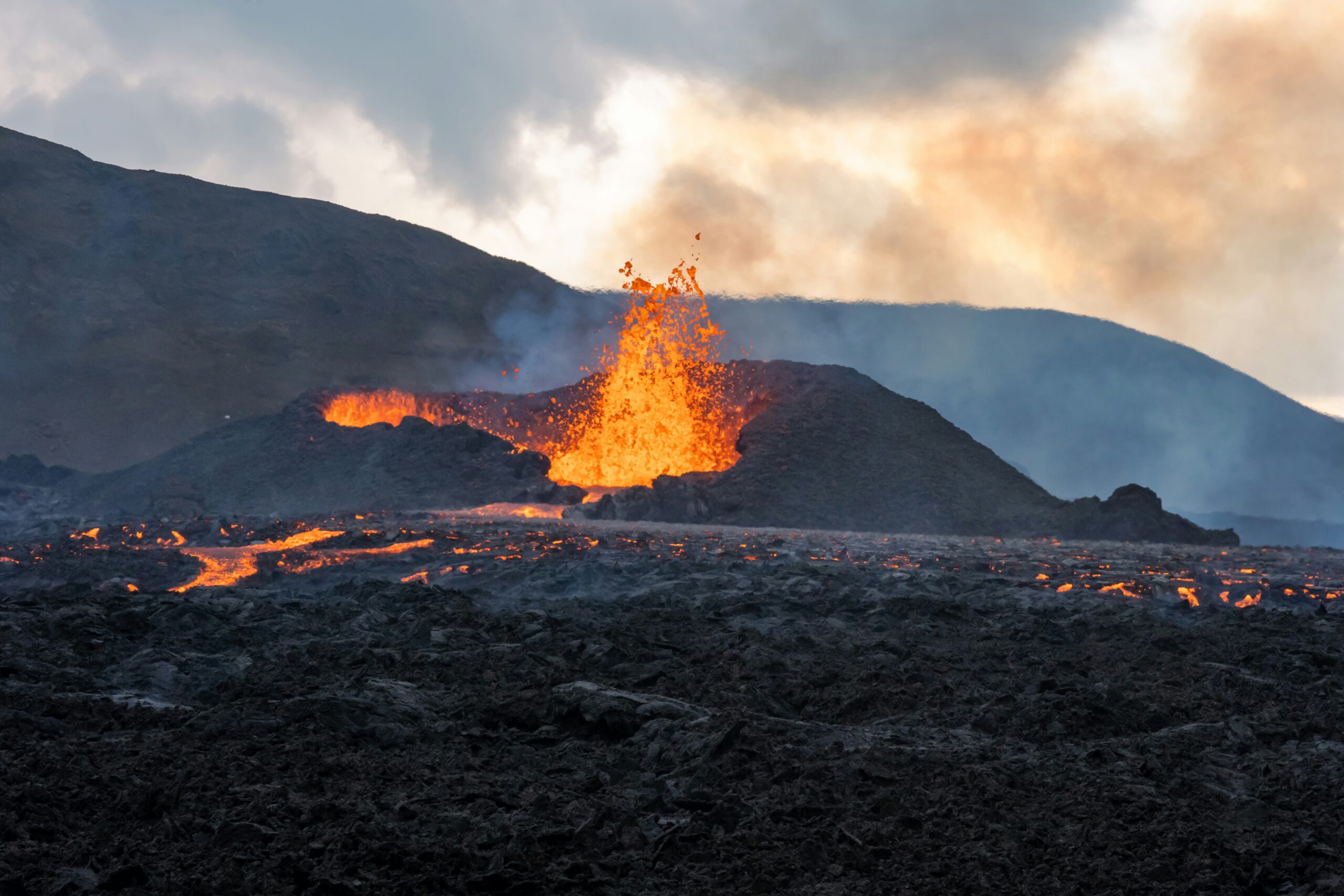
Deep beneath the Earth’s surface, far below our cities, farms, and oceans, there are sleeping giants. They don’t look like towering cones with glowing lava like in the movies. In fact, most of the time you wouldn’t even recognize them. They are called supervolcanoes, and if one of them woke up in a truly massive eruption, it could change life on Earth for years.
That sounds like science fiction—but it’s not. Supervolcano eruptions have happened in Earth’s past, and they could, in theory, happen again.
Let’s explore what a supervolcano is, what it could do to our planet, and why scientists study them so closely.
What is a supervolcano?
A “supervolcano” isn’t a specific official type like “shield volcano” or “stratovolcano.” It’s a term used to describe an eruption so large that it releases at least 1,000 cubic kilometers (about 240 cubic miles) of material—thousands of times more than a typical volcanic eruption.
Instead of a tall mountain, many supervolcanoes are giant underground magma systems with huge “calderas” (large depressions formed after past eruptions). One famous example is the Yellowstone Caldera in the United States. Another is the Toba caldera in Indonesia, which produced one of the largest eruptions known in the last 2 million years.
These systems can stay quiet for hundreds of thousands of years, slowly building pressure. Most of the time, they only release small eruptions or hot springs and geysers. But once in a very, very rare while, they can explode on a scale that affects the whole planet.
What happens during a supervolcano eruption?
A true super-eruption is not just “a big volcano.” It is a global event. Here’s what could happen:
-
Massive explosion and ash fall
-
A supervolcano could eject an enormous cloud of ash, rock, and gas high into the atmosphere.
-
Near the eruption site, everything could be buried under thick layers of ash. Buildings could collapse, crops would die, and breathing would be dangerous without protection.
-
Ash could travel thousands of kilometers, carried by the wind, dusting entire continents.
-
-
Volcanic winter
The most dangerous effect of a supervolcano is not just the lava or ash near the crater—but what happens to the climate.-
The eruption would release huge amounts of sulfur dioxide and fine ash into the stratosphere (the upper layer of the atmosphere).
-
These particles can reflect sunlight back into space.
-
Result: global temperatures could drop for months or even years. This is called a “volcanic winter.”
-
Even a smaller eruption like Mount Pinatubo in 1991 cooled the Earth by about 0.5°C for a couple of years. A super-eruption would be far stronger and could cause much more cooling worldwide.
-
Impact on agriculture and food supplies
Cooler temperatures, darker skies, and shorter growing seasons would be bad news for crops:-
Less sunlight = slower plant growth.
-
Colder temperatures and early frosts could damage harvests.
-
Some regions might experience several years of poor harvests or even crop failures.
-
That could lead to food shortages, higher prices, and pressure on governments and societies around the world.
-
Health and infrastructure problems
-
Volcanic ash is not like soft dust—it’s tiny, sharp pieces of rock and glass. It can damage lungs, especially in people with breathing problems.
-
Ash can clog engines, damage power plants, and contaminate water supplies.
-
Airports might shut down for weeks due to poor visibility and risk to aircraft engines.
-
Has this ever happened before?
Yes—Earth has experienced super-eruptions long before humans built cities and airplanes.
Some known examples from the past include:
-
Toba, Indonesia – erupted about 74,000 years ago.
-
Yellowstone (USA) – has had several massive eruptions over the past 2.1 million years.
-
Taupō (New Zealand) – produced very large eruptions tens of thousands of years ago.
Scientists study ash layers in rocks and ice cores from Antarctica and Greenland to understand how these eruptions affected climate. The evidence suggests they did cause significant cooling and environmental change—but life survived, and so did early humans.
How likely is a supervolcano eruption in our lifetime?
Here’s the good news: supervolcano eruptions are extremely rare. We’re talking about events that happen maybe once every 50,000 to 100,000 years or even less frequently, on average.
Yellowstone, for example, is carefully monitored by scientists:
-
They measure ground movement,
-
Track earthquakes in the area,
-
Study gas emissions and hot springs.
They have not found any sign that a super-eruption is close or “overdue.” The idea that Yellowstone is “ready to blow any day now” is more of a movie storyline than a scientific prediction.
So while it is true that such eruptions can happen again someday, it is very unlikely that one will happen in our own lifetime.
Why do scientists worry about supervolcanoes?
Even though they are rare, supervolcanoes are important to study because:
-
Global impact
Unlike a local flood or storm, a super-eruption could affect the entire planet’s climate and food systems. -
Preparedness
Understanding how much ash might fall, how the climate might change, and how food production could be affected helps governments and international organizations plan ahead:-
Emergency food reserves
-
International trade cooperation
-
Backup energy and transportation systems
-
-
Learning about Earth’s inner workings
Supervolcanoes are windows into the deep parts of our planet. Studying them helps scientists understand how magma moves, how continents evolve, and how Earth’s atmosphere has changed over millions of years.
Should we be afraid?
It’s natural to feel a bit nervous when you hear words like “supervolcano” and “global disaster.” But fear isn’t very helpful—knowledge is.
A few calming truths:
-
Super-eruptions are among the rarest natural events.
-
There is no evidence that any known supervolcano is about to erupt on a massive scale right now.
-
Modern science gives us tools to monitor volcanic activity far better than in the past.
-
The more we learn, the better we can prepare for all kinds of natural risks, from earthquakes and hurricanes to volcanic eruptions.
Instead of living in fear, it’s more useful to see supervolcanoes as a reminder of how powerful our planet is—and how important it is to respect nature, invest in science, and build strong, cooperative societies that can handle big challenges when they come.
Photo by Collin Ross on Unsplash