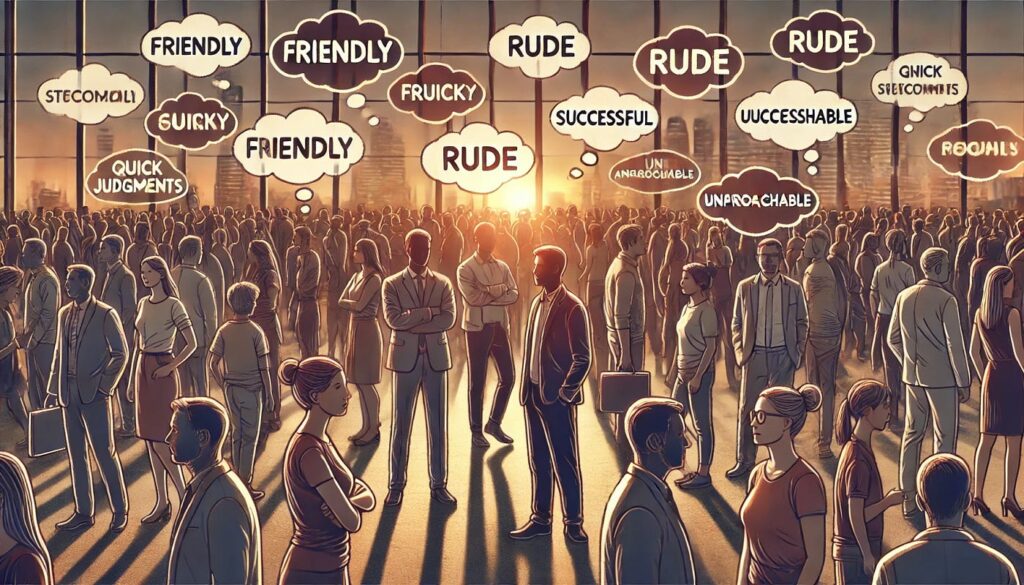

First impressions feel decisive. Immediate. Almost physical. You sense something about a person, a place, or an idea, and your mind rushes to label it. Safe or unsafe. Smart or shallow. Trustworthy or not.
That feeling of certainty is powerful.
It’s also misleading more often than we like to admit.
First impressions don’t reveal truth.
They reveal how fast the brain wants closure.
The Brain Is Built for Speed, Not Accuracy
First impressions come from mental shortcuts. The brain scans for familiar patterns and fills in gaps based on past experience. This is efficient, especially in situations that once involved real danger.
But speed is not precision.
The brain prefers quick coherence over slow accuracy. It would rather be confident than correct. What feels like intuition is often pattern-matching mixed with bias, habit, and projection.
Feeling right is not the same as being right.
Confidence Is Not a Reliable Signal
One reason first impressions are trusted is because they arrive with confidence. There’s no hesitation. No ambiguity. Just a clean judgment.
But confidence is not evidence.
People who are charismatic can appear competent. People who are quiet can seem untrustworthy. People who look familiar can feel safer than those who don’t.
These impressions say more about cultural conditioning than actual character.
First impressions reward appearance, not substance.
Context Shapes Perception More Than We Realize
Mood, stress, hunger, recent experiences, and environment all influence how impressions form. The same person can feel entirely different depending on when and where you meet them.
A bad day sharpens suspicion.
A good mood softens judgment.
If impressions were objective, they wouldn’t fluctuate so easily.
They do.
That variability exposes how fragile they are.
Projection Feels Like Insight
Often, first impressions are projections. We attribute our own expectations, fears, or desires to someone else and mistake that reflection for perception.
We see confidence and assume arrogance.
We see reserve and assume coldness.
We see enthusiasm and assume competence.
Projection feels like knowing. It’s actually guessing with conviction.
Why “Trust Your Gut” Gets Overused
Intuition has value, but it’s often misunderstood. True intuition emerges from deep experience and reflection. First impressions are more primitive.
They are quick, not wise.
Blindly trusting first impressions trains the brain to stop gathering information too early. Curiosity shuts down. Complexity gets flattened.
Good judgment requires patience.
First impressions demand none.
First Impressions Freeze People in Time
One of the quiet harms of first impressions is how they deny change. Once someone is labeled, new information gets filtered to fit the original story.
Contradictions are ignored. Growth is discounted. Context is forgotten.
People become caricatures instead of evolving humans.
This rigidity doesn’t just harm relationships. It limits understanding.
Accuracy Requires Time
Depth reveals itself slowly. Character shows up under pressure, not introductions. Intelligence reveals itself in how someone learns, not how they speak in the first five minutes.
First impressions capture performance.
Time captures truth.
The willingness to revise an impression is a sign of intellectual humility, not weakness.
What to Trust Instead
Instead of asking “What do I feel right now?” a better question is:
What am I missing?
What information hasn’t arrived yet?
What assumptions am I making?
Suspending judgment doesn’t mean ignoring red flags. It means allowing evidence to accumulate.
Good discernment is iterative.
First impressions are drafts.
Reality is the revision.
The Freedom in Waiting
When you stop trusting first impressions as final, something shifts. People surprise you. Situations unfold differently. Your understanding becomes more layered, less reactive.
You trade certainty for accuracy.
Speed for depth.
That trade is worth it.
First impressions feel right because they’re easy.
Truth is rarely that cooperative.
And learning to wait for it doesn’t make you naive.
It makes you precise.