

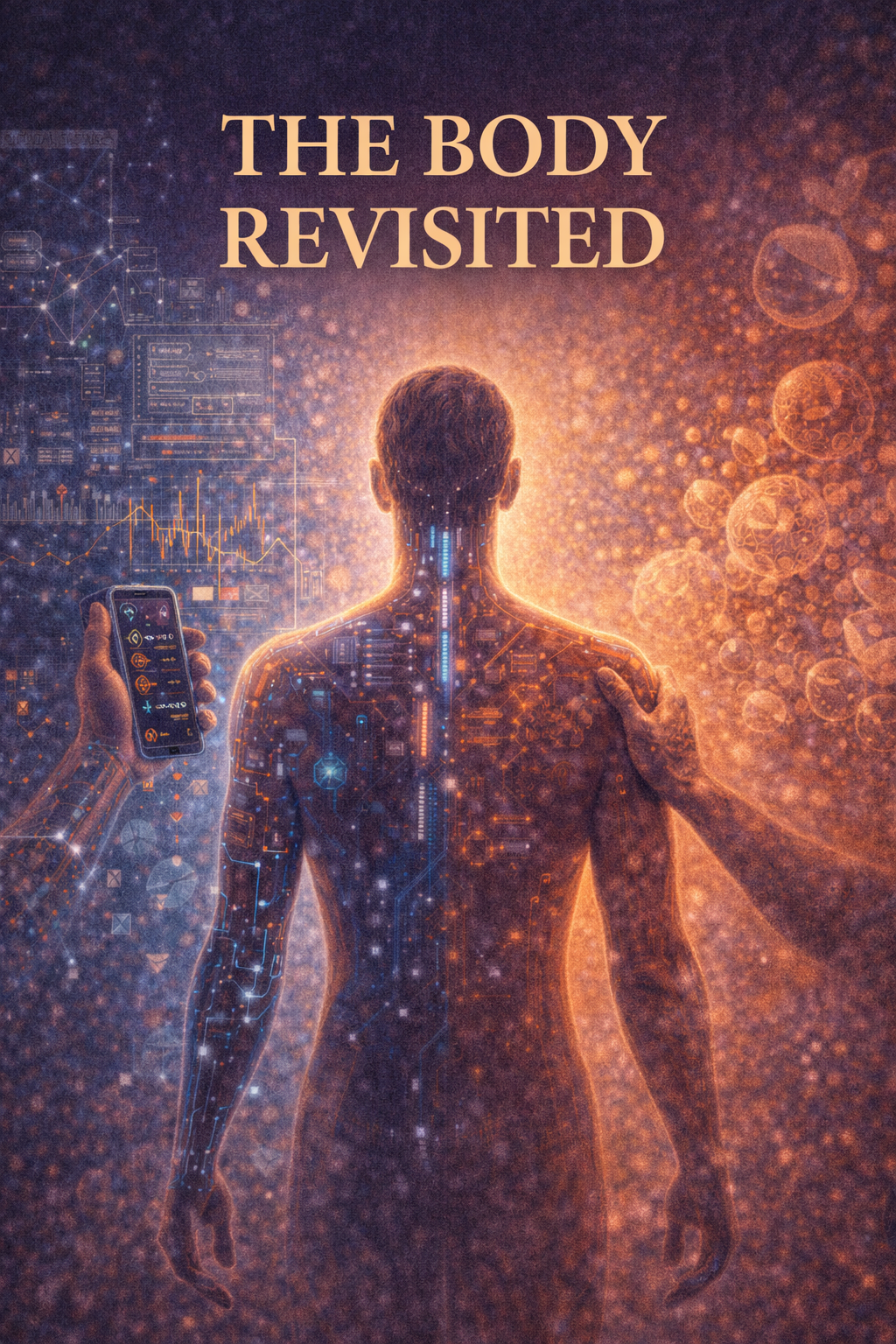
For a long time, the body was treated as something to overcome. Civilization prized the mind, productivity, and abstraction, while the body was disciplined, optimized, corrected, or ignored. The Digital Age intensified this separation, allowing humans to live increasingly through screens, data, and disembodied systems.
Now, the body returns to the center of the conversation.
Not as a limitation, but as a site of meaning, ethics, and resistance.
The Augmented Body
The augmented body represents one of the most visible frontiers of technological progress. Prosthetics that restore movement, implants that regulate heart rhythms, neural interfaces that assist cognition, and genetic tools that promise correction or enhancement all redefine what bodies can do.
Repair is widely embraced. Enhancement raises harder questions.
When does healing become upgrading? When does assistance become expectation? In a world where bodies can be modified, those who choose not to may be seen as incomplete, inefficient, or irresponsible.
The augmented body forces society to confront a central ethical dilemma:
is the goal to support human life, or to redesign it according to technological ideals?
The Measured Body
Never before has the body been so thoroughly quantified.
Steps, sleep cycles, heart rate, calories, stress levels, hormones, and attention are constantly tracked. Health becomes a stream of numbers. Wellness becomes something to manage, display, and optimize.
The measured body promises control and prevention, but it also shifts responsibility inward. Health becomes a personal performance rather than a social condition.
When bodies are reduced to metrics, deviation looks like failure. Rest looks like neglect. Illness feels like a personal flaw rather than a shared vulnerability.
Data can inform care, but it can also erase compassion.
The Exhausted Body
Burnout has become one of the defining bodily conditions of modern life. It is often framed as an individual problem: poor boundaries, weak resilience, insufficient self-care.
In reality, exhaustion is structural.
The exhausted body is produced by constant availability, accelerated time, economic pressure, and the demand to perform across physical, digital, and emotional spaces simultaneously.
Fatigue is not a malfunction. It is a signal.
When exhaustion becomes widespread, it is no longer a personal failure. It is a cultural diagnosis.
The Body as Resistance
In response to constant acceleration, the body has begun to resist.
Slowness, rest, refusal, and presence are quietly radical acts in a system that demands speed, output, and visibility. To rest is to reject constant optimization. To slow down is to reclaim time from metrics.
The body resists not through protest alone, but through limits.
Sleep, stillness, touch, and attention cannot be infinitely scaled. They insist on rhythm rather than efficiency.
In this sense, embodiment becomes political.
The Body in the Ethical Age
As bodies become editable, ethical questions move from theory into flesh.
Who decides what kinds of bodies are acceptable?
Who has access to enhancement and who does not?
What happens to dignity when bodies are treated as upgradeable platforms?
The Ethical Age demands that bodies be understood not as products, but as lived experiences. Dignity cannot depend on performance, appearance, or optimization.
A body has worth not because it is productive, but because it is human.
Re-Embedding the Human
Technology will continue to reshape bodies. That is inevitable. The question is whether humanity allows technology to define embodiment entirely, or whether ethical limits are drawn.
To revisit the body is not to retreat into nostalgia. It is to insist that progress remain anchored in lived experience.
Bodies feel pain, pleasure, fatigue, and care. They age. They heal imperfectly. They carry memory and emotion in ways no system can fully replicate.
The Future Is Embodied
The future will not be disembodied, no matter how advanced technology becomes. It will be lived through breathing, sensing, moving bodies.
The body is not a problem to be solved.
It is the condition through which life is meaningful.
Revisiting the body is not a backward glance. It is a necessary step forward.
Because in the end, every ethical decision, every technological system, and every vision of the future must answer a simple question:
What kind of life does this allow a body to live?