
The Iliad by Homer is one of the foundational works of world literature and one of the most uncompromising explorations of war ever written. Composed nearly three thousand years ago, it does not glorify battle in simple terms, nor does it reduce heroism to victory alone. Instead, it exposes war as a force that magnifies human emotion to its extremes, rage, pride, loyalty, fear, love, and devastating grief. The poem endures because it refuses to look away from the cost of violence, even when sung in the language of gods and heroes.
A war already lost before it begins
The Iliad does not tell the full story of the Trojan War. It begins near the end of a conflict that has already dragged on for years. Cities have burned, warriors have fallen, and exhaustion hangs over both armies like a curse. From its opening lines, the poem announces its true subject: the rage of Achilles. This rage is not a side effect of war; it is the engine that drives the entire narrative. Achilles, the greatest warrior among the Greeks, withdraws from battle after being dishonored by Agamemnon, the leader of the Greek forces. His pride is wounded, and the consequences of that injury ripple outward, costing countless lives.
Honor as a fragile currency
In the world of The Iliad, honor is everything. A man’s worth is measured by how others see him, by his reputation on the battlefield, and by the respect he commands. When Achilles feels his honor has been stripped away, he chooses personal dignity over collective survival. This decision exposes a central tension of the epic: the conflict between individual pride and communal responsibility. Heroes are not portrayed as moral ideals, but as deeply human figures trapped by the codes they live by.
The gods and the cruelty of fate
The gods in The Iliad are powerful, petty, emotional, and deeply involved in human affairs. They take sides, manipulate events, and treat mortal lives as pieces on a game board. Yet even the gods cannot fully control fate. The poem suggests that suffering is not always the result of moral failure, but often the consequence of forces beyond human control. This fatalism gives the epic its heavy, inescapable gravity. Everyone knows the end is coming. No one can stop it.
Grief at the heart of heroism
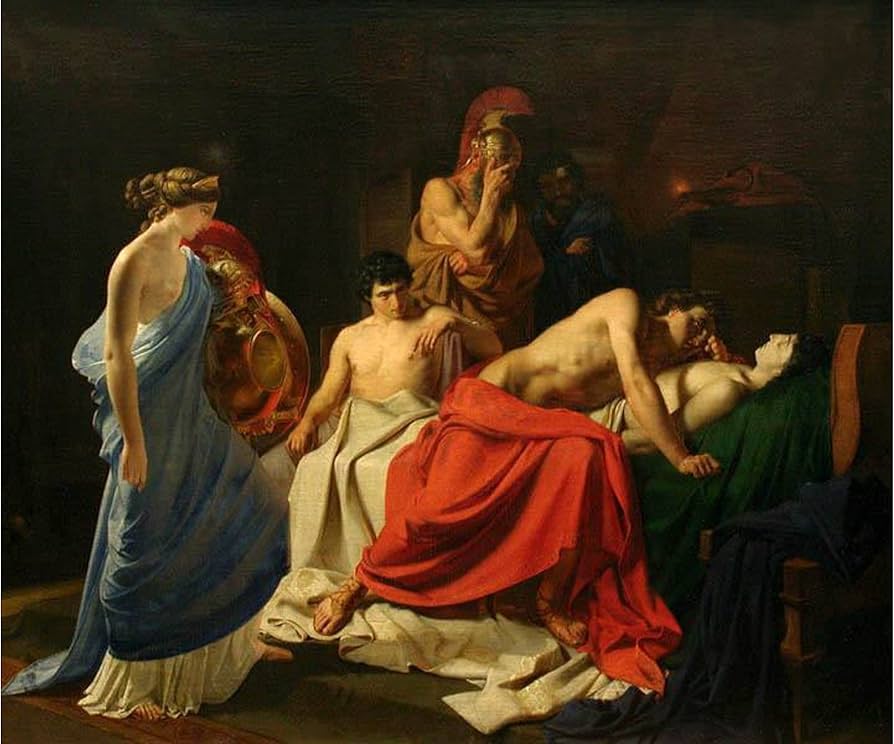
The emotional core of The Iliad is not victory, but loss. When Patroclus, Achilles’ closest companion, is killed by Hector, the Trojan prince, the poem reaches its most devastating turning point. Achilles’ rage transforms into something darker and more absolute. He returns to battle not for honor, but for vengeance. His slaughter of Hector is brutal and excessive, stripping heroism of its glamour and revealing the emptiness that violence leaves behind.
Hector and the humanity of the enemy
One of the Iliad’s greatest achievements is its refusal to dehumanize the enemy. Hector is not a villain. He is a husband, a father, a son, and a defender of his city. His farewell to his wife Andromache and their infant son stands as one of the most tender scenes in all of epic poetry. Through Hector, the poem reminds us that every war has two sides filled with people who love, fear, and hope, even as they march toward destruction.
A quiet ending filled with sorrow
The Iliad does not end with the fall of Troy or the triumph of the Greeks. It ends with a funeral. After killing Hector, Achilles is confronted by Priam, the Trojan king and Hector’s father, who comes to beg for his son’s body. In this moment, rage gives way to shared humanity. Achilles sees his own father reflected in Priam’s grief. The poem closes not with celebration, but with mourning, emphasizing that in war, even the greatest victories are soaked in loss.
Why The Iliad still matters
The Iliad survives because it tells the truth about war without excuses. It does not promise glory without consequence or heroism without pain. It understands that rage can be both powerful and destructive, that honor can inspire and ruin, and that grief is the final companion of violence. In rendering these truths with unmatched gravity, Homer created not just a story of ancient heroes, but a mirror that still reflects the cost of conflict today.