
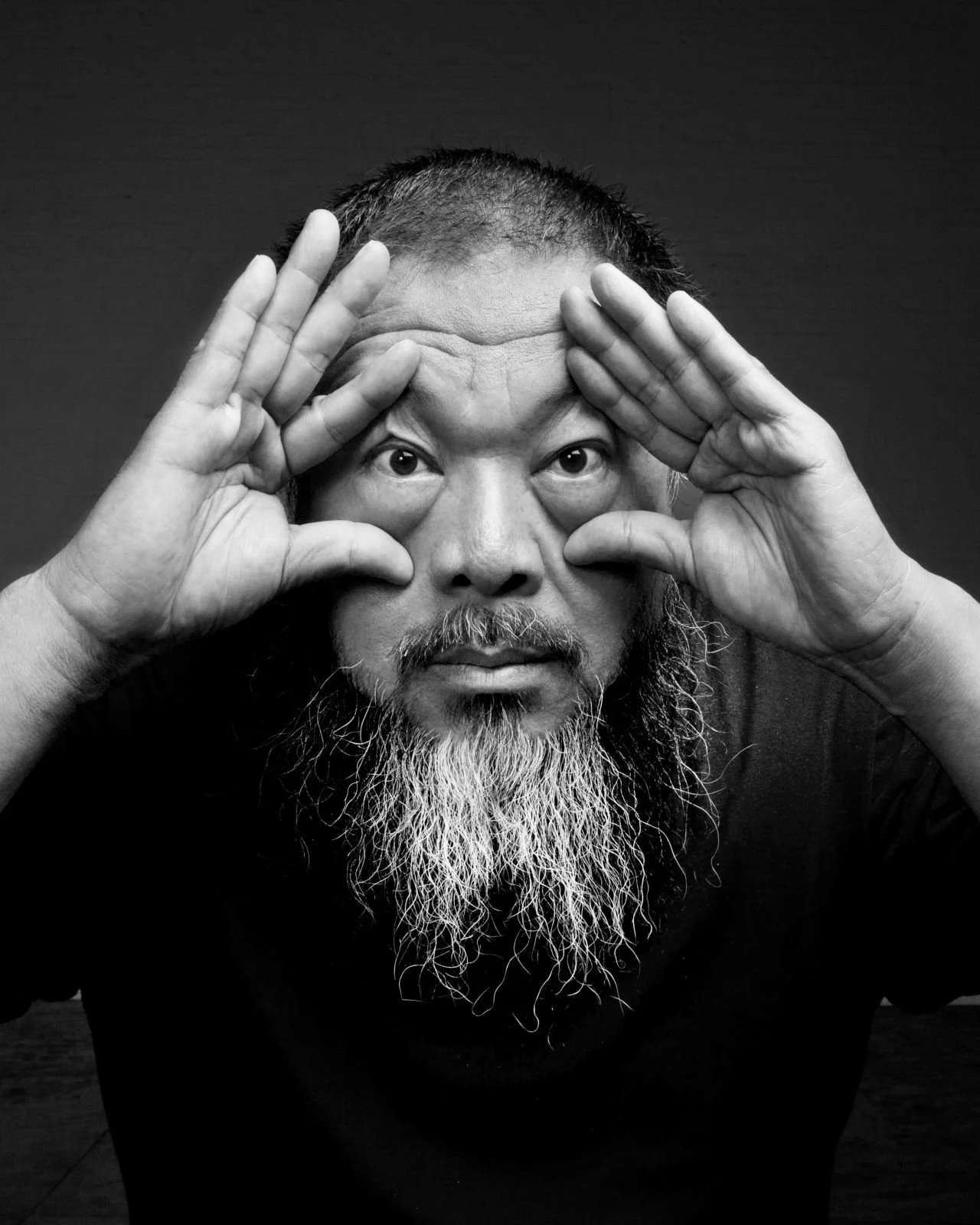
Ai Weiwei does not separate art from life. He treats them as the same act of resistance.
Born in Beijing in 1957, Ai Weiwei grew up in the shadow of political repression. His father, a renowned poet, was exiled during the Cultural Revolution, forcing the family into years of hardship. That early experience shaped Ai’s understanding of power, truth, and the cost of speaking freely. For him, art would never be decoration. It would be confrontation.
Ai Weiwei works across disciplines: sculpture, installation, architecture, photography, film, and social media. Yet regardless of medium, his message remains consistent. Art must question authority, expose injustice, and defend human dignity. He believes that neutrality in times of oppression is itself a form of violence.
Many of Ai’s most powerful works transform ordinary materials into political statements. Ancient urns, bicycles, backpacks, steel rebar, porcelain seeds. These objects carry history, memory, and loss. In one of his most iconic installations, millions of handcrafted porcelain sunflower seeds filled a museum floor, referencing both mass production and individual identity under authoritarian systems. Each piece was unique. Together, they formed a quiet rebellion.
Ai Weiwei’s activism is inseparable from his art. After a devastating earthquake in China, he investigated government corruption surrounding poorly constructed schools, publicly naming victims when officials refused to do so. This act of remembrance came at a personal cost. He was surveilled, beaten, detained, and eventually imprisoned without charge. Yet even confinement did not silence him.
Exile became another chapter rather than an ending. From Europe and beyond, Ai continued to speak on censorship, refugees, surveillance, and state violence. His art expanded outward, addressing global crises while remaining rooted in personal accountability. He does not present himself as a hero. He presents himself as responsible.
Ai Weiwei also challenges the art world itself. He questions who gets visibility, who controls narratives, and how institutions respond to power. By using digital platforms as freely as museums, he collapses hierarchies between elite spaces and public discourse. A tweet, a documentary, or a massive installation can carry equal weight.
What makes Ai Weiwei’s work resonate is its moral clarity. His art is not abstract in intention, even when it is abstract in form. It asks direct questions: Who is silenced? Who benefits? Who is forgotten? And what will you do once you know?
Ai Weiwei proves that art is not fragile. It is resilient, disruptive, and necessary. His work reminds us that freedom is not granted by institutions, but defended by individuals willing to risk comfort for truth.
In a world where silence is often rewarded, Ai Weiwei chose to speak. And by doing so, turned art into an act of conscience.