
How modern astrology differs from its original purpose
When people think of astrology today, they often imagine daily horoscopes, personality traits tied to sun signs, or compatibility memes shared online. But this version of astrology would be almost unrecognizable to its ancient practitioners. For most of its history, astrology was not about personal identity or daily predictions. It was about timing, order, and humanity’s relationship to the cosmos.
Ancient astrology was a sacred science of cycles.
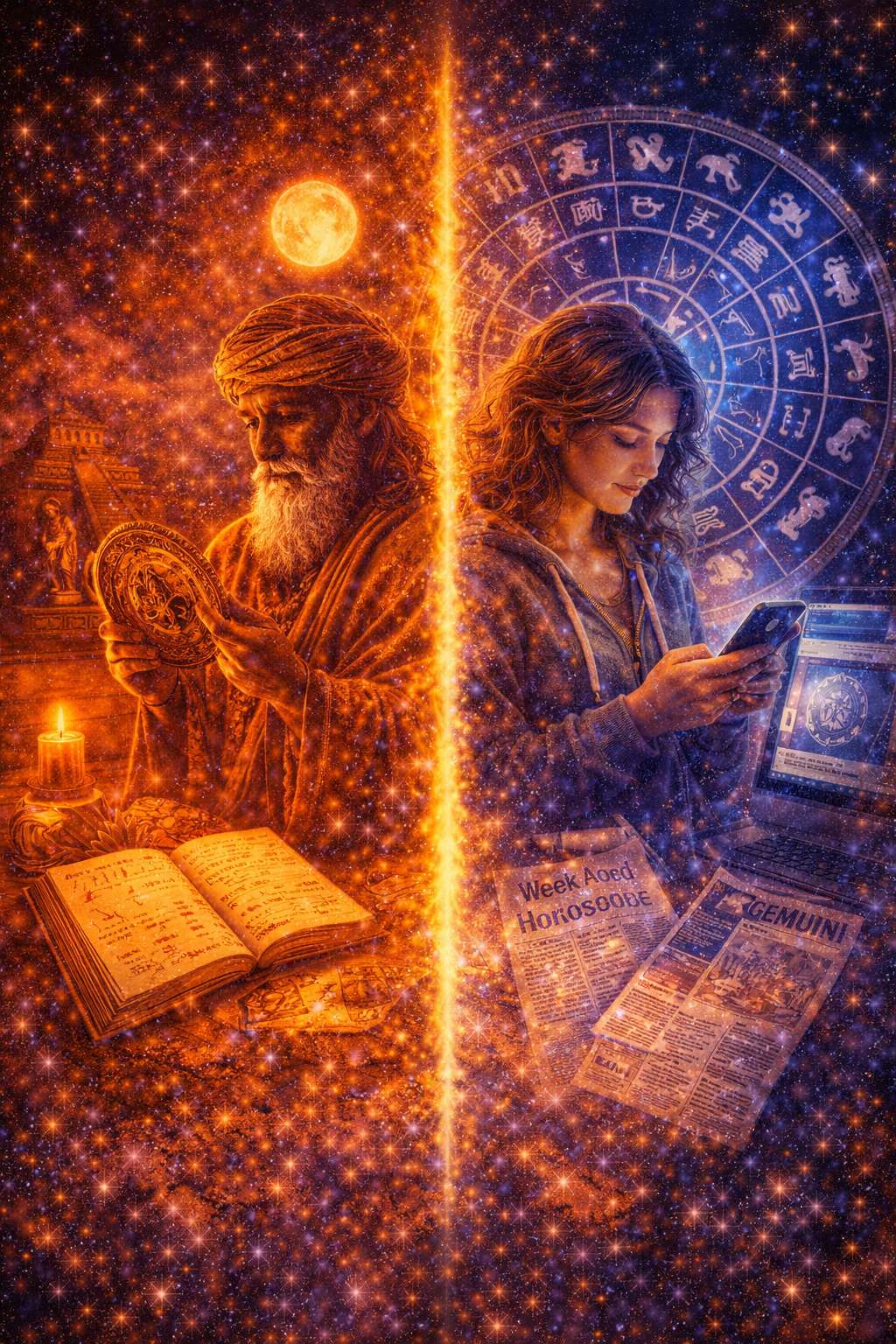
In early civilizations such as Mesopotamia, Egypt, Greece, and later the Islamic world, astrology was primarily collective and observational. Astrologers did not ask, “What does this say about me?” They asked, “What does this moment mean?” The sky was read as a clock, not a mirror.
The earliest astrologers focused on planetary movements as omens for societies rather than individuals. Eclipses signaled political upheaval. Planetary conjunctions were linked to famine, floods, or shifts in leadership. Astrology served rulers, farmers, and priests. It guided decisions about planting, war, rituals, and governance. Personal horoscopes were rare and reserved for elites.
Birth charts, as we know them, came much later.
Even when natal astrology emerged in Hellenistic times, it was not centered on personality. A chart described fate, status, health, and lifespan. It was a tool for understanding one’s place in the cosmic order, not for self-expression. Free will was limited. The chart outlined conditions rather than character.
Modern astrology reverses this orientation.
Today, astrology is inward-facing. It focuses on identity, emotion, relationships, and self-development. The stars no longer announce external events. They describe inner experiences. A transit does not predict a war; it explains a mood. A birth chart does not define social destiny; it maps psychological tendencies.
This shift reflects a broader cultural transformation. Ancient societies emphasized collective survival and cosmic hierarchy. Modern societies emphasize individuality and self-understanding. Astrology adapted accordingly.
Horoscopes, especially daily ones, are a recent invention shaped by mass media. Newspapers in the 20th century popularized sun-sign astrology because it was simple, accessible, and entertaining. Accuracy mattered less than relatability. This democratization of astrology made it widely available, but it also stripped away much of its original complexity.
Ancient astrologers were mathematicians and astronomers. Charts were calculated by hand. Planetary cycles were studied over centuries. Astrology was intertwined with astronomy until the scientific revolution separated the two. What survived was the symbolic language, not the predictive rigor.
Another key difference lies in purpose. Ancient astrology aimed to align human action with cosmic timing. It asked when to act, when to wait, when to prepare. Modern astrology asks how to understand oneself. One sought harmony with external cycles. The other seeks coherence within the self.
Neither approach is inherently superior. They serve different needs.
However, confusion arises when modern astrology is criticized for failing to meet ancient standards of prediction. It is not trying to do the same job. Modern astrology functions more like a reflective practice than a forecasting system. Expecting it to predict concrete events misunderstands its evolution.
Understanding astrology’s origins also clarifies its limits. Ancient astrologers believed the cosmos imposed order. Modern astrology often emphasizes choice and growth. These ideas are philosophically opposed. The former leaned toward fate. The latter leans toward agency.
The transformation of astrology mirrors the transformation of humanity’s worldview. As people moved from collective survival toward individual meaning, astrology shifted from sky-based timing to self-based interpretation.
Ancient astrology was never about horoscopes because horoscopes serve a modern appetite: quick insight, personal relevance, emotional validation. The ancients were not seeking reassurance. They were seeking alignment.
Recognizing this difference does not diminish modern astrology. It places it in context. Astrology did not become shallow; it became psychological. It did not lose seriousness; it changed focus.
What remains consistent across time is the impulse to look upward in order to understand life below. The stars once told people when to act. Now they help people understand how they feel. The language changed. The human need did not.
Astrology’s evolution is not a decline from truth to entertainment. It is a reflection of how humans themselves have changed.