

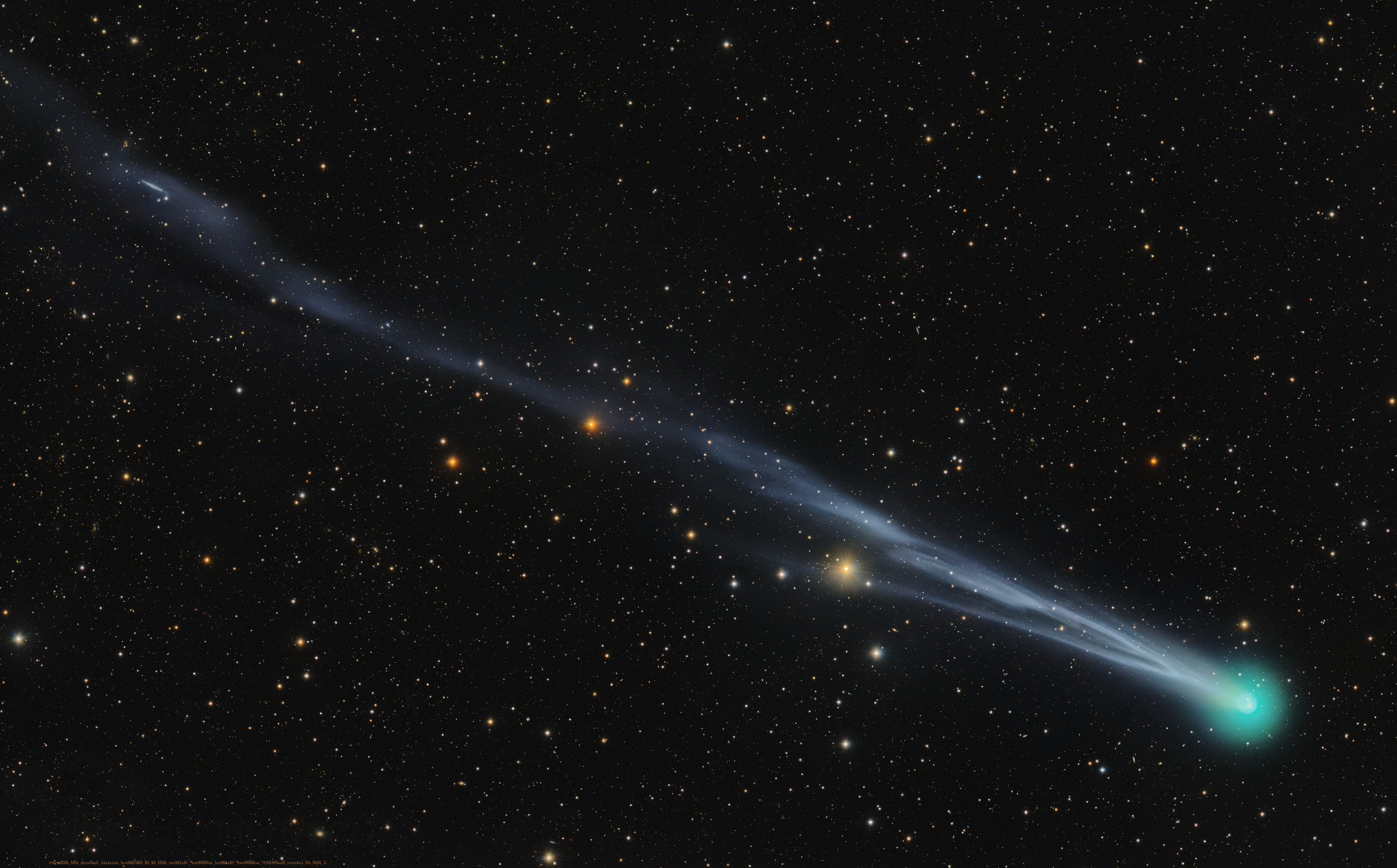
Comets are the travelers of the cosmos. They do not linger. They arrive from the outermost edges of the solar system, make a luminous appearance, and then disappear again for decades, centuries, or even millennia. When a comet returns, it is not just an astronomical event. It is a reunion across time.
At their core, comets are ancient. Often described as “dirty snowballs,” they are made of ice, dust, and rocky material left over from the formation of the solar system more than four billion years ago. For most of their existence, they drift silently in deep cold, far beyond the planets, untouched and unchanged. It is only when they approach the Sun that they awaken.
As a comet nears the Sun, heat causes its icy surface to vaporize. Gas and dust stream outward, forming a glowing coma around the nucleus and a tail that can stretch millions of miles across space. This tail always points away from the Sun, shaped by solar wind and radiation, creating the unmistakable image that has fascinated humans for thousands of years.
Comets have always carried symbolism. Ancient civilizations saw them as omens of change, disaster, or transformation. They appeared suddenly, defied prediction, and ignored human calendars. Even today, knowing their physics does little to soften their emotional impact. A bright comet still feels like a message written directly into the sky.
Scientifically, comets are time capsules. Because they have remained largely unaltered since the solar system’s birth, they hold clues about its earliest chemistry. Some scientists believe comets may have delivered water and organic molecules to early Earth, quietly contributing to the conditions that made life possible. In that sense, comets are not just visitors. They may be ancestors.
What makes comets especially captivating is their rarity. Unlike meteor showers or eclipses, many comets appear once in a lifetime. Some are seen by one generation and never again by the next. To witness a bright comet is to participate in a moment that belongs as much to history as to the present.
Comets remind us that not everything meaningful is constant. Some beauty is built around distance, patience, and return. They cross the sky without urgency, indifferent to attention, yet unforgettable when noticed.
In a universe full of cycles and repetition, comets stand apart. They arrive, glow, and depart, leaving behind nothing but memory, wonder, and the quiet sense that the cosmos is far larger, older, and more poetic than we usually remember.