

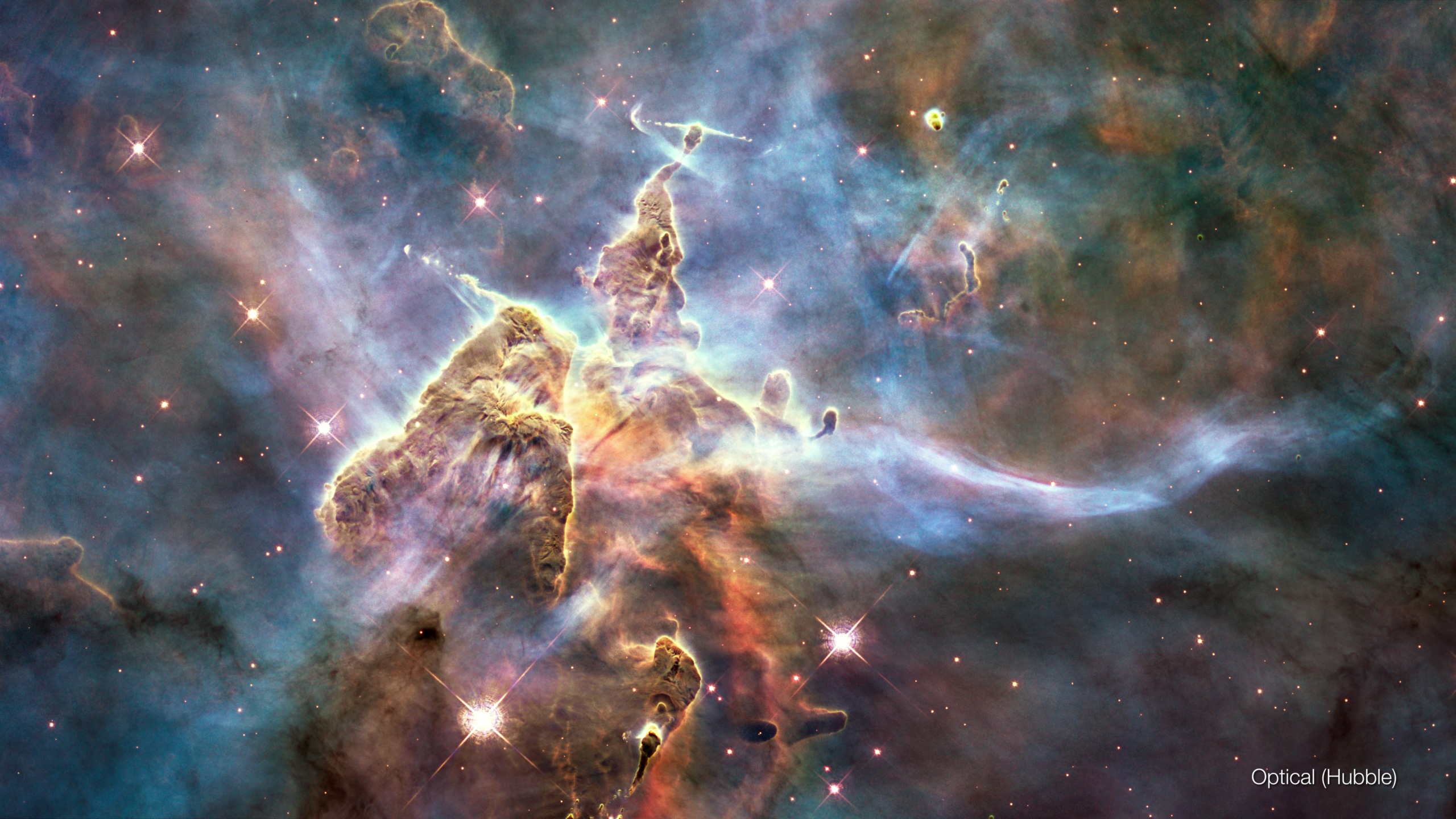
Nebulae are where the universe allows itself to be soft. Vast clouds of gas and dust drift through space, glowing, folding, and reshaping themselves over millions of years. They are neither fully formed nor fully gone. They exist in transition, suspended between what was and what will be.
The word nebula comes from the Latin for “cloud,” and the name fits. Seen through powerful telescopes, nebulae resemble cosmic veils, petals, and smoke plumes caught in slow motion. Blues melt into golds, crimsons fade into violet. They look painted, yet every color is physics, light emitted by energized atoms responding to nearby stars.
Nebulae play two opposing roles in the life cycle of the universe. Some are stellar nurseries, regions where gravity pulls gas together until new stars ignite. Others are the remains of dying stars, shells of material gently released back into space. Birth and farewell share the same architecture, as if the universe uses one design language for both arrival and departure.
Star-forming nebulae are places of quiet ambition. Inside them, dense knots of gas collapse under gravity, warming, brightening, and eventually igniting nuclear fusion. A star is born not in violence, but in patience. These regions often glow pink or red due to energized hydrogen, signaling creation rather than destruction.
Planetary nebulae, despite their misleading name, have nothing to do with planets. They form when a star like our Sun sheds its outer layers near the end of its life. The exposed core illuminates the drifting gas, creating intricate shapes that resemble rings, eyes, and luminous shells. They are among the most delicate structures in the cosmos, brief on astronomical timescales, yet unforgettable in form.
Nebulae are also chemical libraries. Within them exist the building blocks of future worlds: carbon, oxygen, nitrogen, and complex molecules. Every planet, ocean, and living cell carries material once suspended inside a nebula. In that sense, nebulae are not distant. They are ancestral.
What makes nebulae especially compelling is their refusal to rush. They evolve over millions of years, indifferent to urgency. In a culture that demands immediacy, nebulae suggest a different measure of success: slow assembly, gradual illumination, beauty that unfolds on its own terms.
Nebulae remind us that creation does not require sharp edges. Sometimes the universe builds its greatest structures from clouds, silence, and time.