
Black holes are not cosmic villains. They do not roam the universe devouring stars out of spite. They are quieter than that. More refined. Black holes are places where gravity becomes so concentrated that space itself folds inward, creating a region from which nothing, not even light, can escape. They are not emptiness. They are density taken to its extreme.
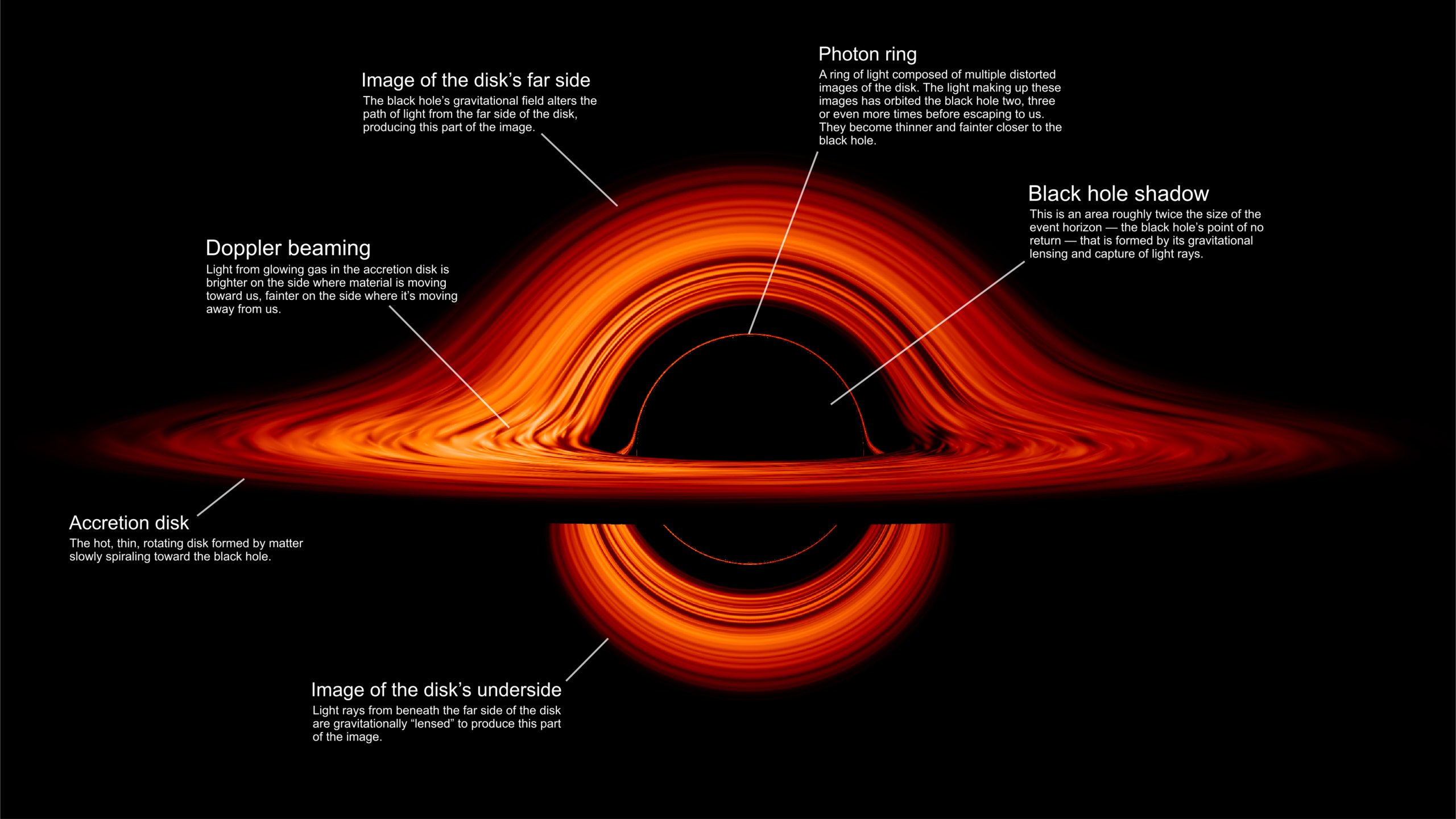
A black hole is born when a massive star exhausts its fuel and collapses under its own gravity. The core compresses beyond imagination, forming what is called an event horizon, the invisible boundary where return becomes impossible. Beyond that edge, the rules we rely on begin to soften. Time slows. Space curves. Cause and effect lose their familiar rhythm.
What makes black holes fascinating is that we cannot see them directly. They announce themselves indirectly, through influence rather than appearance. Nearby stars accelerate into strange orbits. Gas heats up, spins, and glows as it forms a brilliant accretion disk around the darkness. Light bends dramatically, producing warped halos that look more like couture sculpture than physics.
At the center of nearly every galaxy, including our own Milky Way, sits a supermassive black hole. These giants can be millions or even billions of times more massive than the Sun. Rather than destroying galaxies, they help shape them, regulating star formation and anchoring cosmic structure. Power, in this case, comes from balance, not chaos.
Black holes have also reshaped how we think about time. From an outside perspective, anything falling toward a black hole appears to slow down, fading but never quite crossing the event horizon. For the object itself, time continues normally. Two realities coexist, layered like sheer fabric over solid form. It is one of the most poetic contradictions in modern science.
In recent years, black holes have stepped out of theory and into evidence. Scientists have captured images of their shadows, detected gravitational waves from their collisions, and confirmed predictions that once lived only in equations. What was once invisible has become observable, without losing its mystery.
There is something profoundly modern about black holes. They remind us that not everything meaningful needs to be visible. Influence matters more than surface. Silence can carry enormous weight. In a culture obsessed with constant output and illumination, black holes offer a counterpoint: depth without display.
Black holes are not the end of the story. They are punctuation marks in the universe’s long sentence. Pauses. Commas. Colons. Places where the cosmos takes a breath and reminds us that the unknown is not a threat, but an invitation.