
High mountains wear a calm disguise.
Snow lies smooth on the slopes, glittering in the sun, soft and silent.
Skiers carve lines, hikers strap on crampons, and somewhere far above, a fragile balance holds.
Then a crack.
A single fracture races across the snowpack—
and an entire hillside of snow begins to move.
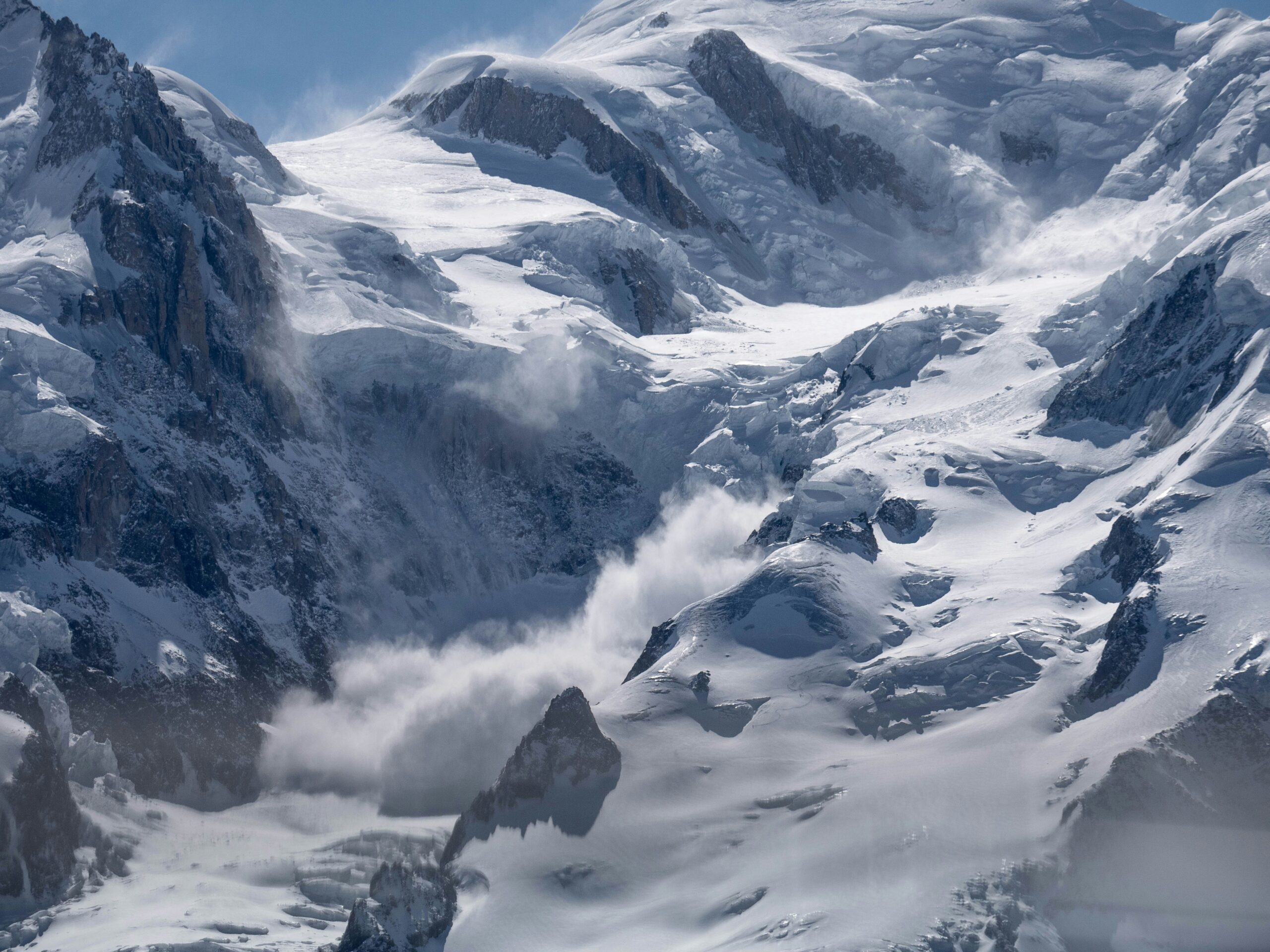
That is an avalanche: a sudden, roaring slide of snow and ice down a mountain, powerful enough to bury anything in its path within seconds.
What is an avalanche, really?
An avalanche happens when a mass of snow loses its grip on the slope and collapses downhill under the pull of gravity.
It’s not just “snow falling.” It’s a whole layer—or multiple layers—of the snowpack breaking free at once.
Factors that matter:
-
Steep slopes (often between about 30° and 45°)
-
Weak layers buried within the snowpack
-
New snow or wind-blown snow piling up faster than it can bond
-
Sudden changes in temperature, sun, or weight on the slope
Once the snow lets go, it can accelerate quickly, reaching speeds of 80 km/h (50 mph) or more—and in large avalanches, even far faster.
Different faces of the white beast
Not all avalanches look or behave the same. Mountain experts often talk about a few main types:
-
Slab avalanches
These are the most dangerous and most common killers of skiers and climbers.
– A firm “slab” of snow sits on top of a weaker layer.
– A trigger—like a skier’s weight, a snowmobile, or natural settling—cracks that weak layer.
– The slab breaks apart and slides as a big, connected sheet before breaking into blocks.
Slab avalanches are fast, powerful, and can pull people off their feet instantly. -
Loose-snow avalanches
These often start from a single point—like a small ball of snow that grows as it rolls downhill.
– They look like a fan or triangle spreading out from one point.
– Often smaller, but can still be dangerous in steep terrain or if they sweep someone over cliffs or into terrain traps. -
Wet avalanches
When temperatures rise and snow becomes saturated with water (spring melt, warm rain), the heavy, slushy snow can let go.
– These move more slowly but carry immense weight.
– They can destroy structures and bury valleys in thick, cement-like snow and debris.
What makes avalanches so deadly?
The danger doesn’t come only from being knocked over—it comes from what happens next.
-
Burial
The moving snow can bury people, animals, and even buildings.
Snow sets like concrete around a buried person in minutes. Breathing becomes difficult or impossible. Most avalanche deaths are due to suffocation. -
Trauma
The avalanche carries chunks of ice, rocks, trees, and debris. Victims can be slammed into these objects, breaking bones or causing fatal injuries. -
Terrain traps
Narrow gullies, creek beds, small basins, and forests can turn even a modest avalanche into a lethal one. Snow piles deeper in these places, increasing burial depth. -
Speed and surprise
From the moment the snow breaks loose, there’s often only seconds to react. Avalanches can outrun even skilled skiers in many situations.
The triggers: nature and humans
Avalanches can release on their own or be triggered by small disturbances in an already unstable snowpack.
Natural triggers:
-
New, heavy snowfall
-
Strong winds that move snow onto leeward slopes, creating thick, fragile slabs
-
Sudden warming or intense sun that weakens bonds between snow layers
-
Smaller avalanches that destabilize nearby slopes
Human triggers:
-
Skiers, snowboarders, snowshoers
-
Snowmobiles (especially powerful triggers due to weight and vibrations)
-
Explosives used for avalanche control (intentionally triggering smaller slides in controlled conditions)
In popular backcountry areas, a single skier may be the difference between a quiet slope and a deadly slide.
The thin line between safe and lethal
The mountains rarely shout their warnings; they whisper them through signs that experienced eyes can read:
-
“Whumpf” sounds—settling noises in the snowpack as weak layers collapse
-
Cracks shooting out from your skis or boots
-
Recent avalanche activity on similar slopes and aspects
-
Heavy new snow on top of weak or old layers
-
Strong winds forming cornices and wind slabs just below ridgelines
-
Rapid temperature rise or intense sun on previously cold, shaded slopes
Ignoring these signs can turn a beautiful day into a race against snow and time.
Surviving the unthinkable
Avalanches can happen even to careful, experienced people. But knowledge and gear can change the odds:
-
Avalanche education
Training courses teach how to read terrain, snow conditions, and weather, and how to make better decisions: when to turn back, when to avoid a slope entirely. -
Essential gear for backcountry travel
– Transceiver (beacon): sends and receives signals to help locate buried victims.
– Probe: a collapsible pole to pinpoint someone buried under the snow.
– Shovel: to dig fast—because every minute matters.
– Airbag backpack (increasingly used): when deployed, can help keep someone closer to the surface of the moving snow, improving survival chances. -
Rescue reality
The most successful rescues are usually carried out by companions, not by professional rescuers. By the time help arrives from far away, it is often too late.
That’s why everyone in a group needs to know how to use their gear and how to act immediately if someone is buried.
Mountains, money, and memory
Avalanches don’t only threaten adventurers in remote wilderness. They also affect:
-
Ski resorts and tourism economies
-
Mountain roads and rail lines
-
Alpine villages and infrastructure
Many resorts and alpine regions invest heavily in avalanche control:
-
Firing explosives into known avalanche paths
-
Building snow fences and barriers
-
Designing structures to deflect or withstand smaller slides
-
Monitoring snowpacks and temporarily closing high-risk areas
Despite these protections, the risk is never zero, especially beyond controlled resort boundaries.
The mountain’s way of rewriting its slopes
From a geological point of view, avalanches are part of how mountains continuously reshape themselves:
-
Snow packs, shifts, and falls, redistributing weight.
-
Avalanches clear unstable snow and debris, making way for new layers.
-
Over time, they sculpt gullies, paths, and runouts that become part of the mountain’s character.
For humans, that natural process can intersect brutally with our desire to live, travel, and play in these landscapes.
Respecting the white silence
There is a special kind of quiet in snowy mountains—a silence that feels sacred.
But within that silence is tension: the delicate balance of snow, gravity, and time.
Avalanches remind us that:
-
Stability in the mountains is temporary.
-
Beauty and danger often share the same view.
-
Knowledge and humility are as essential as skis and boots.
Those who understand avalanches treat the snowpack not as a playground, but as a living system—one that must be read, respected, and sometimes refused.
Because once the slope decides to move, the mountain will not negotiate.
Photo by Krzysztof Kowalik on Unsplash