

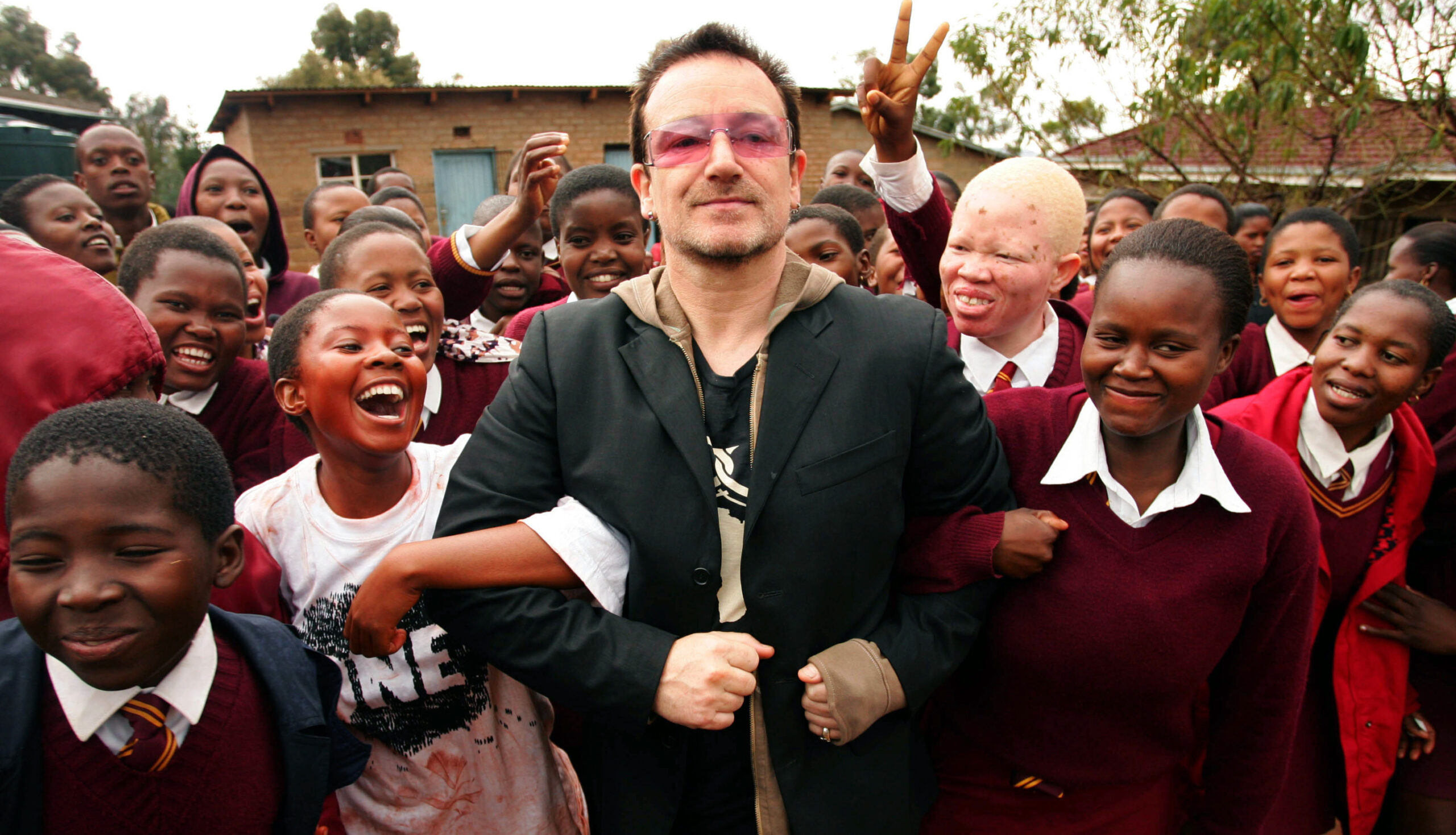
Bono never believed music should end at the edge of the stage.
Born Paul David Hewson in Dublin in 1960, Bono rose to global prominence as the lead singer of U2, a band that fused anthemic sound with moral urgency. From the beginning, his voice carried more than melody. It carried conviction. For Bono, songs were not just expressions of feeling. They were calls to attention.
As a performer, Bono is defined by intensity and reach. His voice stretches from intimacy to stadium-scale power, capable of turning personal doubt into collective experience. U2’s music often wrestles with faith, love, injustice, and hope, refusing easy answers. Bono sings like someone searching in public, inviting millions into that search.
But Bono’s influence extends far beyond music. He became one of the most visible artist-activists of his generation, using fame as leverage rather than shelter. He has campaigned relentlessly for debt relief, poverty reduction, global health, and HIV/AIDS awareness, working directly with world leaders, economists, and humanitarian organizations. For him, activism is not branding. It is responsibility.
What sets Bono apart is persistence. He studies policy, speaks the language of power, and insists that compassion and pragmatism are not opposites. He understands that awareness alone is not enough. Change requires systems, data, and sustained pressure. His activism is not always comfortable, but it is committed.
Bono has often spoken about the tension between art and action, acknowledging the risk of hypocrisy while refusing paralysis. He does not claim moral purity. He claims obligation. His belief is simple and demanding: if you have a voice that reaches millions, you must use it for more than applause.
Critics have questioned his methods, his proximity to power, his visibility. Bono accepts that scrutiny as part of the cost. He believes engagement is messier than silence, but far more effective. To him, retreat is the greater failure.
At his core, Bono remains an artist. His activism grows out of the same impulse as his music: empathy sharpened by urgency. He believes that songs can open hearts, and policy can protect lives. One without the other is incomplete.
Bono’s legacy is still unfolding, but its shape is already clear. He redefined what it means to be a public artist in a global age, proving that passion does not have to fade with success, and that art, when paired with action, can reach far beyond the spotlight.
He reminds us that the loudest voice is not the one that sings the highest, but the one that speaks when it matters most.




Hey would you mind letting me know which hosting company you’re working with? I’ve loaded your blog in 3 different browsers and I must say this blog loads a lot quicker then most. Can you suggest a good web hosting provider at a fair price? Thank you, I appreciate it!
You are a very smart person!
bilrv9
I have been absent for a while, but now I remember why I used to love this web site. Thanks, I will try and check back more often. How frequently you update your web site?