
Symbols, archetypes, and shared meaning across cultures
Astrology is often debated as though it were a religion or a scientific claim. People ask whether it is “true,” whether it should be believed, whether it works. But these questions may be aimed at the wrong target. What if astrology is not a belief system at all, but a language? A symbolic framework humans use to describe experience, much like myth, art, or psychology.
When viewed this way, astrology becomes less about conviction and more about communication.
Languages do not require belief to function. You do not need to believe in grammar for a sentence to convey meaning. You simply need shared symbols and agreed-upon structure. Astrology operates similarly. Planets, signs, houses, and aspects function as symbolic vocabulary. Together, they form sentences about personality, cycles, conflict, and growth.
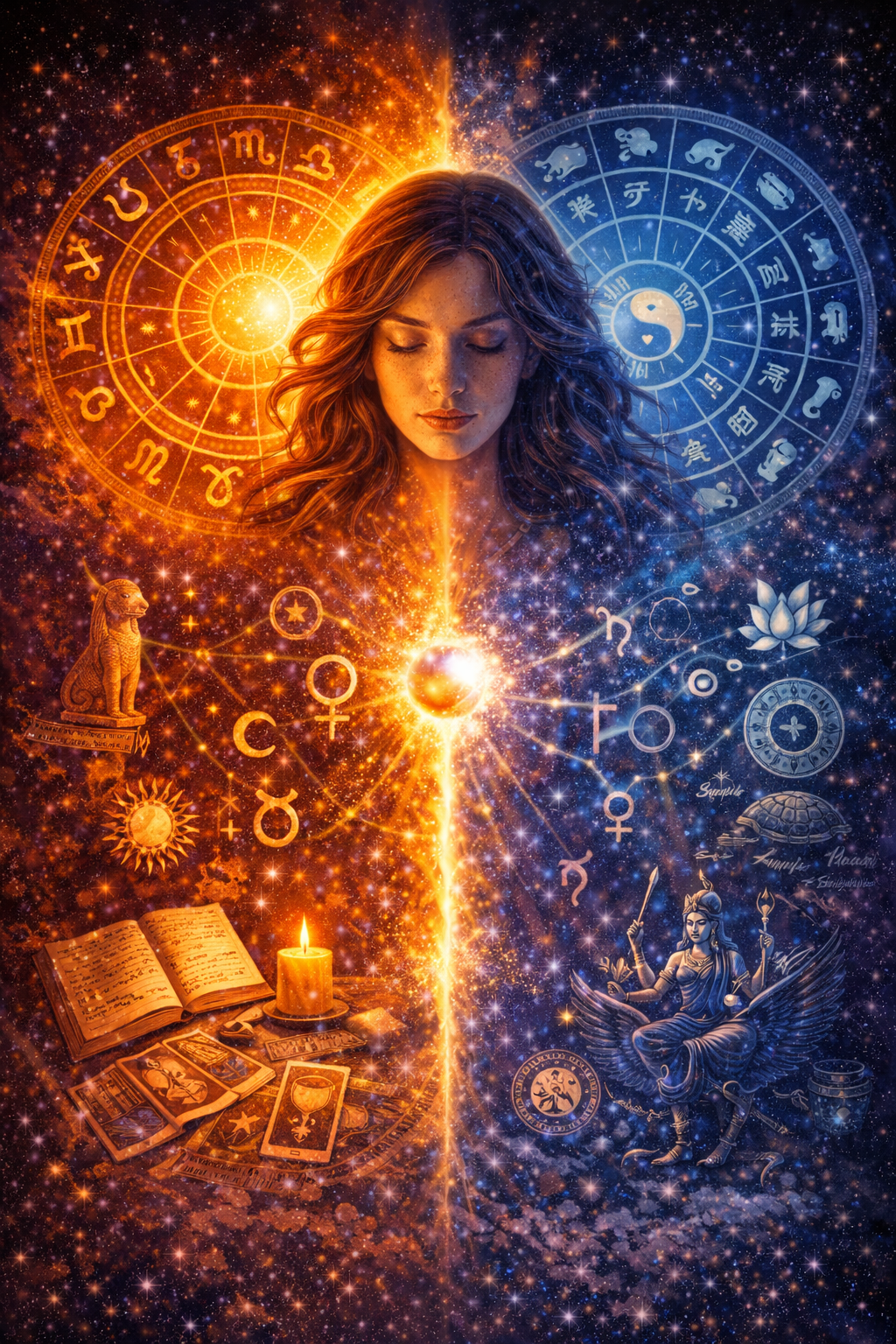
Across cultures, this symbolic impulse repeats. Ancient Mesopotamians tracked planetary movements. Greek philosophers assigned mythic narratives to planets. Vedic astrology mapped cosmic rhythms alongside spiritual development. Chinese astrology aligned celestial cycles with social order and timekeeping. The symbols differed, but the underlying intent was the same: to translate human experience into a cosmic language.
This shared structure explains why astrology feels strangely familiar even to newcomers. Archetypes bypass logic and speak directly to pattern recognition. Mars is associated with action, conflict, and drive across cultures, even when the mythology changes. Venus consistently carries themes of attraction, beauty, and value. These associations endure not because they are empirically proven, but because they mirror recurring human experiences.
Astrology’s critics often demand evidence of causation. Do planets cause behavior? But language does not cause reality. It describes it. No one asks whether the word “storm” causes rain. It is simply a tool to name and understand what is happening. Astrology functions in the same symbolic space.
This is why astrology blends so easily with psychology. Carl Jung referred to astrology as a representation of archetypes rather than a system of forces. Birth charts resemble psychological maps, not destiny scripts. They offer symbolic shorthand for internal dynamics that might otherwise take years to articulate.
Seeing astrology as language also explains its adaptability. Languages evolve. New words appear. Old meanings shift. Astrology has done the same. Ancient astrologers spoke of kings and empires. Modern astrologers speak of trauma, attachment styles, and self-worth. The grammar remains, but the conversation changes.
Importantly, languages do not demand obedience. They invite interpretation. Two people can read the same chart and have different insights, just as two readers can interpret the same poem differently. Astrology’s value lies not in certainty, but in dialogue.
This perspective also resolves a common tension. One does not need to believe that planets control fate to find astrology meaningful. One can engage with it as metaphor, reflection, and shared symbolism. Just as literature can illuminate truth without being literal, astrology can offer insight without requiring cosmic determinism.
Astrology’s endurance across cultures is not evidence of blind belief. It is evidence of shared human needs. Humans seek patterns. We seek stories that connect inner experience to larger cycles. Astrology provides a vocabulary for that connection.
In a fragmented modern world, astrology offers a rare shared symbolic language. It allows people from different backgrounds to discuss emotions, challenges, and growth using common terms. Mercury retrograde becomes a shorthand for miscommunication. Saturn return names a period of restructuring. These phrases work because they compress complex experiences into understandable symbols.
When astrology is treated as language rather than doctrine, many arguments dissolve. It no longer competes with science, because it does not attempt measurement. It does not replace religion, because it does not offer moral law. It simply describes, reflects, and contextualizes.
Perhaps the enduring power of astrology lies precisely here. Not in prediction, not in belief, but in meaning-making. A language older than writing, refined across centuries, still capable of helping humans articulate who they are and what they are experiencing.
In that sense, astrology is less about looking up at the stars and more about finding words for what it feels like to be human beneath them.