

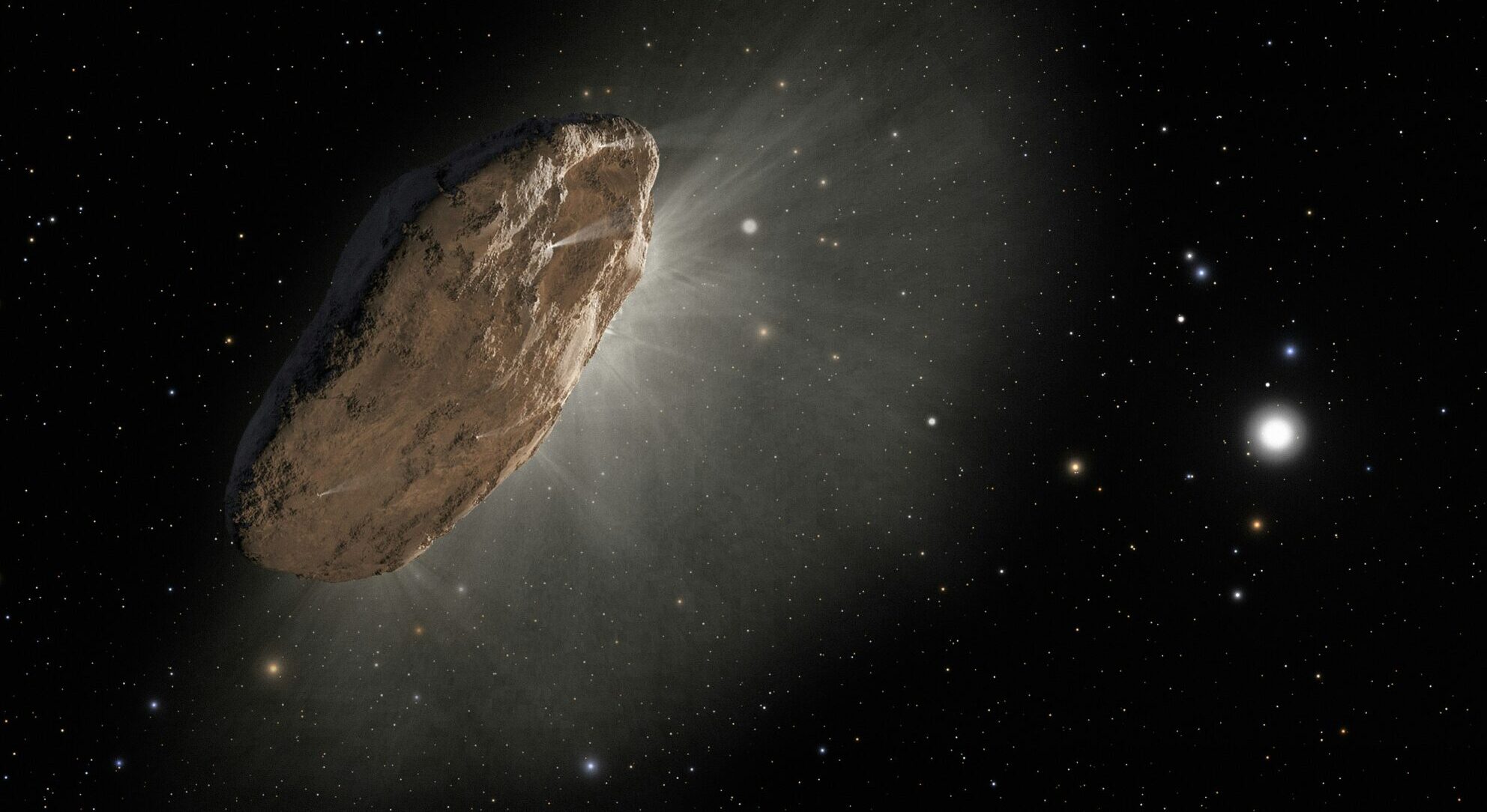
Far beyond the orbits of our planets, space is full of drifting rubble—frozen shards of ancient worlds, forgotten leftovers from the time stars were born. Most of it will never come close to us. But every once in a while, something from that deep, dark ocean cuts straight through our solar system like a ghost ship.
In mid-2025, telescopes in Chile noticed exactly that.
Not a planet.
Not a satellite.
Not even a normal comet or asteroid.
A stranger on a one-way trajectory.
We call it 3I/ATLAS.
And no, it’s not terrestrial. It’s not from here at all. It’s an interstellar comet—only the third known object ever seen passing through our solar system from another star. Wikipedia+1
What exactly is 3I/ATLAS?
Let’s untangle the names first, because your confusion is totally fair:
-
“3I” = third known interstellar object (after 1I/ʻOumuamua and 2I/Borisov).
-
“ATLAS” = the survey that discovered it: the Asteroid Terrestrial-impact Last Alert System.
-
C/2025 N1 = its comet designation. Wikipedia
So:
• Not a terrestrial object (nothing to do with Earth).
• Not just a regular asteroid.
• Officially: an interstellar comet—a small, icy body from another star system, on a hyperbolic path that will never loop back like our usual comets. Wikipedia+1
It was discovered on 1 July 2025 by the ATLAS telescope in Rio Hurtado, Chile. As astronomers refined its orbit and found earlier “precovery” images, the pattern became undeniable: this thing wasn’t bound to our Sun. It was diving in, swooping around, and heading back out into interstellar space—another true visitor from the stars. Wikipedia+1
A comet with no respect for our borders
3I/ATLAS came in fast—over 130,000 mph—on a hyperbolic trajectory that proves it originated in some other stellar system, perhaps billions of years older than our own. Reuters+1
As it neared the Sun in late October 2025 (its perihelion), spacecraft and ground-based observatories saw it flare dramatically:
-
A clear coma: a glowing cloud of gas and dust around a small nucleus.
-
A tail—and even a weird “anti-tail,” a spike of dust pointing sunward due to the way particles and our viewpoint lined up. NASA Science+2Medium+2
-
A surprising bluish shine, suggesting its brightness comes mostly from glowing gases (carbon-rich compounds and water vapor) rather than just reflected dust. Chron+1
NASA’s Perseverance rover on Mars, solar-monitoring spacecraft like SOHO and STEREO, plus telescopes on and around Earth all turned their eyes and instruments toward this one passing spark. NASA Science+2NASA Science+2
The result? 3I/ATLAS looks, in many ways, like a “normal” comet—just one that came from far beyond our solar system’s birth cloud.
A messenger older than our Sun
Interstellar objects like 3I/ATLAS are fossils from somewhere else:
-
It may be 7–8 billion years old—older than our entire solar system. Reuters+1
-
It probably formed in the icy outskirts of another star’s planetary system.
-
At some point long ago, gravity—maybe from a giant planet or a passing star—kicked it out into deep space.
For untold millions of years, it wandered the galaxy frozen and silent… until an accident of celestial geometry lined it up with our Sun and gave us a brief chance to see it.
Watching a ghost with every telescope we have
Because this is only the third interstellar object ever confirmed, astronomers are treating 3I/ATLAS like a once-in-a-career opportunity. European Space Agency+1
They’re measuring:
-
Its composition: water, carbon dioxide, carbon monoxide, cyanide, and unusual amounts of nickel and carbon-bearing gases. Reuters+1
-
Its light: the unexpected blue tone and rapid brightening that challenge our simple models of comets. Chron+1
-
Its radio signature: faint radio emission from hydroxyl (OH) created when sunlight breaks apart water vapor—a classic comet behavior, now detected for the first time from an interstellar object. Live Science
Space agencies from NASA to ESA to ISRO are all taking their turn: Mars rovers, solar probes, Earth-orbiting telescopes, and big ground observatories are squeezing every possible photon out of this brief encounter. NASA Science+3NASA Science+3ISRO+3
The alien question
Because ‘Oumuamua was mysterious and because 3I/ATLAS has its own list of “anomalies” (strange brightening behavior, anti-tail, odd chemistry, very high speed), a few scientists and many YouTubers jumped straight to:
“Is it an alien craft?”
It’s a fun thought experiment—and you’ll find speculative essays about that. Medium+1
But the current scientific consensus is clear:
-
Its behavior matches a very active, gas-rich comet passing close to the Sun.
-
The radio “signal” is just natural emission from water vapor and hydroxyl radicals, not an engineered transmission. Live Science+1
-
Its coma, tail, chemistry, and evolution fit within the family of extreme comets, even if it’s a weird cousin. Wikipedia+2European Space Agency+2
So right now, 3I/ATLAS is best understood as what nature does all by itself: a comet from another star system, not a constructed object or “terrestrial” anything.
Dramatic? Absolutely.
Artificial? No evidence for that at all.
Danger to Earth?
Short answer: none.
Its orbit never comes remotely close enough to hit us. Modeling shows its closest approach to Earth in this era is around 1.8 AU—about 269 million km—far outside any impact concern. TheSkyLive+1
This visitor is all spectacle, no threat. The only thing it will “hit” is our detectors and our curiosity.
Why 3I/ATLAS matters for us
For your magazine, this object fits beautifully into the “rare but real cosmic dramas” theme:
-
It’s a physical piece of another planetary system, sailing right through our backyard.
-
It links to ‘Oumuamua (mysterious, possibly icy shard) and Borisov (a more classic comet) as part of a growing family of interstellar wanderers. Wikipedia+1
-
It forces astronomers to refine what they know about comets, chemistry, and how other solar systems build and eject their icy debris.
-
It reminds us that our solar system is not isolated—we’re part of a constantly exchanging galaxy, where fragments from distant suns can drop by uninvited.
Sometime after late 2025, 3I/ATLAS will fade beyond the reach of our telescopes and slide back into the dark between the stars, leaving only data—and new questions.
But for a brief moment, we get to watch it, measure it, and tell its story:
a cold piece of another sun’s history, cutting across our skies like a message written in ice and comet gas, here once and never again.
Photo by NASA Hubble Space Telescope on Unsplash